

Campbell, Chair of the EMD Uranium (Nuclear and REE) Committee, summarized the 2020 report in the following:
Executive Summary (Summary presented to the 2020 Annual EMD Zoom Conference (here)).
- A significant rise in uranium prices is underway since the first of the year (2020).
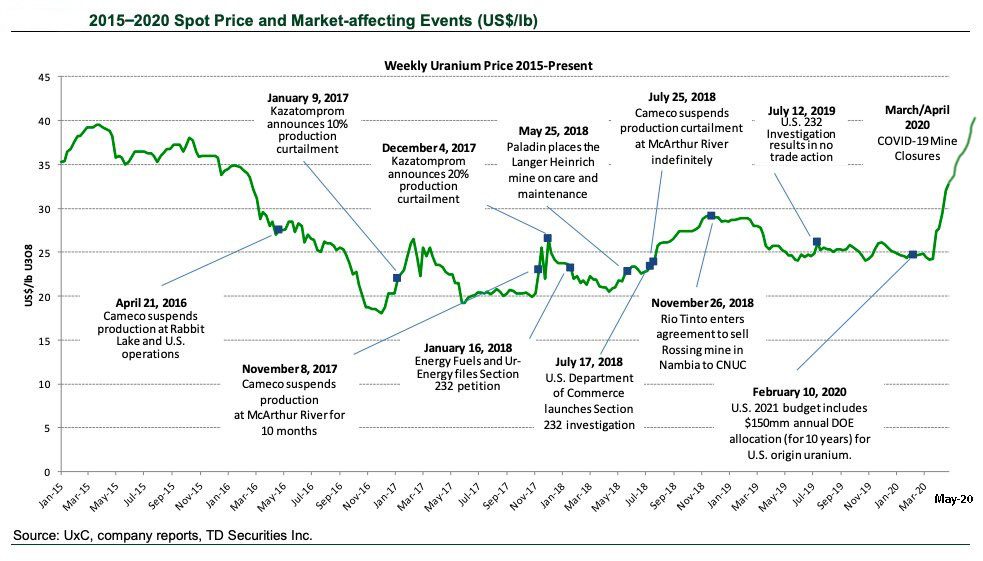
- Senior U.S. uranium industry personnel indicate that recent activities concerning Section 232 requesting protection of the U.S. uranium mining industry has gained traction in the White House.
- Many uranium companies are beginning to resume drilling properties, especially in Wyoming and Texas.
- Numerous discoveries of high-grade uranium deposits have been made in Canada and new low-grade deposits are under development in Argentina and Peru.
- The main Australian uranium mine in South Australia has resumed operations and mines in Western Australia are preparing to resume operations.
- An undeveloped, new uranium “roll front” district has been identified in the eastern Seward Peninsula of Alaska with nearby alkaline source rocks containing high concentrations of uranium, thorium and rare-earth elements.
- Many hard-rock uranium deposits also contain associated REEs to the extent that co-production of raw REEs, thorium, and other critical metals are underway for stockpiling, awaiting shipment to processing sites around the world (more).
- Discoveries of a new uranium mineral occurring like calcrete was made years ago in west Texas., but recently described in detail by the U.S. Geological Survey.
- There is general agreement that substantial uranium (and thorium) reserves will be available to fuel the U.S. as the world's largest fleet of nuclear power and producing more than 30% of worldwide nuclear generation of clean electricity.
- Some 98 nuclear reactors in the U.S. remain in operation, a few more are scheduled for retirement on the grounds of economics and low-priced natural gas, but two new reactors are being completed in Georgia.
- Following a 30-year period during which no new reactors were built in the U.S., it is expected that the two reactors will come online soon after 2021; others resulting from 16 license applications made since mid-2007 are proposing to build 24 new nuclear reactors, most of which are of the new small modular reactor (SMR) design.
- The U.S. produced about 4,015 billion (kWh) of electricity at utility-scale facilities in the U.S. in 2019. Currently, about 63% of the U.S. electricity generation is from fossil fuels (coal, natural gas, petroleum, and other gases). About 20% was from uranium providing nuclear energy, and about 17% (and rising) was from renewable energy sources of solar and wind, including hydroelectric power plants.
- Coal production and burning is falling off rapidly; but coal may be useful without burning as a source of graphene, REE, etc.
- Uranium production cuts were made in 2019 in the U.S. by the world’s largest uranium producers, but uncovered utility demand is expected to reach ~24% by 2021 and 62% by 2025. Hence, production should resume in the foreseeable future as the uranium price continues to rise.
- A number of mines in the U.S. (Texas, Wyoming, etc.) are either on stand-by or are available for rapid development.
- China (99 reactors to be built by 2030), Russia (7 by 2028), Japan (now upgrading nuclear fleet), and India have aggressive nuclear power plant building programs underway.
- Saudi Arabia, South Korea, and UAE are also building nuclear power plants, some will be incorporating the new SMR designs, and “fast breeder” designs (Russia and India) that consumes most used fuel (waste), and a Russian floating nuclear power plant for use along the coast of Siberia and in the Arctic (using SMR designs).
- The U.S. Navy operates more than 40 ships and submarines with SMR nuclear power plants.
- Fusion research is progressing with many companies undertaking serious industrial development (more).
- Numerous sources of REE have become evident over the past 10 years, e.g., in coal, fly ash, and in sea-floor deposits (more).
- Research funding by university and industry remains low, but state geological surveys (e.g., Wyoming and New Mexico) and the U.S. Geological Survey are moving forward with robust research projects on uranium and rare earths.
- The Earth’s radiation environment protected by magnetic fields continue to be monitored; and
- More medical applications in the use of radiation have emerged.
Resource Portal for I2M Clients, Associates, and Geoscientists
Managed & Built by I2M Consulting, LLC | © 2010-

Managed & Built by I2M Consulting, LLC | © 2010-