

Macpherson, of Red Cloud Securities, reported on March 26, 2020 [and with an update on April 7, 2020] that as the broader market drags equities down, Red Cloud analysts continue to be bullish regarding Red Cloud's outlook for the uranium prices over the medium to long-term. Following the UxC’s Q1 2020 report and the Cigar Lake shutdown, Red Cloud's updated supply-demand model shows a slight deficit for 2020 that is set to rapidly expand as several mines reach end of life starting in 2021. While uranium equities have been dragged down with the broader market (e.g., uranium equities off 25% in the last month), the unchanged underlying fundamentals suggest uranium equities are attractively valued. That being said, Red Cloud analysts are of the view that investors should wait for the liquidity driven selling in the broader market to abate before aggressively buying. Early signs of improvement in the general market suggest that we may be through this period of concern.
COVID-19 is not expected to impact longer-term supply-demand fundamentals but may create a black swan event. Red Cloud analysts' view COVID-19 as a transient event and they do not expect it to either 1) impact uranium consumption or 2) alter the long-term uranium market fundamentals. However, with the uranium market expected to be tight in 2020, and Cigar Lake (Cameco – ~10% of global uranium supply) now shutdown for four weeks, the uranium spot market is getting tighter. The loss of Cigar Lake (~1.5 M lbs/yr of production) likely needs to be replaced from the spot market. The impact on the market will depend on the duration of the Cigar Lake shutdown and whether other globally significant uranium producers like Olympic Dam (BHP – ~5% of global supply) and Kazatomprom (~31% of global uranium supply) need to curtail operations.
Red Cloud analysts remain bullish on the uranium market over the medium-term. There remain a number of near-term catalysts that could help drive the expected price increase including:
- Tightening spot market should force utilities into long-term contracts. With Cameco (TSX:CCO, Not Covered) indicating it plans to buy 20-22 M lbs/yr out of the spot market, and Kazatomprom (KAS:KZAP, Not Covered) suggesting they won’t sell into it, the spot market is tightening as inventories decline.
- Increase in SWU, UF6 and Conversion prices should be a leading indicator. With SWU, UF6 and Conversion seeing material price increases last year, this suggests that the market is tightening and U308 should move higher. In particular, the increase in SWU prices should increase uranium demand, as more U3O8 is likely to be used to produce the same amount of fuel.
- Section 232/NFWG saga ending plus the creation of U.S. strategic reserve. Red Cloud analysts conclude that the proposal to create a U.S. strategic uranium reserve is part of the support expected for U.S. uranium miners from the NFWG. In their view, the end of this saga is key because it allows U.S. utilities to return to the long-term market.
Valuations are in the tank but the uranium price remains steady:
Uranium equities have not been immune to liquidity driven selling (i.e. the race to cash); however, the uranium spot price has remained steady. Red Cloud concludes that valuations for most companies are very attractive and present good entry points for long-term investors.
Favor cheap high-quality assets, high-risk jurisdictions and companies with US projects:
Red Cloud analysts' top picks remain: Fission Uranium (TSX:FCU, BUY, C$1.00 target, Derek Macpherson) and GoviEx (CEO Video), BUY, C$0.45 target, Derek Macpherson); however, we are warming up to US producers and developers as the proposed US strategic uranium reserve could be material benefit depending on structure.
Market still in deficit and the stand-off between utilities and continues:
Taking into account recent developments in the uranium space and the UxC’s quarterly updated, Red Cloud has updated their supply-demand model (Figure 1),
while there have been some small changes our conclusion remains unchanged – for future uranium demand to be met the price must rise (Figure 2).
Figure 1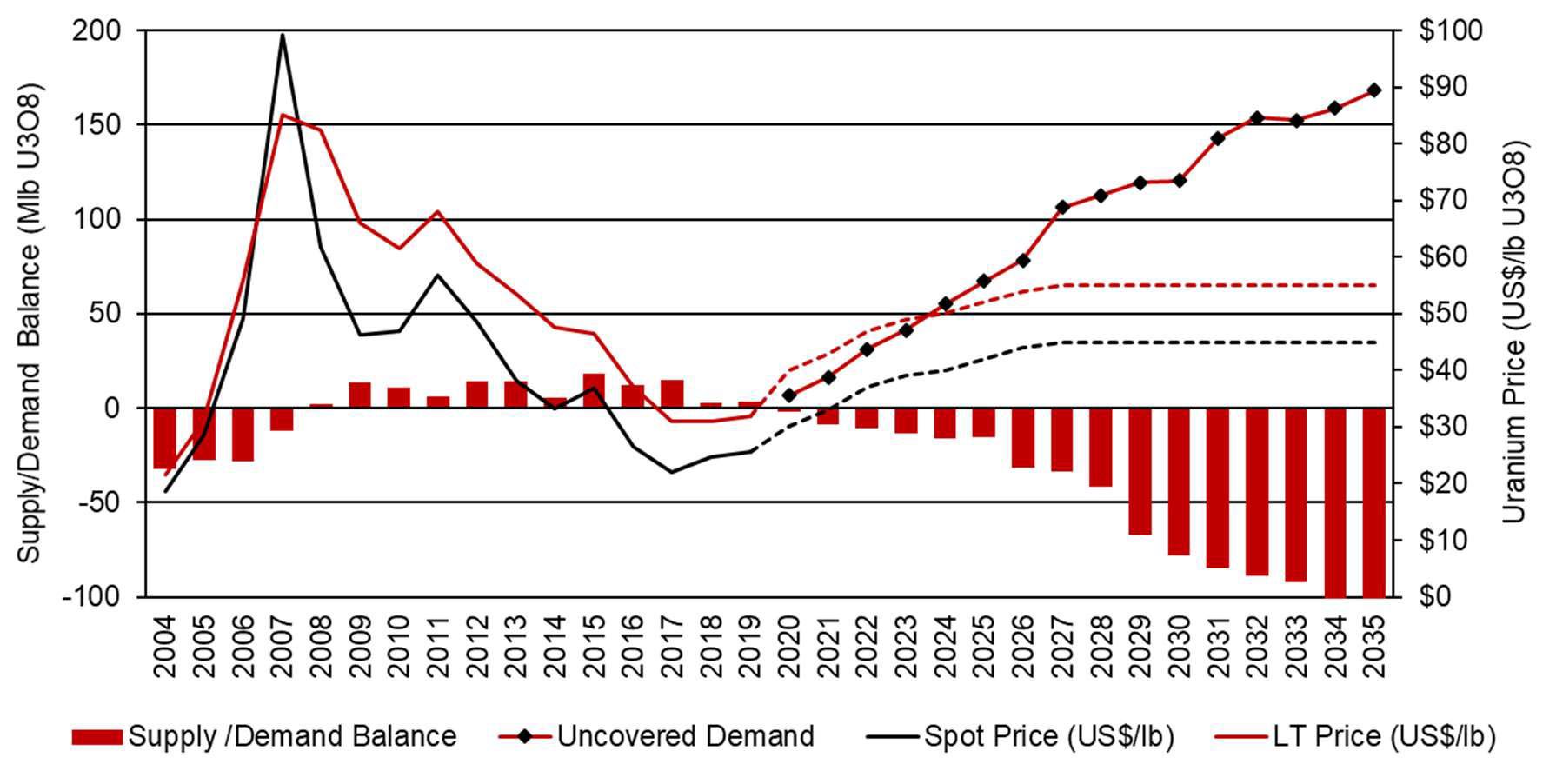
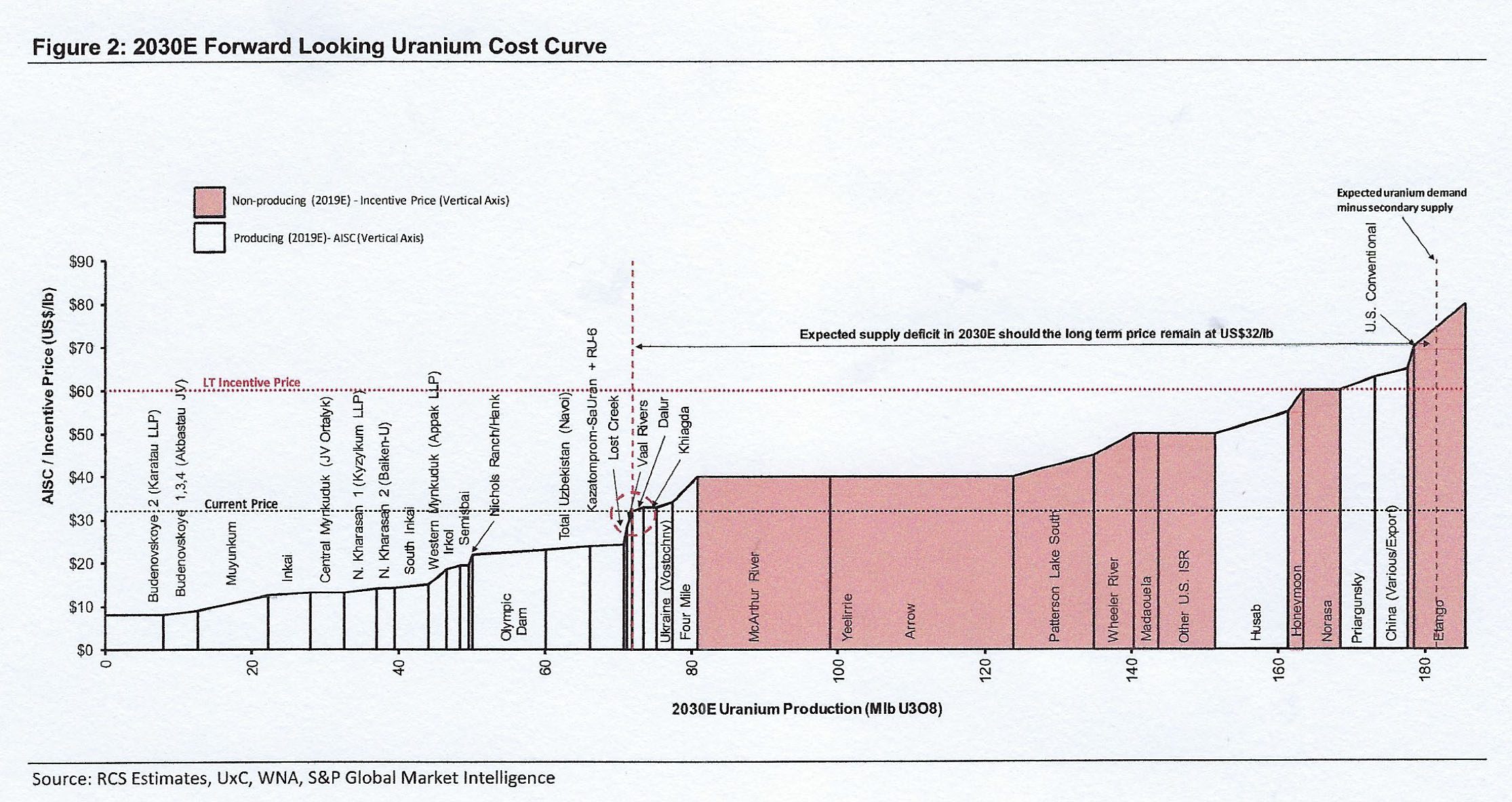
However, the stand-off between producers and utilities continues, with Cameco (TSX:CCO, Not Covered) and Kazatomprom (KAS:KZAP, Not Covered), refusing to contract at the current long-term price. Plus, Kazatomprom has committed to not selling into the spot market and Cameco has guided that it plans to purchase 20-22 M lbs out of the spot market (about ~31% of the 2019 spot market) in 2020 to meet their production commitments under previous contracts.
Breakdown of uncovered demand suggests U.S. utilities (~26% of global demand) need to be executing new long-term contracts today. For the first time the UxC has provided a breakdown of uncovered demand by region which is very important. Starting in 2022, 37% of U.S. requirements are uncovered (~17 M lbs or 9% of global demand, with typical delivery on long-term contracts being ~2 years, this suggests that utilities need to be aggressive with new long-term contracts, particularly since Red Cloud expects a supply deficit of 31 M lbs in 2022. Additionally, the majority of uncovered demand comes from the Asia & Oceania region, which supports their position that projects in higher risk jurisdictions are likely to be coveted by reactor and uranium suppliers which dominate the builds in this region (e.g., China Nuclear International Uranium Corporation and the Rosatom State Nuclear Energy Corporation).
Market deficit and uncovered demand should accelerate inventory decline. Global inventories are at ~780 M lbs U3O8e, which compares to 2020 E demand of ~182 M lbs U3O8e. However, Red Cloud concludes that ~33% is Chinese strategic supply for its aggressive reactor build plans both domestically and abroad. This suggests that inventory available for utilities, continues to be below three years. With utilities preferring to hold two to three years of inventory, and long-term contracts taking more than two years for first delivery, the time for new long- term contracts is now.
[Read on. The Red Cloud report is especially important information on the future price of uranium, and hence the vitality of the overall uranium industry.]
In case this report is removed from Red Cloud servers, here is a PDF of this report: http://www.i2mconsultants.com/downloads/corp/20200326-Uranium-Update.pdf
Managed & Built by I2M Consulting, LLC | © 2010-
