

Nelson and Czerwinski reported in late 2018 that California and Germany could have mostly or completely decarbonized their electricity sectors had their investments in renewables been diverted instead to new nuclear, a new Environmental Progress analysis finds. In 2017, Germany generated 37 percent of its electricity from non-carbon sources. In pursuing the Energiewende, Germany will have invested $580 billion in renewable energy and storage by 2025. If Germany had invested in nuclear instead, it could have built 46 1.6 GW EPR reactors at the $12.5 billion per reactor cost of the U.K.’s Hinkley Point C. German companies assisted with the design of the EPR and the reactor was explicitly planned to meet the strictest European regulations.
In this scenario, EP assumes that a Germany pursuing nuclear power would maintain the same level of nuclear generation as it produced annually before implementing its nuclear phase-out in 2011, about 133 TWh per year. With 46 EPRs operating at 90 percent capacity factor, Germany could first eliminate all coal, gas, and biomass electricity, then make up for today’s 150 terawatt-hours per year of wind and solar from its renewables investment, all while exporting 100 terawatt-hours of electricity to its neighbors (double 2017’s actual exports). Finally, with the remaining 133 terawatt-hours, Germany could decarbonize its entire light vehicle fleet including all 45 million of its passenger vehicles.
California, by contrast, has much higher solar irradiation and patches of stronger wind speeds compared to Germany. In 2017, California generated 53 percent of its electricity from non-carbon-emitting sources. An estimation similar to Bloomberg’s for Germany of California’s total spending through 2025 on its energy transition was not available, so we used publicly available data on certain California solar and wind projects to estimate the state’s total capital investment on solar photovoltaics, solar thermal, and wind since 2001.
The authors estimated that the state has invested $100 billion. This represents both a narrower categorization of spending and a narrower time-frame than Bloomberg’s estimates for Germany. If California had instead at the turn of the millennium chosen to pursue nuclear energy, it would have found that South Korea at that time was building its OPR1000 reactors on-time and under-budget. As the OPR1000 was a lightly-modified 1GW-capacity version of the 1.3GW reactors built next door to California in Arizona at Palo Verde, which still export power into the state today, it is assumed that these Korean reactors would have been licensable by the Nuclear Regulatory Commission for construction in the U.S.
The authors also assumed that a fleet of 20 OPR1000s could have been built in California, perhaps four to a plant, for a cost of $5 billion per reactor, more than double the cost of construction in South Korea. Coastal and inland nuclear plants in California were planned to host up to six 1GW reactors, as at Diablo Canyon where only two were eventually built. In this scenario, EP assumes that California pursuing nuclear power would keep San Onofre and Diablo Canyon in service while also keeping its large hydro and geothermal electricity production.
Then, with 20 OPR1000s operating at the current U.S. national average 93% capacity factor and San Onofre and Diablo canyon still online, California could be producing 200 terawatt-hours of clean electricity — more than total in-state generation in 2016 and 97 percent of in-state generation in 2017.
Careful siting of these new nuclear plants would reduce or eliminate the need for new transmission projects currently being built in the state to deal with distant solar and wind farms. However, those project costs were not included in estimated spending in California.
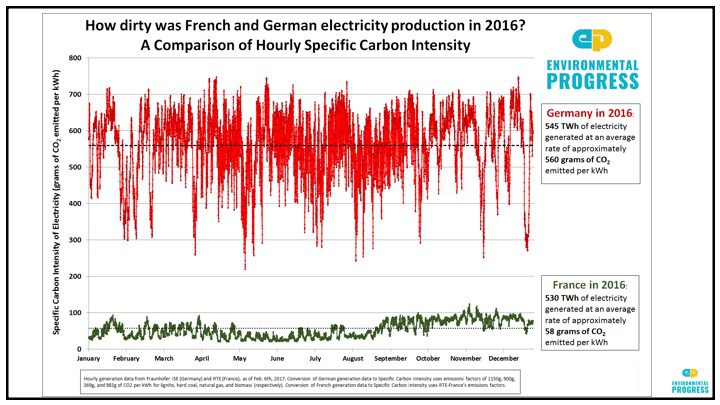
These scenarios for Germany and California were chosen to be similar to the scale, speed, and price of nuclear expansion in France from 1980 to 2000. It would of course have been necessary for a successful nuclear transition for Germany and California to have shared France’s governmental and societal support for nuclear energy. However, government and social commitment for nuclear may indeed turn out to be cheaper and easier in the long run than harnessing fluctuating solar and wind energy flows, as the living examples of France, Germany, and California show.
Note: see references cited in the report linked above.
Managed & Built by I2M Consulting, LLC | © 2010-
