

Ponce and Glen reported in 2008 that the origin and character of a prominent large-scale geophysical feature in north-central Nevada that is coincident with the western margin of the northern Nevada rift—a mid-Miocene rift that includes mafic dike swarms and associated volcanic rocks expressed by a NNW-striking magnetic anomaly. The geophysical feature also correlates with mid-Miocene epithermal gold deposits and is coincident with the central part of the Battle Mountain–Eureka mineral trend.
The Reese River Valley, a 2-km-deep Cenozoic basin, is located along the western margin of this feature and is inferred from the inversion of gravity data to be influenced by, and perhaps in part structurally controlled by, the geophysical feature. Geophysical modeling indicates that the source of the geophysical anomaly must extend to mid crustal depths, perhaps reflecting a transition from Paleozoic crust in the southwest to Precambrian crust in the northeast, the presence of felsic intrusive rocks in the middle crust, or the edge of mid- to subcrustal mafic intrusions related to late Tertiary magmatic underplating associated with hot-spot magmatism.
These cases offer very different possibilities for the age, depth, and origin of the source of the geophysical anomaly, and they present distinct implications for crustal evolution in the northern Great Basin. For example, if the anomaly is due to a pre-Cenozoic basement structure, then its coincidence with the mid-Miocene northern Nevada rift suggests that the trend of the rift was guided by the preexisting crustal structure. On the other hand, if the anomaly is related to Tertiary mafic intrusions, then the western limit of this magmatism may have been influenced by hot-spot fracturing of the crust.
The authors concluded that a prominent combined magnetic, gravity, and basement gravity feature in north-central Nevada is coincident with the western margin of the eastern northern Nevada rift, a long arcuate magnetic anomaly associated with a mid-Miocene mafic dike swarm. Geophysical modeling and boundary analysis indicate that this feature is an abrupt, near-vertical crustal-scale structure. Part of this geophysical feature also appears to be subparallel to and partially coincident with an inferred crustal fault zone along the central part of the Battle Mountain–Eureka mineral trend in between but exclusive of Battle Mountain and Eureka [.....and south beyond Lookout Mountain, the site of mining during the early-mid 1980s. See *Note below for additional mining history of the area].
At Battle Mountain and southeast of and including Eureka, the geophysical feature and the Battle Mountain–Eureka mineral trend clearly deviate from one another. If the crustal faults along the mid-Miocene northern Nevada rift and the central part of the Eocene and older Battle Mountain–Eureka mineral trend are in fact the same feature, deposits at a greater distance from the crustal feature associated with the northern Nevada rift at Battle Mountain could be explained by post-emplacement tectonic events. However, those deposits near Eureka may be related to the intersection of two crustal-scale faults. The association of the northern Nevada rift and the central part of the crustal fault zone along the Battle Mountain–Eureka mineral trend suggests that the location of the northern Nevada rift was at least in part preferentially influenced by a pre-existing structure.
Although the broad basement gravity feature in northern Nevada is likely related to a pre-Cenozoic geologic structure, its continuity with a broad gravity high extending from the Snake River Plain suggests that the source of the anomaly is, in part, related to hotspot magmatism. This implies that the extent of underplating was either limited by northern Nevada rift diking that tapped subcrustal magmas or that hot-spot magmatism was guided and influenced by pre-existing structures. In any case, these large-scale crustal features are important to understanding the metallogeny, tectonics, and magmatism of the Great Basin, as well as water
and environmental issues.
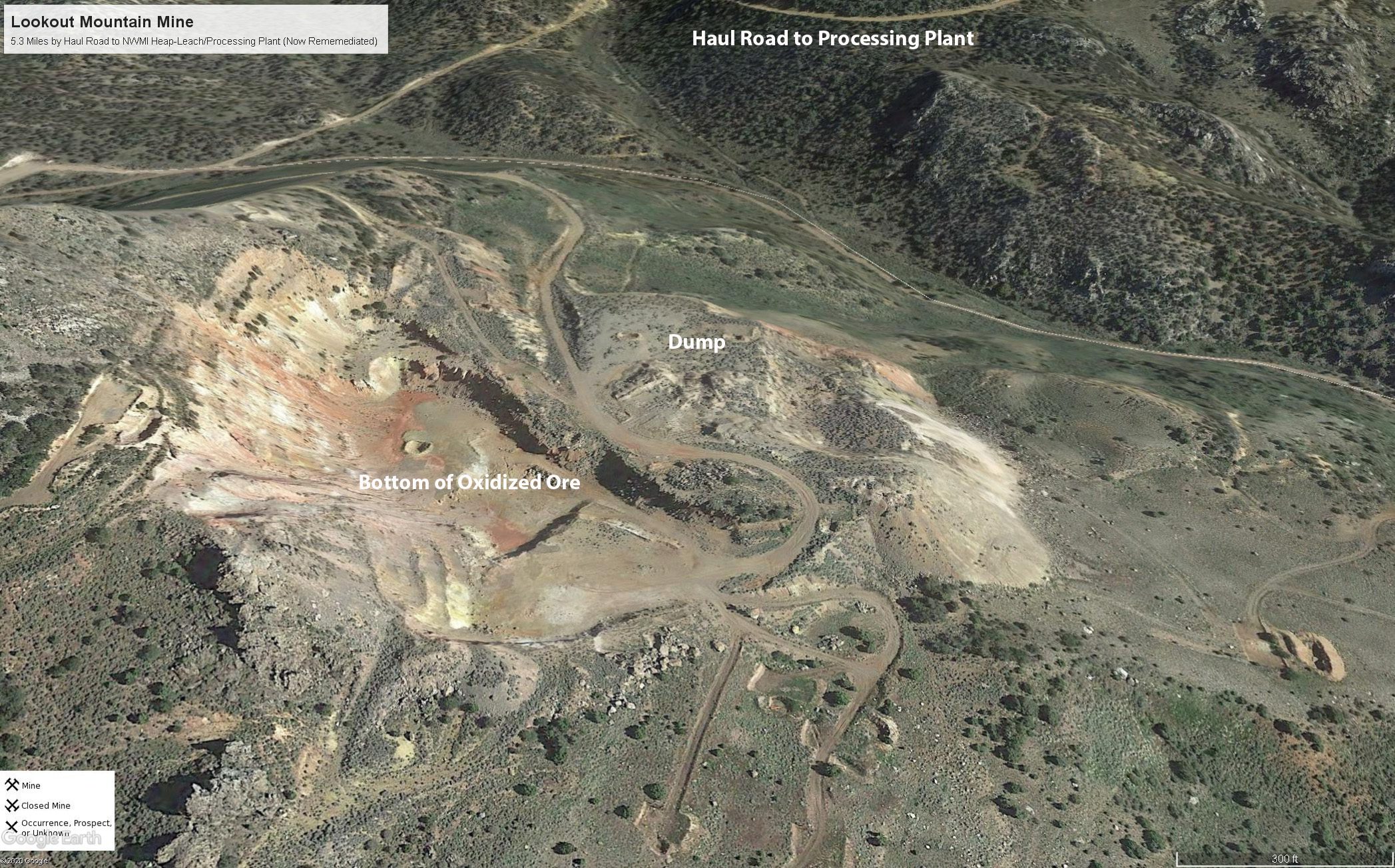
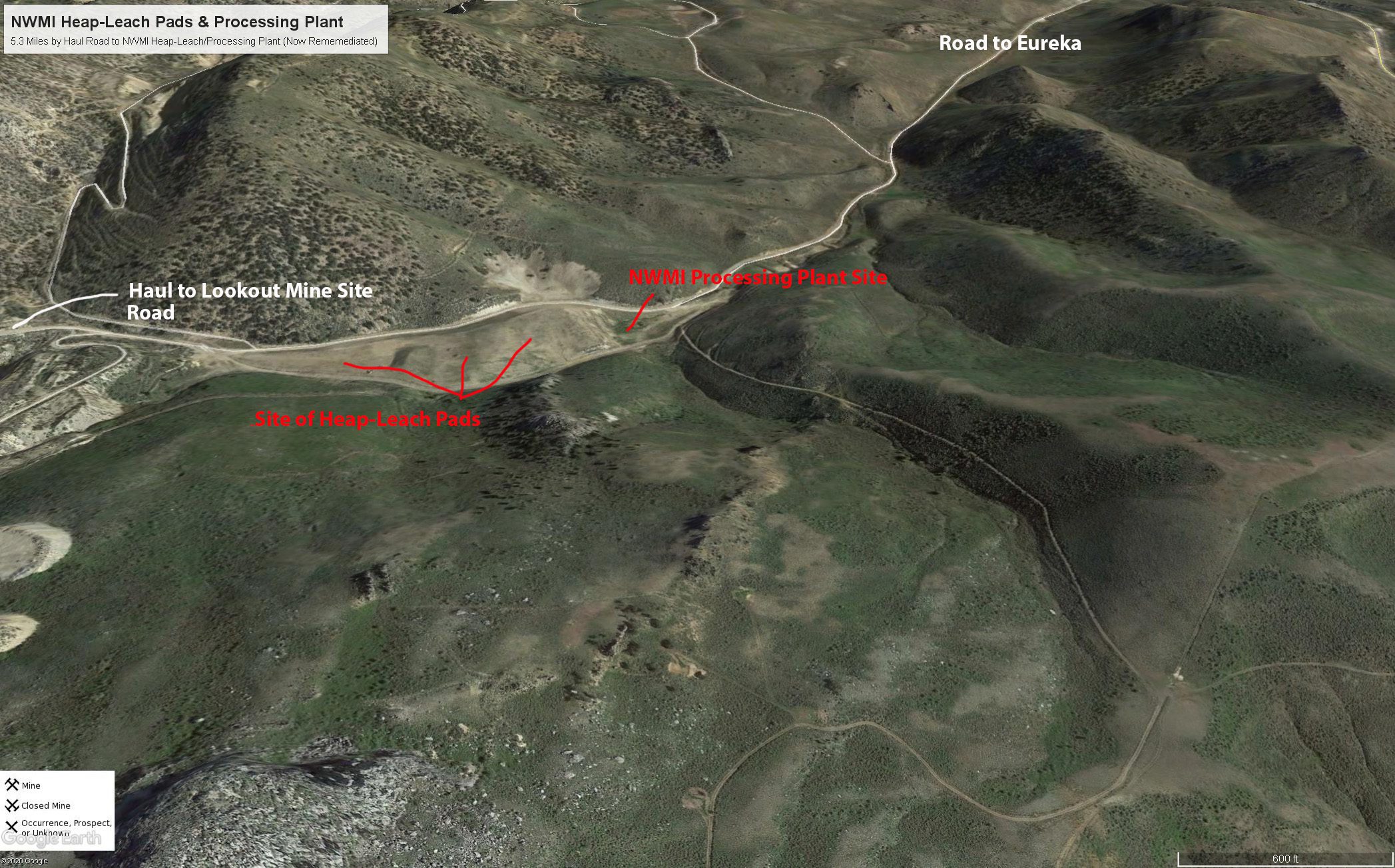
[ *Note: The Lookout Mountain prospect, an Amselco spin off property, was acquired by Norse Windfall Mines, Inc., a joint venture of Norwegian, Swiss and American companies in the early to mid 1980s. NWMI gathered up all the prospective dumps south of Eureka and heap-leached for gold and silver and processed into dore after refurbishing the old Windfall processing plant, while an $800,000 road was being built to Lookout Mountain mine, where the oxidized ore was subsequently mined by open pit, agglomerated on-site, and transported to the new heap leaching pads via the new road, where using leaky recycled rubber pipe for applying cyanide solutions, the resulting pregnant solutions from which where piped and processed at the mill using electrolytic cells at the new NWMI processing plant to produce 99% Au dore that was transported under guard to Salt Lake for final smelting and payment. Significant sulfide mineralization remains at depth below the current surface of the now remediated Lookout Mountain pit area. The processing plant and heap-leach pads to the north some 5 miles by haul road have been removed and the area covered as remediated by State contractors.]

Managed & Built by I2M Consulting, LLC | © 2010-
