

Hou, and 7 co-authors, reported in 2011 that the marine Eucla basin in southern Australia is emerging as a major new heavy minerals province in Australia. Beach placers are associated with a series of partially buried Cenozoic coastal barrier sands formed along an arcuate 2,000-km-long basin margin, the trace of which is up to 320 km inland of the present coastline. The presence of high-grade deposits with dominant zircon over ilmenite and lesser amounts of rutile and leucoxene was established with the discovery of the Jacinth and Ambrosia heavy mineral deposits in late 2004. An additional 10 heavy mineral prospects were subsequently identified and are at various stages of evaluation.
The Eucla basin and its adjacent paleovalley system have a large areal extent that contains a complicated succession of marine and nonmarine strata spanning a wide range of depositional environments. Four distinct constructional phases for the development of shorelines can be recognized and correlated with major third-order sea-level events, established by others from the marine depositional record as occurring during the middle Eocene (~42.5 Ma), late middle Eocene (39–36 Ma), late Eocene (36–34 Ma), and Miocene-Pliocene (15–2.6 Ma). Prevailing westerly winds built extensive dune systems by longshore drift. Sediment movement was from west to east. Detrital zircon grains from the Ooldea and Barton barriers show a distribution of zircon age that is consistent with the Proterozoic Musgrave province to the north of the basin as the dominant primary source area of the heavy minerals, with a contribution from the Albany Fraser orogen to the west. The likelihood is that these heavy minerals have been recycled via sedimentary basins that flank the Musgrave province and include the Neoproterozoic to Cambrian Officer basin and Permian to Mesozoic deposits of the Bight basin.
The authors' current depositional model is summarized as follows:
1) initial rapid transgression and deposition of a shallow marine sand sheet subsequently overlain by shallow marine limestone during middle Eocene;
2) a major Eocene transgression and deposition of a shelf, barrier, and lagoonal shoreface marine complex during the late middle Eocene;
3) further transgression and highstand deposition during the late Eocene; and
4) renewed transgression of barrier, lagoonal, and possibly flooding deltaic sand blanket in the southeastern coastal plain with neotectonic uplift tilting in the western Eucla margin during Mio-Pliocene time. Each stage of reworking increased the potential for heavy mineral concentration in placer deposits.
The authors concluded that the evolution of the Cenozoic shorelines of the Eucla basin is characterized by a landward stepwise migration of the coastline. There is evidence for at least four main phases of paleoshoreline sedimentation: middle Eocene, late middle Eocene, late Eocene, and middle Mio-Pliocene. Shorelines formed during these third-order sea-level rises contain beach placers, mostly formed during coastal sea-level change, at sites where there was supply of heavy mineral sands and conditions for concentration and preservation favorable for heavy mineral deposits. In aggregate, the accumulation of barrier island sands is up to 30 km wide and their complexity conceals numerous individual strandlines, deposited during high order events of sea-level rise that are mostly undocumented and remain highly prospective for heavy mineral sands.
Around the peak of transgression and highstand, heavy mineral deposits formed in beach or barrier island and dune sand complexes. Stillstands were likely associated with late middle Eocene deposition as this shoreline includes some of the largest and richest deposits. The heavy mineral deposits are most likely to have arisen from multicyclic origin. The likely sources for heavy mineral-rich zircon sands are late Mesoproterozoic to Cambrian fluvial and shallow marine sandstones along the northern and western margins of the Eucla basin, with recycling of heavy mineral sands sourced primarily from cratonic basement rocks of the Musgrave province and the Albany Fraser orogen, (based on crystallization ages from those terranes) with lesser contribution from older terrains. Apart from the relatively well known Ooldea and Barton barriers, other shorelines are prospective for hosting heavy mineral deposits. These include the middle Eocene Hampton Sandstone in the central part of the Eucla basin and Neogene
strandlines in the eastern basin.
Reconstructing early shorelines of the middle Eocene Wilson Bluff shoreline in the central basin is hampered by marine limestone cover and limited drill hole data. Similarly, tracing the extent of Neogene shorelines, especially in the more prospective areas near paleoriver outlets and across older coastal barrier islands, is difficult due to extensive surficial cover of younger aeolian dunes. Further research to delineate these systems may provide additional heavy mineral targets. Many world-class heavy mineral deposits were formed during the late Miocene to early Pleistocene marine transgressive-regressive events. These include:
- Eneabba in Western Australia (Lissiman and Oxenford, 1975; Baxter, 1977)
- New Jersey (Puffer and Cousminer, 1982),
- Trail Ridge of Florida (Force and Rich, 1989),
- North Carolina and Virginia (Carpenter and Carpenter, 1991),
- the southeast coast of Australia (Roy, 1999), and the
- Murray basin of Australia (Roy et al., 2000; Roy and Whitehouse, 2003).
The authors' findings here have significance for worldwide exploration for older (Eocene) heavy mineral deposits in that concealed deposits of the type described here may exist in areas that have received little or no previous exploration for heavy mineral deposits, in particular where they lie adjacent to Precambrian shield areas. Given the example here, such deposits may be located over 120 km (Jacinth-Ambrosia deposits) and even 320 km (Cyclone) inland from modern shorelines.
Major points arising from the present study are as follows:
1. The Eucla basin has potential to become a major new heavy mineral province in Australia, and probably a world-class zircon source. At the time of writing, over 12 separate heavy mineral prospects have been reported from paleobeach and barrier island sands in the Eucla basin, with mining at the Jacinth deposit commissioned in 2009.
2. The deposits are in mostly unconsolidated sands above the water table and generally have a favorable ore thickness to overburden ratio. Consequently, mining and processing appear relatively feasible. The remote location and general lack of infrastructure mean that large or high-grade deposits with a high content of the more valuable heavy minerals are more likely to be developed in the near future as driven by economic conditions.
3. Recent stratigraphic investigations and new data from mineral exploration suggest revision of earlier views that the prospective coastal strandlines resulted from a single transgressive-regressive cycle across the basin. More than four generations of Cenozoic shorelines comprise many heavy mineral-bearing strandlines.
4. The regional distribution of the heavy mineral-bearing strata and the shoreline evolution is consistent with landward terrace migration of the shoreface complexes from the central basin to the onshore margin—by over 300 km—as a result of sea-level change. The predominance of zircon in high-grade heavy mineral deposits originating from the Musgrave province enhances the prospectivity of the northern and eastern margins of the Eucla basin.
5. The valuable heavy mineral assemblage consists mostly of zircon and altered ilmenite with lesser proportions of rutile and leucoxene. Zircon is the dominant heavy mineral in parts of the eastern basin, while ilmenite predominates in prospects along the northern and western basin. The highest concentration of zircon (up to 65% of the heavy mineral fraction) is found along the Ooldea barrier in the eastern Eucla margin.
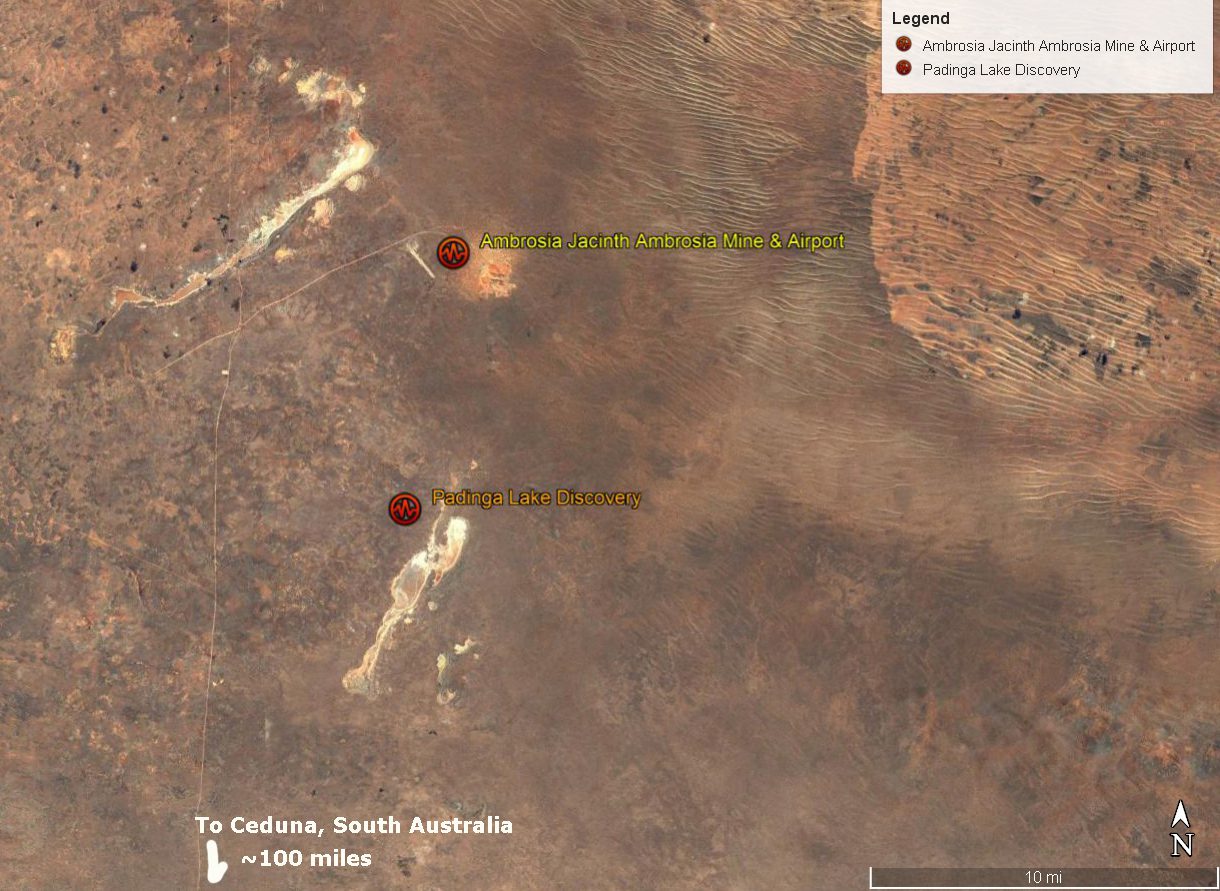
[Interesting Note: This deposit was developed within a few miles of where in 1969 Mr. Campbell discovered very high radioactivity and a light-green radium mineral in the nearby Pidinga dry lake beds. See (here). Google Earth locations of mine and discovery (more).
Managed & Built by I2M Consulting, LLC | © 2010-
