

Hou and Keeling reported in 2008 that the onshore extent of the Eucla Basin in southern Australia contains remarkably preserved Cainozoic coastal barriers and palaeovalley systems, inland of the vast Nullarbor Plain. These are attractive for mineral exploration because fluvial and shallow-marine sediments within the basin and palaeovalleys were derived from the surrounding mineral-rich cratons and the sediments host remobilized gold, uranium and heavy minerals. In particular, the preserved
palaeoshoreline sequence along the northeastern margin of the Eucla Basin is highly prospective for heavy mineral placer deposits. This is confirmed by the number and quality of new heavy mineral discoveries in the region, which include the world-class zircon deposits of Jacinth and Ambrosia.
Understanding the history of the Eucla Basin and palaeovalleys provides insights for mineral exploration that can help target these commodities. Tectonics, sea-level change and climate were important controls on the changing physical palaeogeography of the region, the distribution of sediments in the basin and inland valleys, and, consequently, the sites of mineral deposition and accumulation. In a recent review of the evolution of the Eucla Basin, Hou et al. (2008) outline the sequence and timing of major events affecting basin sedimentation.
Evidence of topographic variation in key stratigraphic units across the basin is interpreted in terms of new ideas on post-Palaeogene tilting of the Australian continent. The major events and impact of neotectonic activity described in Hou et al. (2008) are summarized here with specific reference to coastal dune development and the significance for heavy mineral exploration.
The authors concluded that the Eucla Basin nearshore coastal barrier systems, coastal lagoons and palaeovalleys contain remarkably well-preserved and varied sedimentary facies of mainly Cainozoic age. Stratigraphic correlation of the sediments across the Eucla Basin and palaeovalleys shows that the marginal basin and adjacent palaeovalleys include at least three main phases of sedimentation: Middle–Late Eocene, Middle Miocene – Early Pliocene, and Quaternary. Progressive (relative) east-down tilting in combination with persistent westerly weather systems explains: the absence of large coastal barriers in the western margin of the basin; the smoothly curved Ooldea Barrier; a western and northern source of sediment supplies indicated by sediment provenance studies; the series of parallel J-shaped (Barton) barriers of Late Eocene age; ‘reverse flow’ features of Neogene channels draining the Gawler Craton; and progressive reworking of older Eocene barriers during the Neogene along the western Eyre Peninsula. This provides new insights into the geological history of the entire Eucla Basin and associated palaeovalleys that establishes a basis for future investigations of the landscape and tectonic history of the southern part of the Australian continent. This has particular relevance to exploration for heavy mineral placer deposits along the northern and eastern margins of the basin.
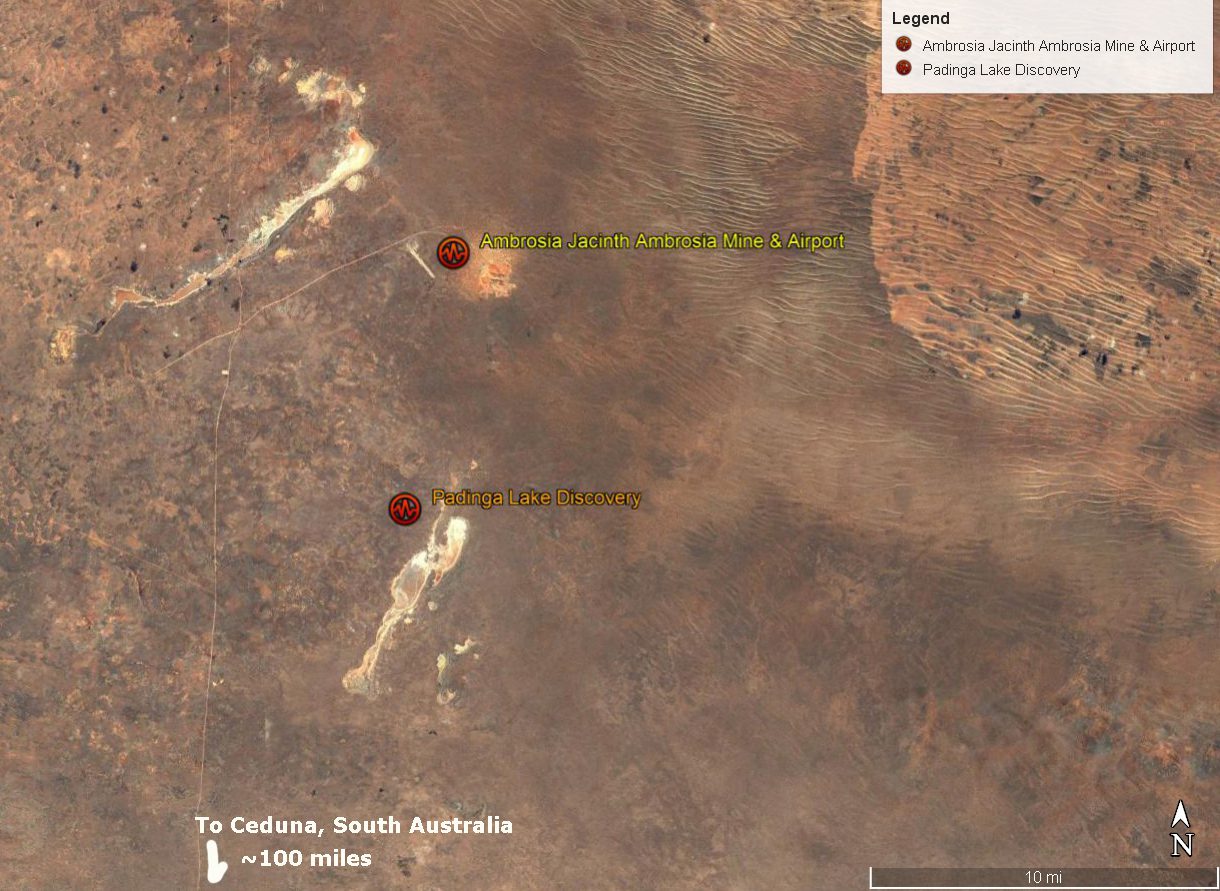
[Interesting Note: This deposit was developed within a few miles of where in 1969 Mr. Campbell discovered very high radioactivity and a light-green radium mineral in the nearby Pidinga dry lake beds. See (here). Google Earth locations of mine and discovery (more).]
Managed & Built by I2M Consulting, LLC | © 2010-
