

Rolle and Le Borgne reported in 2019 that the interplay between mixing and reactive processes plays a pivotal role in a range of biogeochemical processes controlling the transport, transformation and turnover of chemical elements (McClain et al. 2003; Dentz et al. 2011; Valocchi et al. 2018). The study of these processes is of primary importance in many scientific disciplines and technical applications, including fluid mechanics, geochemistry, chemical engineering, reservoir engineering, subsurface and contaminant hydrology, water treatment, and remediation of contaminated sites. Mixing fronts often act as hot spots of biogeochemical reactions as they induce chemical disequilibrium and bring together reactants that may be otherwise segregated. By definition, reactive mixing fronts are characterized by strong and evolving chemical gradients; therefore, they cannot be in general understood and modeled under the conventional assumption of well-mixed chemical systems.
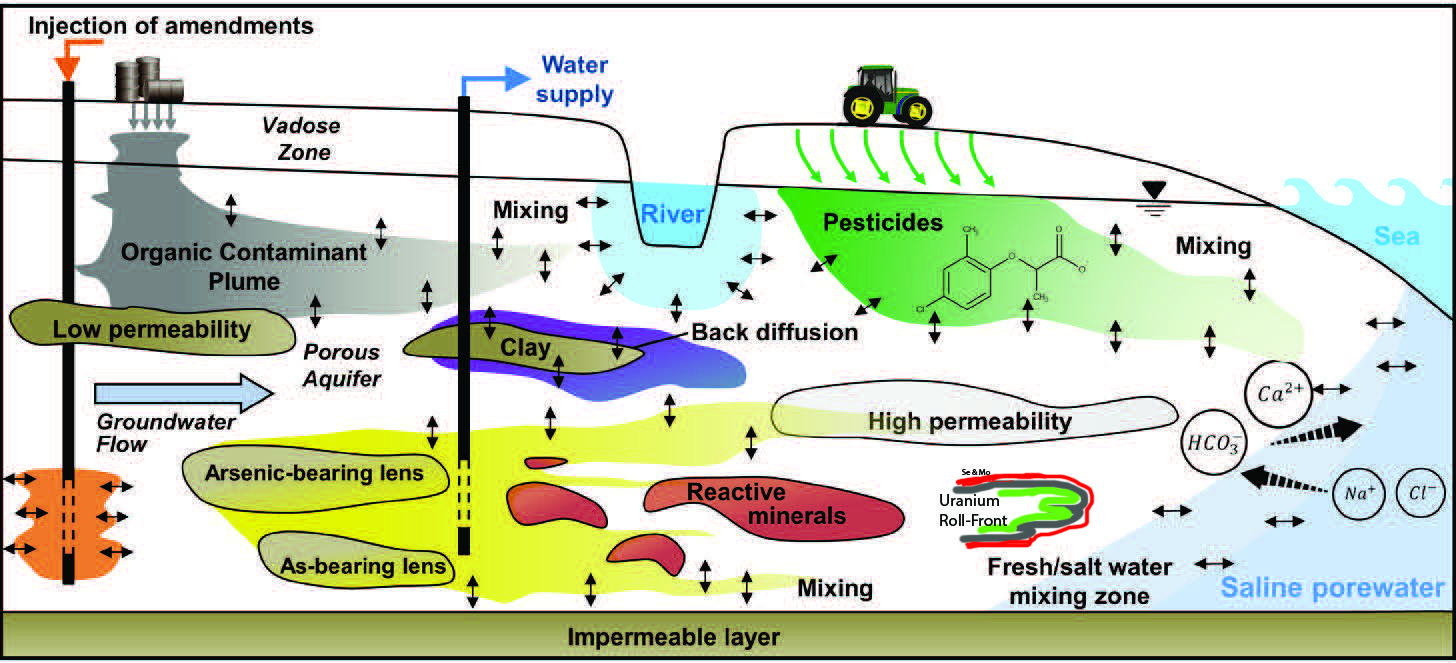
In this chapter, the authors provided an overview of some recent advances in the characterization, understanding and modeling of mixing and reactive fronts in the subsurface. They focused on incompressible water flow in porous media and discussed two main types of mixing fronts, which play an important role in a range of applications from contaminant transport to geochemistry and eco-hydrology:
i) transient mixing fronts, where an advancing fluid progressively displaces a fluid of different chemical composition,
ii) steady-state mixing fronts, which develop around continuously released plumes.
The authors presented the basic mechanisms that govern the effective mixing and reaction rates of such fronts, and discuss recent findings that have changed the view on the deformation dynamics of these fronts in heterogeneous porous media and motivated the development of new modeling frameworks. They provided examples and discuss implications of mixing front dynamics for different biogeochemical reactions at scales ranging from the pore scale to the field scale.
A few examples of mixing and reaction fronts, which occur naturally (e.g., river/groundwater, sea/groundwater interactions) or as a result of contaminant release in groundwater from anthropogenic and/or natural sources. As they bring together reactants and create chemical disequilibrium, mixing fronts are often viewed as hot spots of biogeochemical reactions, where reaction rates can be much larger than in other areas. They can thus control key geochemical processes at interfaces between different water bodies (groundwater, rivers, lakes, oceans) and determine the fate of released pollutants and the delivery of reactants and amendments.
In the context of contaminant hydrology, hot spots of mixing occur at the fringes of contaminant plumes where the dissolved contaminants contact clean groundwater. The mixing of different waters triggers important reactions that may lead to contaminant degradation and to the alteration of the groundwater and/or porous medium chemistry through precipitation and dissolution reactions. For instance, the fate of organic contaminant plumes depends on microbially-mediated redox reactions in which the pollutants can be degraded through different electron acceptor processes.
In the mixing zones at the plume fringes favorable conditions occur since soluble electron donors and acceptors, such as the organic contaminants and dissolved oxygen, nitrate and sulfate present in the pristine groundwater, come into contact. This favors the degrading activity of indigenous microorganisms that can access the necessary substrates for their metabolic activity. Subsurface porous media are poorly mixed environments in which water flow is dominated by viscous forces and mixing is hindered by the absence of turbulence. Under such conditions of creeping flow, dilution of conservative solutes (i.e., their distribution over increasingly larger volumes or water fluxes) and mixing of initially segregated reactants control many reactive processes. These processes often represent the bottleneck and the rate-limiting steps for the overall reaction rates since they are typically slow and characterized by long time scales. Aqueous diffusion of the solutes in the groundwater is the ultimate control on mixing processes since diffusion is the only physical mechanism leading to the increase of entropy and to the decrease of the peak concentration of solute plumes.
[To the above considerations of "reactive fronts", the "roll-front" uranium biogeochemical cell must be added as well. See: https://i2mconsultants.com/downloads/mdcampbell/CamBidd77.pdf and https://i2mconsultants.com/downloads/mdcampbell/CampbellWiseRackleyGCAGS2007l.pdf ]
Managed & Built by I2M Consulting, LLC | © 2010-
