

Zolfagharifard reported in 2014 that the lunar soil (aka regolith) brought back by mankind's first moonwalkers contained an abundance of titanium, platinum and other valuable minerals. But our Moon (and other moons with similar geologic history) also contains a substance that could be of even greater use to civilization – one that could revolutionize energy production. It's called helium 3 (3He) and has been deposited on the Moon in vast quantities by solar winds over the past billions of years.
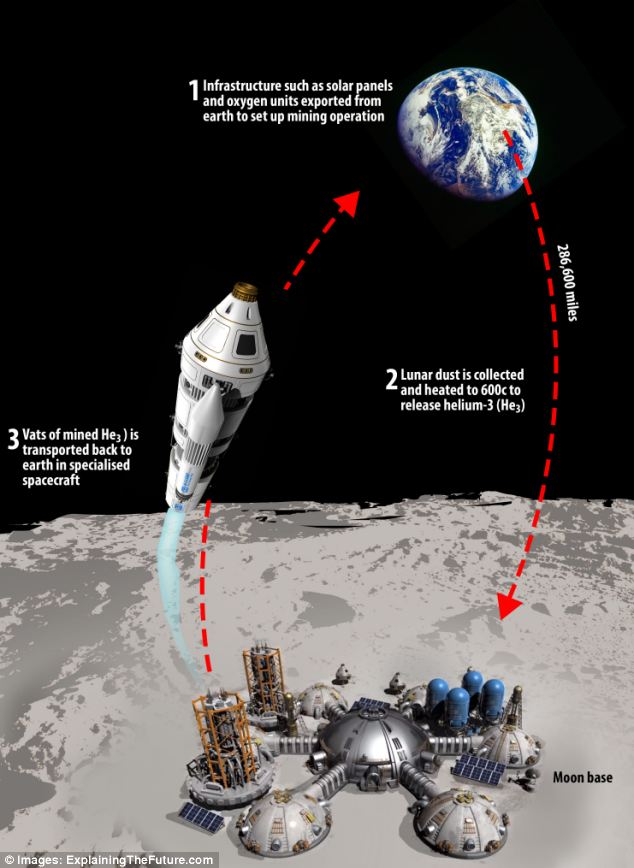
Helium 3, geoscientists suggest, could power clean fusion plants. Two fully-loaded Space Shuttle cargo bay's worth - about 40 tonnes worth - could power the United States for a year at the current rate of energy consumption. Pictured are the stages in getting the material back to Earth. Professor Ouyang Ziyuan, the chief scientist of the Chinese Lunar Exploration Program, recently said that the moon is 'so rich' in helium 3, that this could 'solve humanity's energy demand for around 10,000 years at least.'
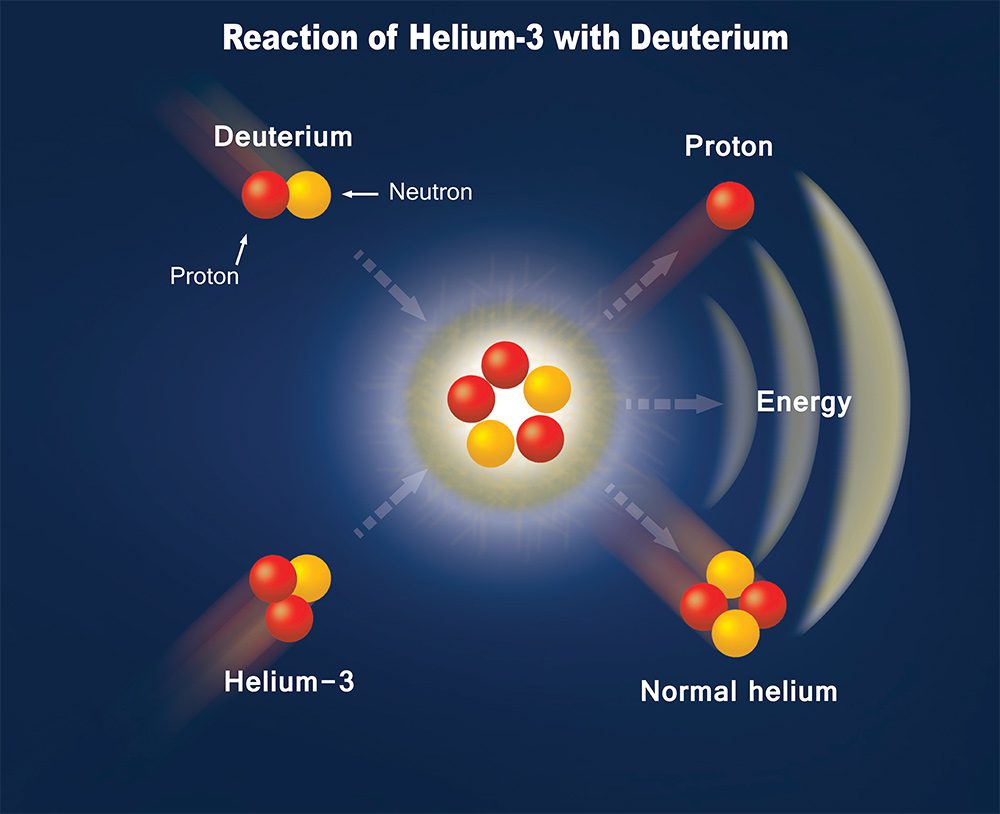
The isotope is so rare on the Earth because our atmosphere and magnetic field prevent any of the solar helium-3 from arriving on the surface. Helium-3 is a light, non-radioactive isotope of helium with two protons and one neutron. It is abundant in the Moon's soil after being dumped there by solar winds. Helium-3 is abundant in the Moon's soil having about 13 parts per billion (ppb) by weight. Two fully-loaded Space Shuttle cargo bay’s worth - about 40 tonnes worth - could power the United States for a year at the current rate of energy consumption. The isotope is so rare on the Earth because our atmosphere and magnetic field prevent any of the solar helium 3 from arriving on the surface
Its presence is rare on Earth, but it is sought after for use in nuclear fusion research. It is also used in MRI scanners and in sensors to detect smuggled plutonium. The gas, he estimates, has a potential economic value of billions of dollars/tonne of the gas, likely making it economically viable to consider mining from the Moon once a market has been established. According to experts in the U.S., the total estimated cost for fusion development, rocket development and starting lunar operations would be about $20 billion (£11.8 billion) over two decades. Fabrizio Bozzato, a doctoral candidate at the University of Tamkan in Taiwan, recently wrote in World Security Network that helium-3 could be extracted by heating the lunar dust to around 600°C, before bringing it back to the Earth.
While China has expressed an interest, it has yet to outline concrete plans about how it would mine the moon for helium. The prospect, however, raises the controversial issue about who owns our satellite. The United Nations Outer Space Treaty, signed by China, suggests that lunar resources are for all mankind. China is hoping to mine helium 3 from the Moon, as as mining water for oxygen and hydrogen. Private groups are also interested in using fuel from the moon by mining water rather than helium
However, legal experts claim the language is ambiguous enough to allow for commercial exploitation of the moon. In a recent paper, Mr Bozzato said: 'China appears determined to make [lunar mining] a reality of tomorrow. 'China maintains its lunar mining would be for the benefit of all humanity,' he added. 'However, given the absence of willful competitors, it is also speculated that the Chinese intend to establish a helium 3 monopoly.' Private enterprise is also interested in using fuel from the moon – although possibly by extracting water rather than helium 3. The Shackleton Energy company envisages providing propellant for missions throughout the solar system using lunar water.
Some teams vying for the Google Lunar X-Prize also see mining as an ultimate goal of their landers. ESA has also considered using the Moon to help missions farther into the Solar System. Arguments have also been made for mining Helium-3 from Jupiter's atmosphere, where it is much more abundant – it would need to be given the distances involved. Extracting the molecule from Jupiter would also be a less power-hungry process.
For updates on China's Lunar activities to date, see: http://i2mportal.com/search_resource.php?search_value=China+Lunar&sort=relevance#page=1
More about lunar activities: http://i2mportal.com/search_resource.php?search_value=Moon+base#page=1
More about helium-3 as a fuel on the Moon and with mining natural helium on earth: http://i2mportal.com/search_resource.php?search_value=helium-3#page=1
[Also see Chapters in Memoir 101: http://www.i2mconsultants.com/downloads/corp/Memoir101-T0fC2016.pdf ]
Managed & Built by I2M Consulting, LLC | © 2010-
