

Kreuzer, and 6 co-authors, reported in 2013 on the apparent relationship between death from non-malignant respiratory diseases (NMRD) and exposure to silica dust or radon in a cohort of 58,690 former German uranium miners. In the follow-up period from 1946 to 2008, a total of 2,336 underlying deaths from NMRDs occurred, including 715 deaths from chronic obstructive pulmonary diseases (COPD) and 975 deaths from silicosis or other pneumoconiosis. Exposure to respirable crystalline silica and radon was individually assessed by means of a comprehensive job-exposure matrix. Risk analyses were based on a linear Poisson regression model with the baseline stratified by age, calendar year and duration of employment.
The authors concluded that there was no increase in risk of death from COPDs or any other NMRDs in relation to cumulative exposure to silica (mean=5.9, max=56 mg/m3-years), except in the group of deaths from silicosis or other pneumoconiosis. Here, a strong non-linear increase in risk was observed. Cumulative radon exposure (mean=280; max=3224 Working Level Months) was not related to death from COPDs or any other NMRDs. The present findings do not indicate a relationship between mortality from COPD with silica dust or radon. However, validity of cause of death and lack of control for smoking remain potential sources of bias.
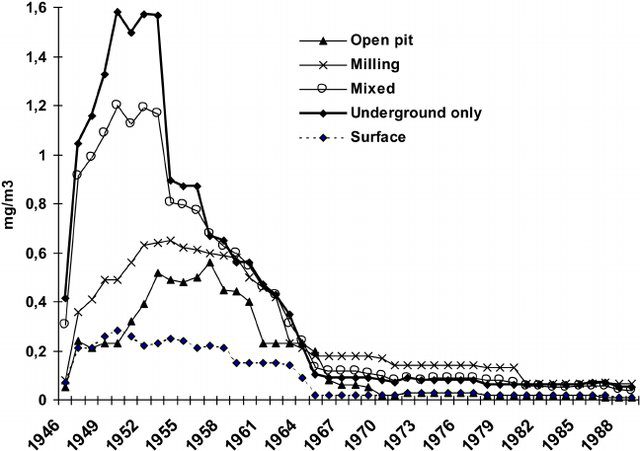
Figure above shows the distribution of the average annual silica dust exposure in mg/m3 for workers at five different work places (open pit, underground, surface, processing/milling and mixed) showing increased management over the years of miner exposure to silica dust.
Smoking of tobacco is the most important risk factor for NMRDs, and it is therefore advisable to perform detailed adjustment for smoking in studies of other risk factors. Unfortunately, only very limited and incomplete data on smoking exist in the full cohort that could not be used. In a nested case-control study on lung cancer, it was shown that most Wismut miners were smokers and adjustment for smoking only marginally reduced the radon-related lung cancer risk. Smoking was broadly categorized into non-smokers defined as lifetime non-smokers or ex-smokers since 20 years or smokers. The correlations between this smoking status with cumulative radon exposure or silica dust categories were very low and weakly positive, indicating no major confounding or at least no negative confounding, that is, underestimation of risk. The corresponding proportions of ‘smokers’ in the categories of cumulative silica dust exposure 0– 0.5, 0.5–2, 2–5, 5–10, 10–20, 30+ were 67%, 80%, 64%, 72%, 70%, 80%, 78%, among controls (n=400) and 92%, 96%, 98%, 96%, 94%, 92%, 96% among lung cancer deaths (n=600), respectively. Data on duration of smoking and intensity of smoking are missing in the nested case-control study. Thus, residual confounding cannot be excluded.
The present study does confirm a strong relationship between silicosis mortality and cumulative silica dust exposure. By contrast with this, findings indicate no association between mortality from COPDs or other NMRDs and cumulative radon or silica dust exposure, even at high levels of exposure.
Kreuzer, co-authors, reported on previous work in 2011 via: /category_open.php?category_id=70#page=1
Managed & Built by I2M Consulting, LLC | © 2010-
