

Freier and 13+ co-authors in a report issued by the Strategic Studies Institute (SSI) (part of the U.S. Army War College) indicated that the report is a strategic-level study agent for issues related to national security and military strategy with emphasis on geostrategic analysis. The mission of SSI is to use independent analysis to conduct strategic studies that develop policy recommendations on:
• Strategy, planning, and policy for joint and combined employment of military forces;
• Regional strategic appraisals;
• The nature of land warfare;
• Matters affecting the Army’s future;
• The concepts, philosophy, and theory of strategy; and,
• Other issues of importance to the leadership of the Army.
Studies produced by civilian and military analysts concern topics having strategic implications for the Army, the Department of Defense, and the larger national security community. In addition to its studies, SSI publishes special reports on topics of special or immediate interest. These include edited proceedings of conferences and topically oriented roundtables, expanded trip reports, and quick-reaction responses to senior Army leaders. The Institute provides a valuable analytical capability within the Army to address strategic and other issues in support of Army participation in national security
policy formulation.
At Our Own Peril is the product of a year-long U.S. Army War College (USAWC) research effort. The report was sponsored by Army G-3/5 (Strategy, Plans, and Policy Directorate), the Joint Staff, J-5 (Strategy Development Division), and the Office of the Deputy Assistant Secretary of Defense for Strategy and Force Development. The work is intended to add to the inevitable debates on risk and risk assessment accompanying forthcoming defense strategy development.
The report endeavors to inform the defense strategy discussion by evaluating the components, high-level assessment, and articulation of risk by the Department of Defense (DoD) at the strategic and military levels of analysis, as well as across the operational and future challenges time horizon. Moreover, in doing so, it answers a single simple question: How should DoD adapt its current risk identification and assessment conventions to accommodate an environment defined by persistent, disruptive change?
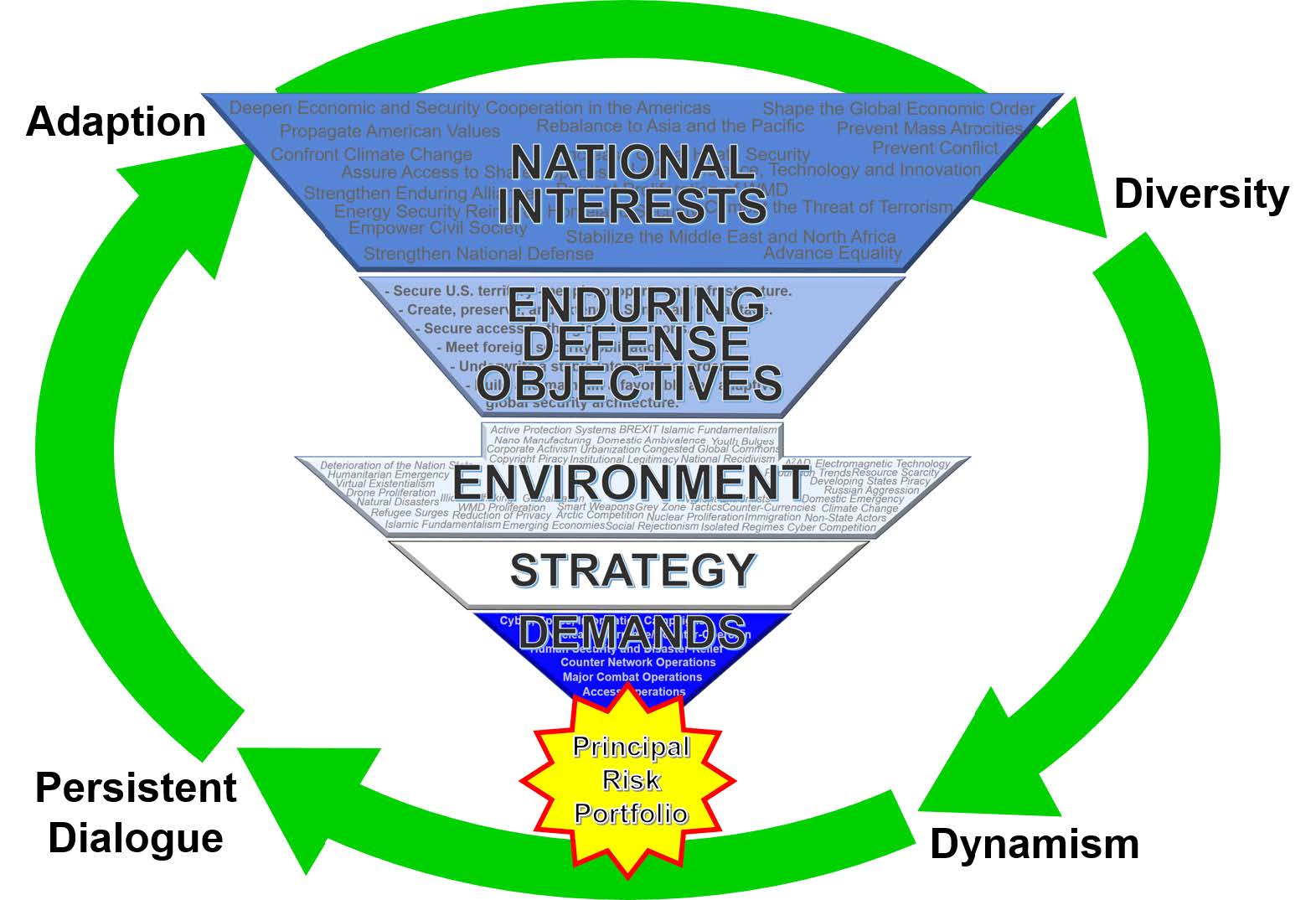
Four Governing Principles of Post Primacy Risk.
To arrive at actionable findings and recommendations, the USAWC study team examined DoD’s risk assessment challenge in four principal areas of inquiry: describing risk, identifying risk, assessing risk, and effectively communicating risk. The study team found three clear vulnerabilities or shortcomings in current risk convention. First, it is excessively focused on near-term military threats. Second, it lacks a meaningful connection back to concrete defense objectives. Finally, third, it has proven to be an insufficient catalyst for essential post-primacy defense innovation and adaptation. These are reflected in a general dissatisfaction among many DoD stakeholders on the state of risk as it relates to corporate-level strategy.
In response, this study recommends that risk becomes the persistent business of DoD’s senior leadership. It further argues that corporate-level risk judgments should revolve around a new post-primacy risk concept and its four governing principles of diversity, dynamism, persistent dialogue, and adaptation.
Original working URL: https://i2mconsultants.com/downloads/corp/AtOurOwnPeril-DoDRiskAssessmentinaPost-PrimacyWorld-pub1358.pdf
Managed & Built by I2M Consulting, LLC | © 2010-
