

Olive Heffernan reported in Nature in 2019 that in 1972, a young ecologist named Hjalmar Thiel ventured to a remote part of the Pacific Ocean known as the Clarion–Clipperton Zone (CCZ). The sea floor there boasts one of the world’s largest untapped collections of rare-earth elements. Some 4,000 metres below the ocean surface, the abyssal ooze of the CCZ holds trillions of polymetallic nodules — potato-sized deposits loaded with copper, nickel, manganese and other precious ores.
Thiel was interested in the region’s largely unstudied meiofauna — the tiny animals that live on and between the nodules. His travel companions — prospective miners — were more eager to harvest its riches. “We had a lot of fights,” he says. On another voyage, Thiel visited the Red Sea with would-be miners who were keen to extract potentially valuable ores from the region’s metal-rich muds. At one point, he cautioned them that if they went ahead with their plans and dumped their waste sediment at the sea surface, it could suffocate small swimmers such as plankton. “They were nearly ready to drown me,” Thiel recalls of his companions. In a later confrontation, Thiel — who was at the University of Hamburg in Germany — questioned how industry planned to test the environmental impacts of sea-bed mining. He was curtly advised to do his own test. So he did, in 1989.
Thirty years on, the test that Thiel and a colleague devised is still the largest experiment ever on the potential impacts of commercial deep-sea mining. Called DISCOL, the simple trial involved raking the center of a roughly 11-square-kilometer plot in the Pacific Ocean with an 8-meter-wide implement called a plough harrow. The simulated mining created a plume of disturbed sediment that rained down and buried most of the study area, smothering creatures on the sea floor. The test revealed that the impacts of sea-bed mining reached further than anyone had imagined, but it did not actually extract any rocks from the sea bed, which itself would have destroyed even more marine life.
There have been many attempts to advance DISCOL’s basic approach, but none has succeeded, mostly owing to technical and financial difficulties. The most recently planned mining trial, to test a robotic nodule harvester in the CCZ this April, was called off at the last minute because of a technical failure. The trial, planned by the Belgian contractor Global Sea Mineral Resources, would have given scientists a better grasp of the impacts of sea-bed mining by using a 25-tonne tractor to plough the ocean floor.
“This was definitely a significant setback, because it was really the only opportunity to try to even start to see the interaction of these big, heavy machines with the marine environment,” says Kristina Gjerde, a high-seas policy adviser with the International Union for Conservation of Nature in Cambridge, Massachusetts. Such has been the troubled trajectory of deep-sea mining ever since eager industrialists proved, nearly a half century ago, that it was technically feasible to extract rare metals and minerals from the ocean floor. Companies and nations have often promised that they would soon start pulling valuable ores from the depths, but commercial efforts have failed to take off for a variety of reasons — notably huge up-front costs, the historically low value of deep-sea ores and the lack of regulations, which have contributed to investors’ wariness.
“The technology is available — it’s the financial and regulatory uncertainty that has held the industry back,” says Govinder Singh Chopra, founder of SeaTech in Singapore, a designer of deep-sea mining support vessels. Now, it seems this nascent industry’s time has come. A growing demand for batteries to power electric cars and to store wind and solar energy has driven up the cost of many rare-earth metals and bolstered the business case for sea-bed mining. What’s more, the industry’s long-awaited regulations — in the form of a mining code — are due to be finalized by 2020, putting in place a process whereby contractors can apply for 30-year licences to mine assigned ‘claim areas’ in parts of the international sea bed such as the CCZ. Already, miners are exploring the potential wealth of these claim areas, but no commercial extraction will begin until the regulations are in place. Investments in this industry are now growing.
Last month, a start-up called DeepGreen in Vancouver, Canada, announced that it is raising US$150 million to begin exploring mineral wealth in part of the Pacific Ocean — a sign of growing confidence in the industry’s future. Both scientists and conservationists, however, are worried that the creation of regulations will encourage the industry to start mining long before there is enough information on how operators can avoid causing serious environmental harm. The scarce data that exist suggest that deep-sea mining will have devastating, and potentially irreversible, impacts on marine life.
Deep sea animals collected from abyssal ocean floor in Clarion-Clipperton Zone. Clockwise from top left: Sea cucumber known as the ‘gummy squirrel’ (Psychropotes longicauda), a sea urchin and two sea cucumbers.Credit: DeepCCZ Project Since the DISCOL experiment was completed, scientists have returned to the site four times, most recently in 2015. The site has never recovered. In the ploughed areas, which remain as visible today as they were 30 years ago, there’s been little return of characteristic animals such as sponges, soft corals and sea anemones. “The disturbance is much stronger and lasting much longer than we ever would have thought,” says Thiel.
The deep sea — usually defined as the realm below 200 metres — is a world of extremes. Temperatures near the sea bed in many places hover near 0 °C, there is next to no light, and pressures can exceed 1,000 bars, equivalent to having a couple of elephants standing on your big toe. But still life thrives. The deep sea contains a vast array of ecosystems that researchers have barely begun to study.
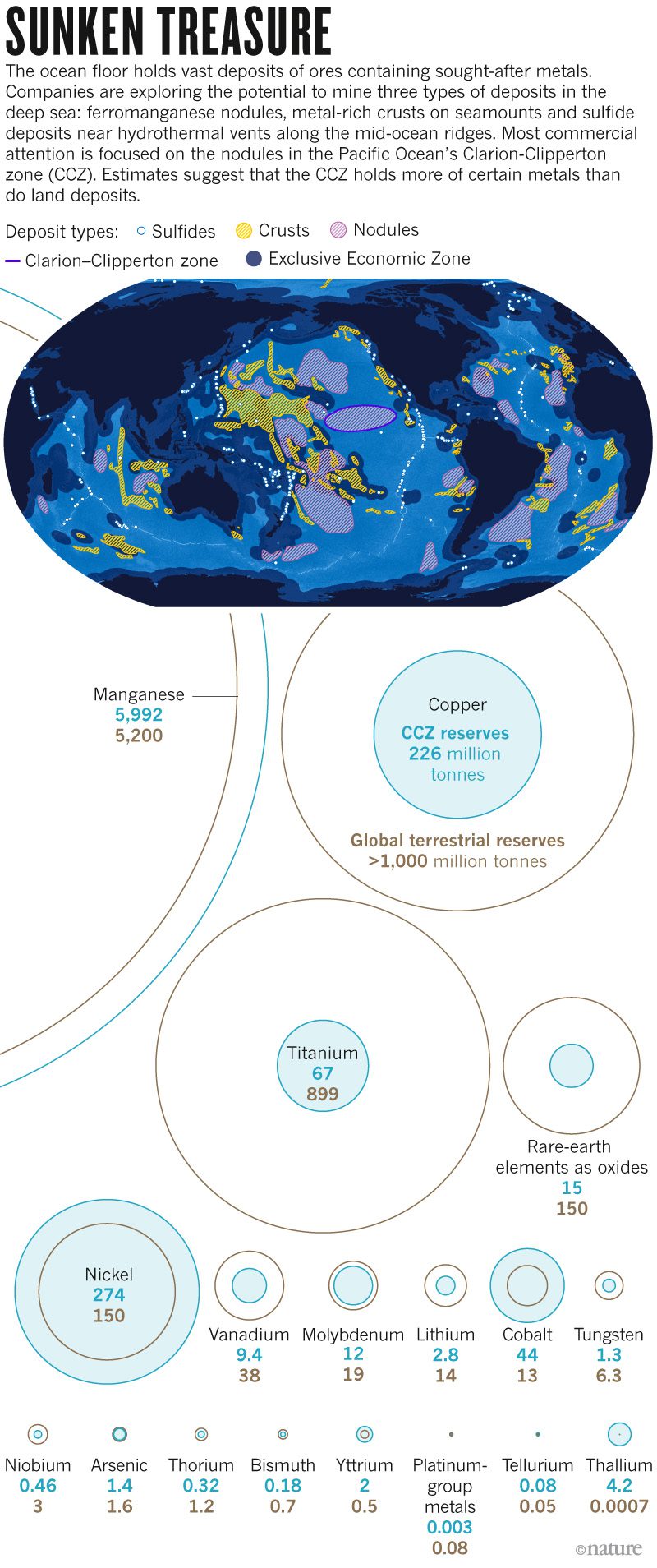
Miners have focused on three environment types to explore for potential harvesting. Abyssal plains such as the CCZ are littered with metallic nodules that form over millions of years as minerals precipitate around fish teeth, bones or other small objects. These regions are some of the quietest, most remote ecosystems on the planet, where fine sediment rains down at a rate of about one centimeter every 1,000 years. That low-energy environment is home to polychaete worms, crustaceans, sponges, sea cucumbers, starfish, brittle stars, sea urchins and various deep-sea fish, as well as countless microbial species and tiny sediment-dwelling creatures.
Another type of mineral deposit is the metal-rich crust that covers seamounts, which rise thousands of metres above the abyssal plains. These coatings are packed with high-value metals, such as cobalt, platinum and molybdenum. The seamount environment is dominated by corals, sponges and other filter feeders as well as tuna, sharks, dolphins and sea turtles.
A third form of mineral deposit that is attracting attention is massive sulfides — rich in copper, lead, zinc, gold and silver. These ores form around vents of superheated water that occur along the volcanic ridges running through ocean basins. The hydrothermal vents support creatures such as the small, blind yeti crab (Kiwa tyleri) with its characteristic blonde, furry hair, and the scaly-foot snail (Chrysomallon squamiferum), which armours its soft interior with an iron shell and is the first deep-sea animal to be declared endangered because of the threat of mining.
For years, it was assumed that the first deep-sea environment to be mined would be hydrothermal vents in Papua New Guinea’s territorial waters. Nautilus Minerals in Toronto, Canada, was pursuing that project, but financial difficulties and local opposition derailed the venture, leaving the CCZ as the most likely test bed for deep-sea mining. Estimates suggest that the nodules in that region contain more cobalt, manganese and nickel than the total of all known deposits on land (see ‘Sunken treasure’). The CCZ stretches from Hawaii to the Baja California Peninsula, and is as wide as the contiguous United States.
Read on ....
Managed & Built by I2M Consulting, LLC | © 2010-
