
Technology Roadmap Update for Generation IV Nuclear Energy Systems
Nuclear Power Industry
Date posted: 09/14/19
This report was issued in 2014 by the OECD Nuclear Energy Agency for the Generation IV International Forum. Nuclear power plants, which produce low-carbon electricity at stable and competitive costs, constitute an element of the solution to global warming and a means of delivering power to emerging and developed countries. Further development of nuclear technology is needed to meet future energy demand. The Generation IV International Forum (GIF) was created in January 2000 by 9 countries, and today has 13 members, all of which are signatories of the founding document, the GIF Charter.
GIF defined in its Technology Roadmap four goal areas to advance nuclear energy into its next,“fourth” generation (see Figure ES.1):
• sustainability;
• safety and reliability;
• economic competitiveness;
• proliferation resistance and physical protection
Figure ES.1: Generations of nuclear power: Time ranges correspond to the design and the first deployments of different generations of reactors
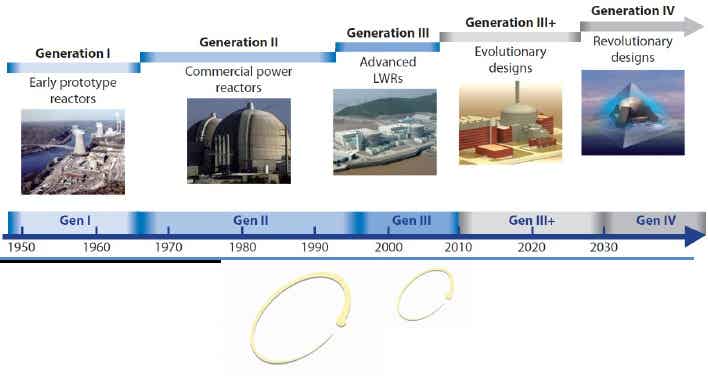 The Technology Roadmap also defined and planned the necessary R&D to achieve these goals and allow for the deployment of Generation IV energy systems after 2030. Generation IV nuclear energy systems include the nuclear reactor and its energy conversion systems, as well as the necessary fuel cycle technologies.
Closing of the nuclear fuel cycle is an important component for achieving the sustainability goal. It is based on the reprocessing and partitioning of spent nuclear fuel and the management of each fraction with the best possible strategy. Fissile material, for example, can be recovered from the spent fuel and used to make new fuel. At present, almost 95% of the spent fuel from light water reactors can be reused in the form of reprocessed uranium and MOX fuel.With advanced fuel cycles using fast-spectrum reactors and extensive recycling, it may be possible to breed fissile fuel from fertile material, and thus produce equal or more fissile material than the reactor consumes. This would also significantly reduce the footprint of deep geological repositories for the disposal of ultimate waste. The advanced separation technologies for Generation IV systems are being designed to avoid the separation of sensitive materials, and they include other features to enhance proliferation resistance and incorporate effective safeguards.
The Technology Roadmap established an understanding of the ability of various reactors to be combined in so-called symbiotic fuel cycles, for example, through combinations of thermal reactors and fast reactors to accommodate transition periods. This was one of the primary motivations for having a portfolio of Generation IV systems rather than a single system in the original Technology Roadmap, since various combinations of a few systems in the portfolio would provide a symbiotic system worldwide.In 2002, GIF selected six systems from nearly 100 concepts as Generation IV technologies:
•gas-cooled fast reactor (GFR);
•lead-cooled fast reactor (LFR);
•molten salt reactor (MSR);
•sodium-cooled fast reactor (SFR);
•supercritical-water-cooled reactor (SCWR);
•very-high-temperature reactor (VHTR).
The Technology Roadmap Update has confirmed the choice of these six systems.Timelines and research needs were developed for each system, categorized in three successive phases:
• the viability phase, when basic concepts are tested under relevant conditions and all potential technical show-stoppers are identified and resolved;
• the performance phase, when engineering-scale processes, phenomena and materials capabilities are verified and optimized under prototypical conditions;
• the demonstration phase, when detailed design is completed and licensing, construction and operation of the system are carried out, with the aim of bringing it to the commercial deployment stage.
The main objective of this Technology Roadmap Update is to focus on the most relevant developments of the six Generation IV systems selected, providing a high-level report that summarizes the achievements of the past ten years and defines R&D goals for the next decade.The original and updated timelines for each GIF system are summarized in Figure ES.2, and the main milestones for each system and methodology working group are provided in Table ES.1.The development of technologies and associated system designs to the point of commercialization for each of the six systems, as identified in the original Technology Roadmap ,would have required considerable investment and international commitment. Since the “startingpoint” and R&D funding of the different Generation IV systems were not equivalent, the degree of technical progress over the past decade has not been uniform for all systems. A number of participating countries devoted significant resources to the development of the SFR and VHTR, for example, in large part due to the considerable historical effort associated with these technologies. More limited resources were dedicated to the other systems.
Managed & Built by I2M Consulting, LLC | © 2010-
