
40 Years After Three Mile Island, Americans Split on Nuclear Power
Nuclear Power Industry
Date posted: 09/11/19
Reinhart, of Gallup, reports that the poll preceded the 40th anniversary of the March 28, 1979, TMI accident. That accident, combined with a decreasing electricity demand, effectively halted the expansion of nuclear power in the U.S., with no new plants constructed for 30 years after the partial meltdown at TMI [but there were no injuries, no radiation, and no deaths, just unfounded fear generated by the news media]. Now, many of the country's existing nuclear power stations are potentially approaching the end of their service lives and the industry faces pressure from organized opposition [by small groups and commercial environmental companies, i.e., Greenpeace, EDF, etc. all depend on membership fees] to the use of nuclear power as well as competition from cheaper energy alternatives such as natural gas. [The former is because such anti-nuclear people are ignorant of the facts about nuclear power safety, longevity, and its usefulness as a clean energy to manage climate issues].
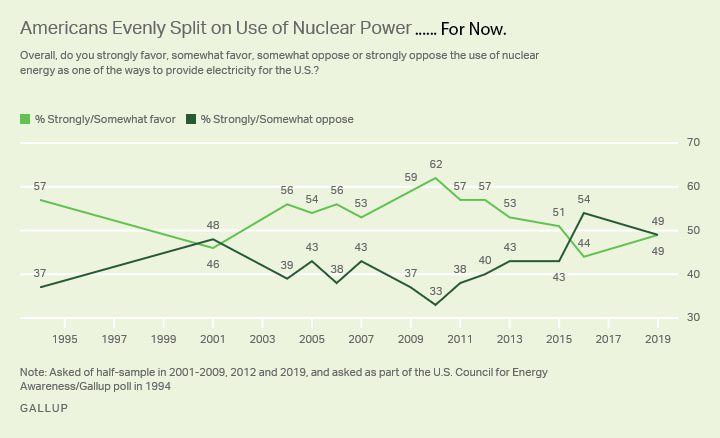
The current 49% of Americans who support nuclear power in the U.S. is a modest five percentage points higher than the 44% who said the same the last time Gallup asked about this issue in 2016. However, it is well below the record-high 62% who favored nuclear power in 2010. That high point came amid surging oil prices in the U.S. that made nuclear power a welcome alternative. Since then, increased production of domestic oil and natural gas has driven energy costs lower and Americans' support for nuclear power has subsequently trended downward -- perhaps causing the public to consider whether the risks of using nuclear power outweigh its benefits. [The "risks" are no different from any heavy industry. Any "meltdowns" have been handled at TMI and Japan without loss of life or injury (Chernobyl is not included here because that was a true disaster resulting from bad design and bad management by Soviet leaders who over-reacted in attempting to minimize the conditions by rushing first-responders to fight fires exposing about 30 people to deadly radiation in the area of reactor remains. Also, about 3,000 children contracted thyroid cancer, but about 95% were treated and recovered.]
An earlier Gallup question asked in the 1970s and 1980s found that Americans' willingness to have a nuclear power plant built within five miles of their area plummeted from 42% in 1976 to 23% in 1986, spanning both the 1979 TMI accident and the far more severe 1986 Chernobyl disaster in northern Ukraine -- one of the world's worst nuclear accidents.... [caused by the Soviet's perceived need to compete with the West and cut-corners in design to keep up.]
Republicans, College Graduates and Men Most Supportive of Nuclear Power
As with many other issues, Americans' views on the use of nuclear energy reveal a substantial partisan divide. Republicans (65%) are more likely than Democrats (42%) to favor the use of nuclear power. Republicans typically have been more supportive of nuclear energy throughout Gallup's trend dating back to 1994. Support for the use of nuclear power is higher among those with more formal education. Sixty percent of college graduates favor its use, compared with 51% of those with some college education and 37% of those with no college education. Additionally, there is a significant gender divide on the issue, with 56% of men in support of nuclear power, compared with 39% of women.
Americans Also Split on the Safety of Nuclear Power Plants
Roughly equal percentages of Americans say nuclear power plants are safe (47%) as say they are not safe (49%). This is the first time in Gallup's 10-year trend on this question that a plurality of Americans have considered nuclear power unsafe, [a clear indication that the number of ignorant people is increasing]. Even in the 2011 poll, conducted two weeks after the high-profile Fukushima Daiichi nuclear accident in Japan, a majority said they viewed nuclear power plants as safe, [Why? ... because they haven't been watching/reading the news ...?]
As with support for nuclear power in general, perceptions of the safety of nuclear power plants vary significantly by party, education and gender. Sixty-nine percent of Republicans say that nuclear power plants are safe, compared with 33% of Democrats. Thirty-eight percent of those with a high school education or less say nuclear power plants are safe, compared with 48% of those with some college education and 57% of college graduates. Nearly six in 10 men (59%) believe nuclear power plants are safe, while fewer than four in 10 women (37%) say the same.
Bottom Line
Americans' views on the use of nuclear energy to provide electricity for the U.S. have fluctuated since Gallup first measured them in 1994, seemingly in reaction to domestic energy prices. Support for nuclear power climbed as the price of oil spiked in 2010. However, Americans' interest in nuclear power since then generally has trended downward as the prices of oil and natural gas have decreased and domestic production of these energy sources has increased. In early 2016, amid a glut of domestic oil and a price plunge, support for nuclear power hit a record low in Gallup's trend.
The latest results show a modest increase in support for nuclear power, possibly in response to increased oil prices in 2019. Or perhaps some of the increase in support stems from the fact that nuclear energy generates emissions-free electricity -- 60% of Americans favor dramatically reducing the use of fossil fuels [especially coal] to reduce greenhouse gas emissions. However, despite the modest increase in support, the public remains divided in their views on the use of nuclear power in the U.S., [until the new SMR units arrive; the support will surely increase. I2M Web Portal Results on SMRs (more)].
Managed & Built by I2M Consulting, LLC | © 2010-
