

Tobiska, and 21 co-authors (2018) reported that Air safety is tied to the phenomenon of ionizing radiation from space weather, primarily from galactic cosmic rays but also from solar energetic particles. A global framework for addressing radiation issues in this environment has been constructed, but more must be done at international and national levels. Health consequences from atmospheric radiation exposure are likely to exist. In addition, severe solar radiation events may cause economic consequences in the international aviation community due to exposure limits being reached by some crew members. Impacts from a radiation environment upon avionics from high-energy particles and low-energy, thermalized neutrons are now recognized as an area of active interest. A broad community recognizes that there are a number of mitigation paths that can be taken relative to the human tissue and avionics exposure risks. These include developing active monitoring and measurement programs as well as improving scientific modeling capabilities that can eventually be turned into operations.
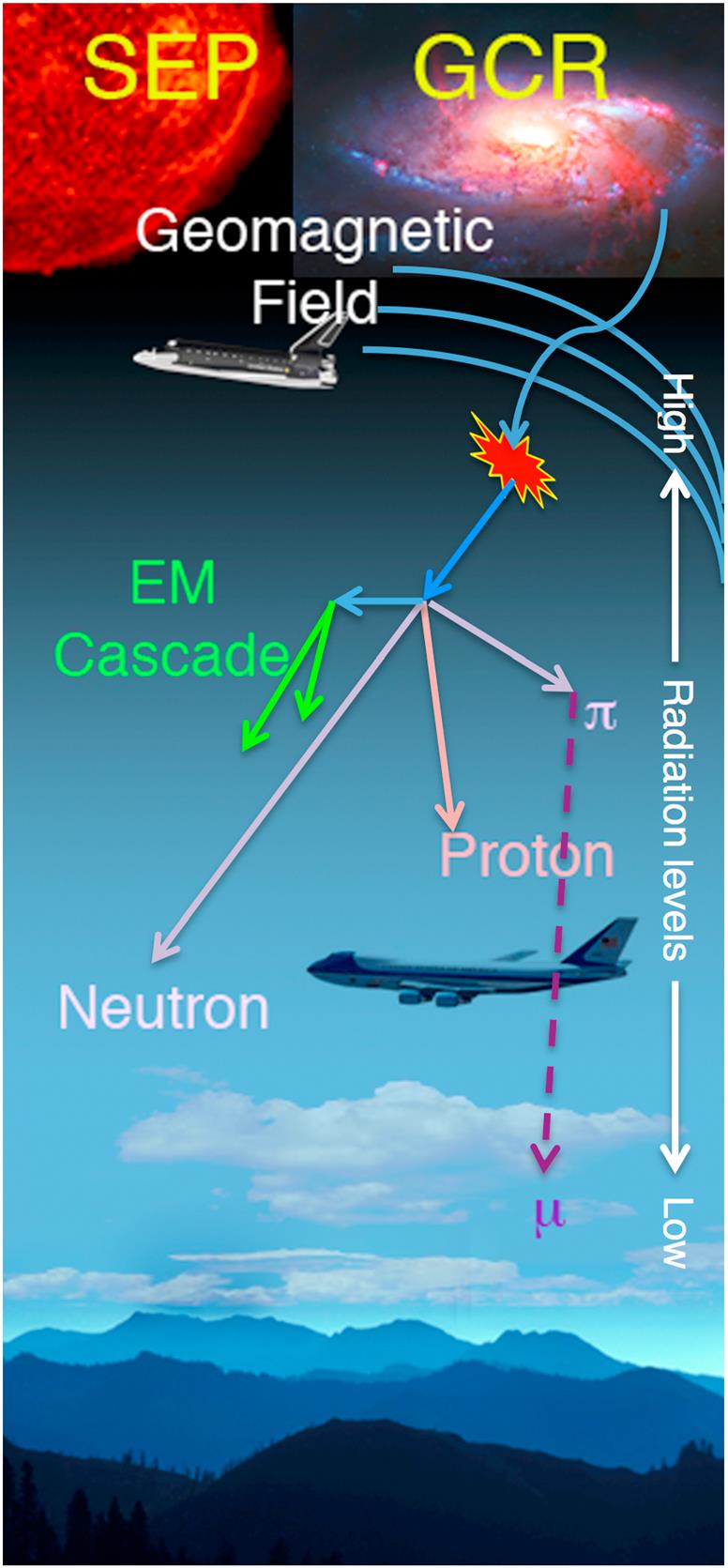
A number of roadblocks to risk mitigation still exist, such as effective pilot training programs as well as monitoring, measuring, and regulatory measures. An active international effort toward observing the weather of atmospheric radiation must occur to make progress in mitigating radiation exposure risks. Stakeholders in this process include standard-making bodies, scientific organizations, regulatory organizations, air traffic management systems, aircraft owners and operators, pilots and crew, and even the public. There are two challenges in our ever more mobile, technologically dependent global society. First, pilots, crew, and passengers, which include fetuses between their first and second trimesters, might face additional radiation hazards in terms of dose equivalent rate (rate of absorbed dose multiplied by the quality factor), particularly when flying at commercial aviation altitudes above 26,000 ft. (7924.8 m) (8 km).
Second, avionics can experience single event effects (SEEs) from both the ambient high-energy and thermal neutron environments. The source of this radiation in either case is twofold—from the continuous bombardment by primary background galactic cosmic rays (GCRs) and also from solar energetic particles (SEPs) emitted during occasional solar flare events lasting up to a few days. Galactic cosmic rays from outside the solar system consist mostly of energetic protons but also contain heavy ions such as iron. Solar energetic particles are commonly associated with solar flaring events and are dominated by protons.
Regardless of their source and depending upon their energy, these charged particles enter the Earth’s atmosphere at different magnetic latitudes and collide with atmospheric molecules. Below the top of the atmosphere (~100 km), the primary radiation decreases as a result of atmospheric absorption, while a secondary radiation component increases. This occurs because many low-energy particles are created by the initial impacts. These competing processes produce an ionizing maximum that occurs between 20 and 25 km (65,000–82,000 ft) called the Pfotzer maximum, although observational evidence may point to variable altitudes of this maximum. Below the Pfotzer maximum, down to the Earth’s surface, the particle fluxes decrease. The secondary radiation, including protons, neutrons, pions, electrons, and gamma rays, has varying energies and is emitted in all directions.
The primary and secondary energetic particles collide with atmospheric molecules, the aircraft structure, and interior materials (including passengers) to cause a further alteration of the radiation spectrum. This resulting complex spectrum of the radiation environment may potentially cause an increase in cancer risk as the dose equivalent exposure increases.
Managed & Built by I2M Consulting, LLC | © 2010-
