

With the increased level of investigation into uranium deposits in recent years, a wealth of new information has become available, which has made it possible to investigate some of the least understood aspects of uranium metallogeny. This publication defines a new classification scheme, which is simple and descriptive, but flexible enough to encompass the recent advances in our understanding of uranium geology and deposit genesis. It contains improved definition of the deposit types, supported by type examples of those deposits for which good data are available, but not well described in previous literature. Along with the descriptive information, new data on uranium resources available for each deposit type are also provided.
The IAEA expresses its gratitude to all who have contributed to this publication, either by directly providing suggestions for new types and sub-types or by providing new data to improve deposit descriptions. The classification was largely inspired by the work of the late F.J. Dahlkamp (Germany), fondly remembered as the uranium guru and who guided this work with an intense level of participation. He will be greatly missed by the uranium community. The IAEA officers responsible for this publication were M. Fairclough and H. Tulsidas of the Division of Nuclear Fuel Cycle and Waste Technology.This document is termed: IAEA-TECDOC-1842, 430 p
Background
In 2009, a working group was created by the IAEA in order to review the various existing classification schemes for uranium deposits and to propose a new or a modified classification that would be used internationally. Numerous new publications have appeared and more company data have been made available since the rise of uranium prices that began in 2005 and the ‘flurry’ of exploration work that followed. This has provided a wealth of information on uranium deposit geology that has been used to revise the previous classification dating back to 1993.
Objective
878 deposits were recorded in the IAEA uranium deposits database (UDEPO). By the end of 2015, the database had increased to 1807 deposits from which the data used in this report were supplied.
Scope
The IAEA classification presented in this volume was officially accepted in 2013. It has since been adopted in The 2014 and 2016 Red Books.This publication, after a review of the past and current classifications, presents the new classification.
Structure
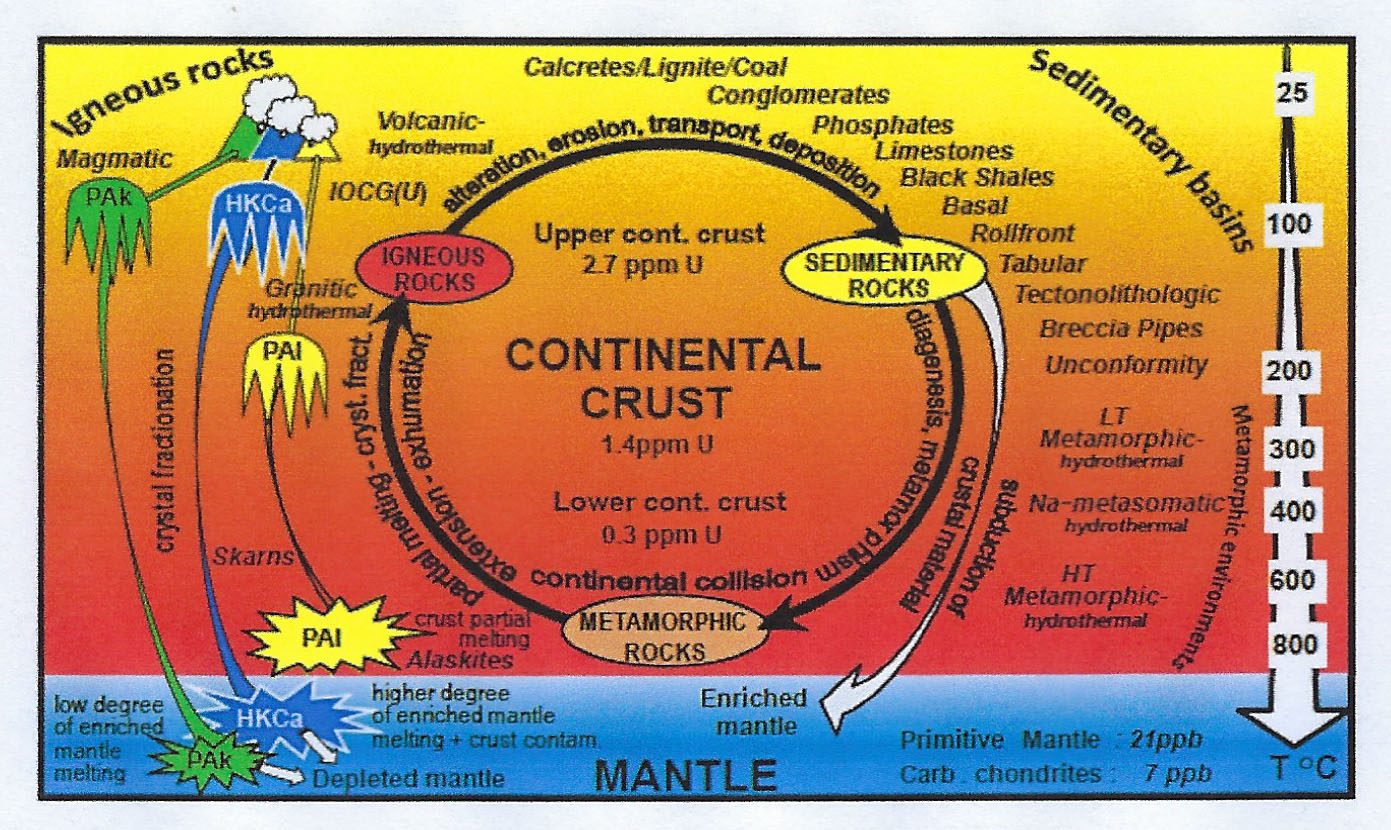
The main characteristics of the types, sub-types and classes and about 50 selected uranium deposits/districts representing all types and sub-types are described. Position of uranium deposit types with respect to the main fractionation processes along the geological cycle. The different types of uranium-rich magmas are indicated (PAk: peralkaline, HKCa: high K calc-alkaline, PAl: peraluminous).
Managed & Built by I2M Consulting, LLC | © 2010-
