

Dr. Conca reports that Rare Earth Elements, or REE, is a class of elements that have their own row in the Periodic Table, the second to last one shown in the table that begins with lanthanum and ends with lutetium. But more broadly, they fit into a class of elements known as rare metals, many not in that row, that include indium, vanadium, gallium, niobium, molybdenum, thorium and even cobalt. Rare Earths, REE, RE and rare metals are often used interchangeably in the industry. Most of these elements are not really rare since they occur in the Earth’s crust in significant amounts but, between mining, concentrating and processing, they are really difficult to separate into individual elements as needed.
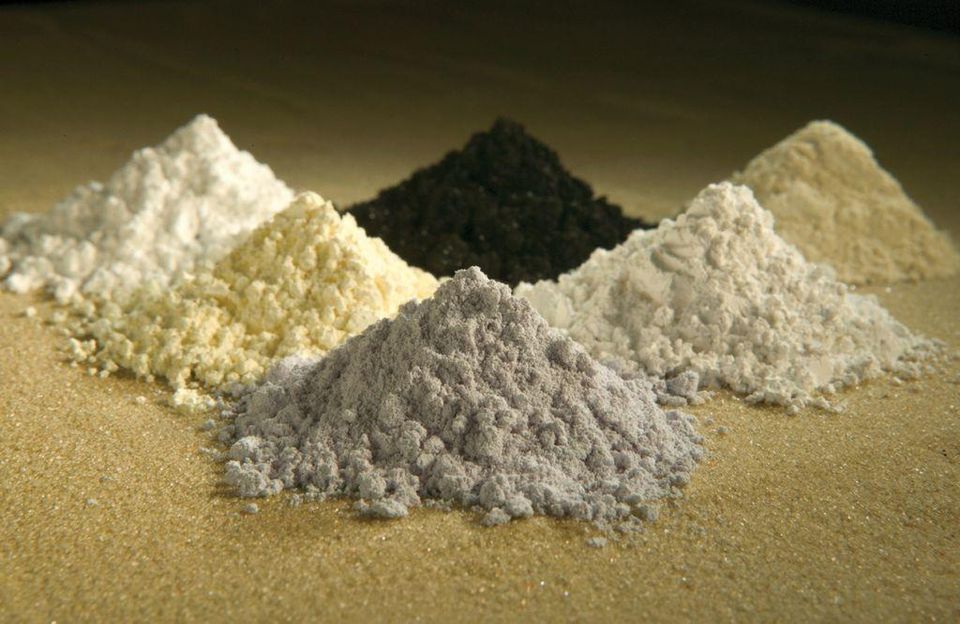 Clockwise from top center: praseodymium, cerium, lanthanum, neodymium, samarium, and gadolinium.
At present, rare earth resources have been discovered in about 35 countries and regions around the world, according to the AAPG's Energy Minerals Division's Uranium (Nuclear and REE) Committee's 2015 Mid-Year Report, pp. 36-37, with total production/year of around 200 million tons, of which nearly half are owned by China alone (more). (Disclosure, Dr. Conca is a member of the Advisory Group of this committee, p. 3 of the above UCOM report). Rare Earth Elements is separated and upgraded from their original ore, which is often associated with uranium and thorium mineralization. Many uranium mines now recover by-products of REE, vice versa (more). Thorium is often association with the uranium and REE deposits and widely available worldwide, especially in Australia (more).
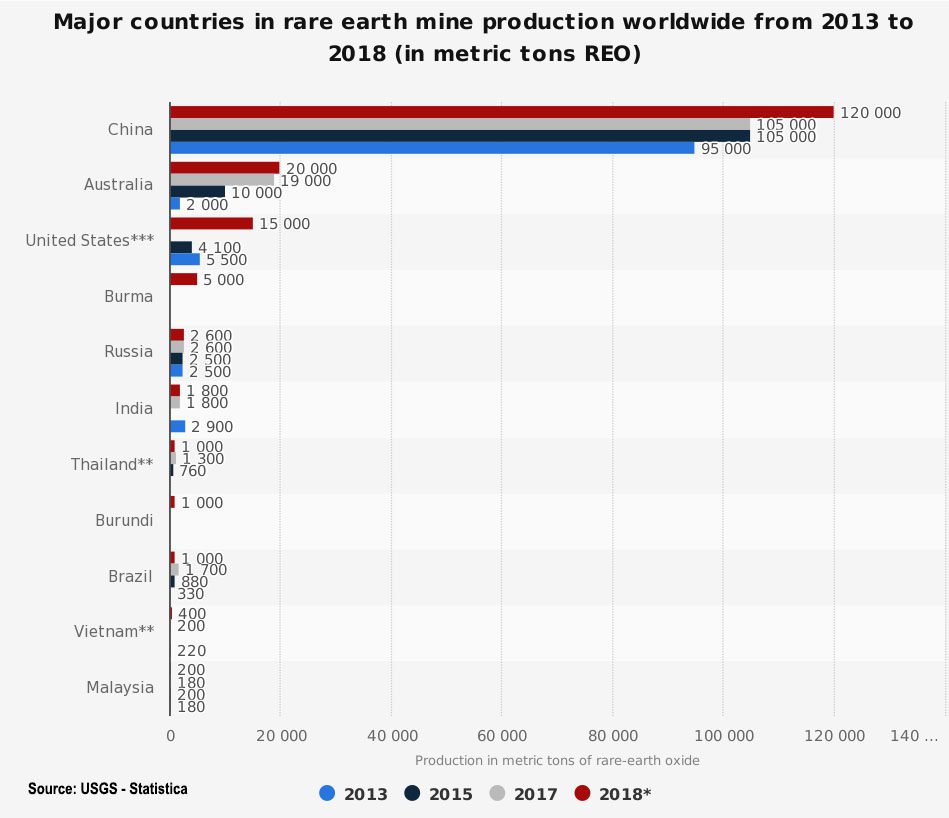
Through government subsidies and aggressive trade practices, China has completely captured the REE market, bankrupting all competitors. China produces over 80% of all REE in the world, making everyone in the modern world dependent on them to some degree. China has not only the largest proportion of the total global rare-earth resources in production on Earth, but also the most extensively developed total supply chain for rare earths. And perhaps most important of all, China has the overwhelming majority of rare earth research and development programs, implemented by the largest group of rare earth-devoted scientists and engineers on Earth. This makes President Trump’s trade war with China much more tense. Our society would grind to a halt without China’s supply. America has only one mine (The Mountain Pass Mine, once owned by Molycorp) which has only recently somehow changed from U.S. ownership. Worrisome, is that China is now a minority stakeholder in this mine located in California, and it has already been hit by the tariffs.
Another rare earth mine in the U.S. has started up in west Texas and it will produce REEs and uranium. Also,there are REEs in coal and even coal ash, and we have abundant supplies of both in the U.S., although we will not be burning it to exhaustion because of climate concerns. Work has been underway for some to determine if REE could be recovered economically. There is no reason to burn coal when it has potential reserves of REEs, but also graphene, a carbon molecule that is also material of the future.
According to Luisa Moreno, managing director of Tahuti Global, in the 2nd Quarter of 2019, “Prices of some of the critical REE elements soared from around mid-May to end of June 2019, likely as a result of the trade dispute between the United States and China.” Neodymium is now almost $54,000/ton and praseodymium is $59,000/ton (see I2M for further analysis). In contrast, stainless steel is only $2,900/ton.
Thus, Senator Marco Rubio (R-FL) recently introduced S-2093, a bill called the Rare Earth Coop 21st Century Manufacturing Act. Rubio’s bill would allow investors to form a cooperative that is exempt from antitrust laws, in an attempt to shield it from government-backed competition from China and volatile markets that destroyed this industry in America. The Commerce Secretary would grant a charter for the privately-funded coop that would be operated as dictated in the legislation. This bill is critical since the uses, applications, and demand for rare-earth elements has expanded over the years and underpin our entire electronics-driven society. Globally, most REEs are used for catalysts and magnets. In America, the majority of REEs are used for catalysts, ceramics, glass and polishing, petroleum refining, diesel additives, and magnet production for electric motors in hybrid and electric vehicles, generators in wind turbines, hard disc drives, portable electronics, microphones, and speakers (more).
Rare Earth Element production has been dominated by China for the last 20 years. The rare metals Ce, La, Ga and Nd are important in alloy making, in the production of fuel cells, Nickel-metal hydride batteries, and in the production of LCD and plasma screens, smartphone cameras, fiber optics and lasers as well as in medical imaging. Additional uses for earth elements are as tracers in medical applications, fertilizers, agriculture and water treatment. It’s difficult to find a part of our society that is not dependent on rare metals. You might say that we live in a rare metal world. So it is no wonder that most industrialized nations are stockpiling these materials.
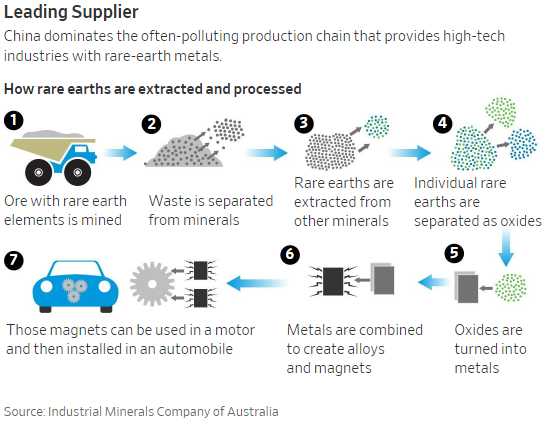
Interestingly enough, the amount of REEs required are not that much - the amount used today is only in the thousands of tons range to be refined - but in the future, it may be somewhat higher because their usefulness is exponentially expanding. The good news is that there are other REE deposits available in the U.S., Canada, and Australia, plus others around the world. It’s all a matter of the cost to develop and refine for use in industry (more). Thus, the need for legislation.
“Continued U.S. dependence on China for the mining and processing of rare earths and the manufacture of those metals into useful products is untenable—it threatens our national security, limits our economic productivity and robs working-class Americans of future opportunities for dignified work,” said Rubio. As a government-sanctioned monopoly, the Coop would be open to investment from the Defense Department and its private suppliers, according to Mr. Rubio’s staff members. The legislation allows international investors as well, subject to approval from the U.S. Committee on Foreign Investment.
So passing this bill seems a no-brainer. Which is lucky as Washington seems to have few brains left.
Original Working URL: https://www.forbes.com/sites/jamesconca/2019/08/21/marco-rubio-knows-americas-future-depends-on-rare-elements/#7345479a6088
Managed & Built by I2M Consulting, LLC | © 2010-
