

Georgia Williams reports that the U.S. Department of Commerce (DOC) is calling on other government bodies to help find domestic deposits of key resources. The move is an attempt to free the country of its dependence on foreign nations for critical metals.The announcement comes after two weeks of concerns that China will limit rare earth exports to the US in retaliation to Trump’s ever-growing list of tariffed and taxed goods. A rare-earth quota could potentially impact a number of industries that rely on the diverse group of metals to manufacture electronic and technological products.
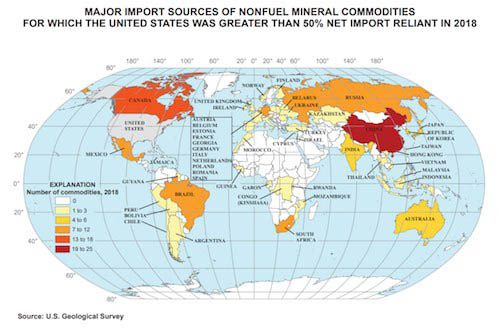
The report, titled “A Federal Strategy to Ensure a Reliable Supply of Critical Minerals,” was uploaded as an unsecured document on Tuesday (June 4) by the DOC. With six distinct calls to action, the goal, as outlined in the document, is to make America’s economy and defense more secure. It asks the Department of the Interior (DOI) to: locate domestic supplies of critical minerals; ensure access to information necessary for the study and production of these minerals; and expedite permitting for minerals projects. [Shouldn't the REE industry be doing this, without government interference (sounds like Socialism)? The government could assist industry by reviewing and removing outdated regulations and permitting requirements that has put up roadblocks to the development of these resources in the past.]
Today’s federal strategy lays out a blueprint for America to once again be a leader in the critical minerals sector,” DOI Secretary David Bernhardt said in a subsequent announcement. “As with our energy security, the Administration is dedicated to ensuring that we are never held hostage to foreign powers for the natural resources critical to our national security and economic growth.”
The US is heavily reliant on foreign imports of rare earths, uranium and a dozen other resources in order to generate electricity, provide materials to the technology and electronics sectors and more. [This has been so for decades to encourage international development and good relations]. While the DOI may be amped and ready to identify new resources and mining opportunities for the nation, David Anonychuck, managing director of M.Plan International, pointed out that it takes quite a long time to get a rare earth mining project in full swing [Government should stay the hell away from "identifying" resources, except for the U.S. Geological Survey, which is helpful to industry. Otherwise, identifying, exploration and mining is the mining industries job. Trump is pushing a Socialist agenda ...???].
“Most rare earth mining companies are at an exploration or early project stage, so it will take considerable time for industry to fully develop projects, perhaps seven to 10 years from resource estimate to project production [This delay is usually related to state and federals permitting issues, which could be fast-tracked if the government actually wanted to help industry]. The exploration phase can last two to three years,” he said to the Investing News Network. “The project study phase for mineral resource through to feasibility study can take five to seven years or more, with environmental permitting and social push-back often the longest path. Project construction is about two years to get to commissioning.” When you add it all together, it could take the U.S. as long as 20 years to build a reliable, steady supply of rare earths. However, the announcement could entice explorers and mining companies to start the long process.
“The investment community will be taking a new look at rare earth junior mining companies and projects. That is the upside given the U.S./China trade dispute and recent media attention on rare earths,” said Anonychuck. “Exploration programs should pick up; however, (companies) will need to secure new funding given the renewed interest.” In addition to offering support and fast tracking for permits for the mining sector, the U.S. will also look to other methods of recovery to bolster its resource stocks.
“Alternatives, such as recycling, processing mine waste, extraction from seawater, or even filtering them from energy byproducts, could [as in the past] prove valuable sources for critical minerals,” states the report. There is also a “Buy American” caveat that would see all U.S. departments that use natural resources only source domestically produced minerals and metals, [which is nothing new. This mantra has been around for 50 years. Recycling and product replacement all depend on the economics, and always have].
Managed & Built by I2M Consulting, LLC | © 2010-
