
Research on Feasibility of Recovering REE from Coal
Rare Earth Deposits & Mining
Date posted: 06/05/19
The Department of Energy (DOE) and the National Energy Technology Laboratory’s (NETL) Feasibility of Recovering Rare Earth Elements program is currently focused on developing extraction, separation and recovery technologies for the production of rare earth elements (REEs) and critical materials (CMs) from coal and coal-based resources. This RD&D program consists of developing process and production technologies, environmental management, and field materials sampling and characterization, along with systems integration, optimization and efficiency improvements to produce REEs and CMs from coal and coal by-products streams, such as coal and coal refuse, clay/sandstone over/under-burden coal seam materials, power generation ash and aqueous effluents as acid mine drainage (AMD) sludge.
Our Nation’s vast coal reserves contain quantities of REEs that offer the potential to reduce our dependence on others for these critical materials and to create new industries in regions where coal plays an important economic role. The DOE-NETL REE-CM program offers a pathway to improve the economics and reduce the environmental impact of a domestic coal-based value chain. The development of an economically competitive supply of REEs and CMs will assist in securing and maintaining our Nation’s economic growth and National Security.
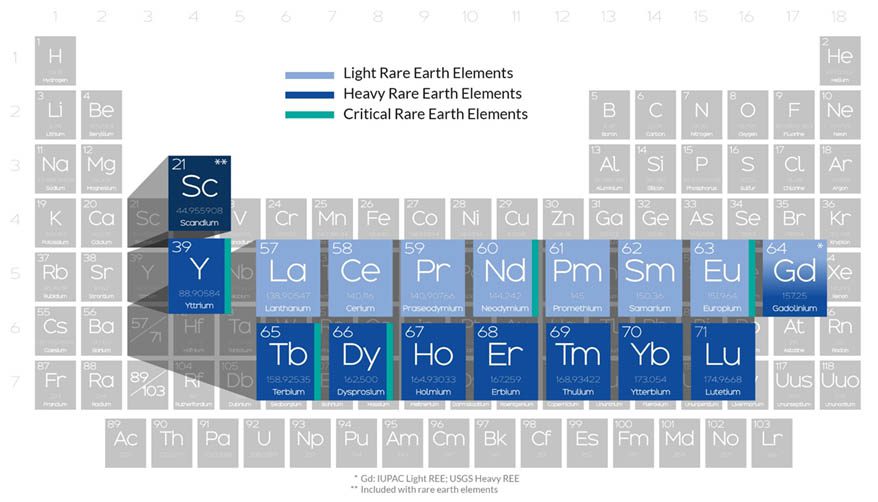 Rare-Earth Elements - The Lanthanide Series Including Scandium and Yttrium​​​​​
Rare earth elements are part of the lanthanide series of elements that are essential materials in a broad range of technologies that are significant to domestic and national security, energy, and daily consumer products. REEs include lanthanum (La), cerium (Ce), praseodymium (Pr)m neodymium (Nd), promethium (Pm), samarium (Sm), europium (Eu), gadolinium (Gd), terbium (Tb), dysprosium (Dy), holmium (Ho), erbium (Er), thulium (Th), yterrbium (Yb), lutetium (Lu), and the transition elements scandium (Sc) and yttrium (Y).
REEs typically occur at low concentrations throughout the earth’s crust. REEs are not found in an isolated form readily available for extraction, but are distributed throughout a variety of minerals, and are also found in coal-based resources. REE-bearing mineral deposits are relatively rich in either light rare earth elements (LREEs) or heavy rare earth elements (HREEs), with LREEs being more abundant.
The critical REEs (CREEs) are those deemed as being a potential supply risk and are highly important to future United States clean energy technologies. REEs are important elements used in high technology products, such as catalysts, cell phones, computer hard drives, hybrid engines, lasers, magnets, batteries, medical devices, televisions, and other applications.
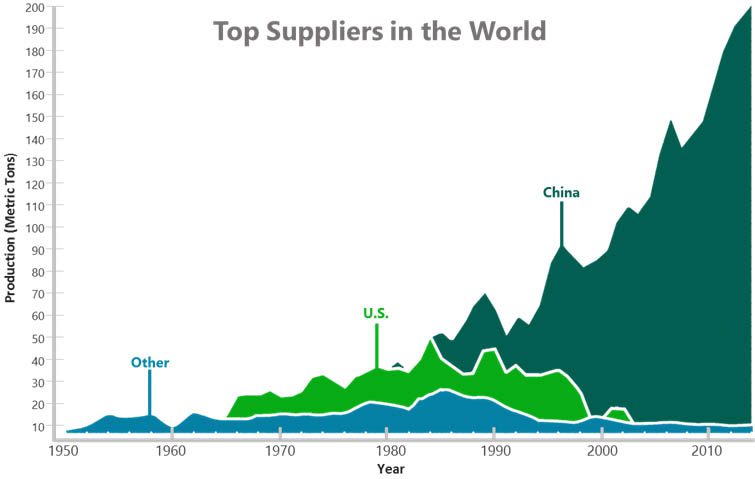 Major International REE Suppliers​​​​​
China has been the dominant supplier of REEs since 1988, providing 95 percent of the global REE market in 2011. As recently as 2011, decisions by China to restrict exports and favor its own domestic industries resulted in REE price volatility. Consequently, rising concern among industrialized nations has driven a resurgence of global interest in REE mineral exploration and extraction, and related research on supply, demand, utilization, recycling, reuse, and substitution. Several new commercial REE projects are in various stages of planning and development, and are focused on diversifying supply. In contrast, new efforts to purify and refine REEs are limited.
Significant Sources
Coal refuse, power generation ash, ash ponds, and acid mine drainage sludge have received attention for the potential economic value that these materials may have based on contained REEs. Certain coal and coal by-products have elevated concentrations of HREEs - which are lowest in supply, rank high in criticality and price, and are projected to increase in demand - making them attractive targets for REE recovery despite their low concentration. Basket price can be used as a rough tool to compare the compositional distribution of REE-bearing ores based on the current relative value of each element or oxide as a pure or nearly 100 percent pure commodity. The REE distributions found in coal and coal by-products can exhibit a compositional distribution that could command a higher basket price than some of the more conventional or well-recognized REE ores.
Reserve Estimates
An initial assessment of the amount of REES that is likely to be found in coal deposits and associated mineral matter was performed by DOE-NETL in 2014-2015. These estimates indicated that approximately 6 million MTs of REEs could potentially be recovered from known coal reserves in select western state coal basins in Montana, Wyoming, Colorado, Utah, New Mexico and Arizona. Similar estimates indicated that nearly 5 million MTs were potentially available among the coal deposits found in Pennsylvania, West Virginia, Kentucky and Virginia. In addition, separate estimates were made for the total tonnage of REEs that might be available in coal ash and coal mine refuse, and these estimates suggested several additional million MTs of REEs could be found in these sources as well. The actual amounts that can be recovered would ultimately be a function of mining practices, the ease of extraction of REEs from the base feedstock material, and the overall process economics.
Recovery Opportunities
Long-term opportunities to economically recover REEs from coal and coal-based resources depend not only on RD&D that is focused on near-term technical and economic feasibility success, but also on leveraging the knowledge gained to develop novel recovery concepts that are applicable to low REE concentration feedstock materials. These new processes and systems must incorporate steps to recover, separate, and refine REEs without generating additional unwanted products. These advances may facilitate recovery of REEs from large volumes of fly ash and bottom ash, as well as other low REE-containing materials as acid mine drainage effluents and/or sludges. Moreover, co-production of REEs with other useful materials that are present in coal-based resources offers the potential to further enhance the economic viability of REE recovery. The following schematic illustrates the coal value chain as it relates to opportunities to recover REEs.
Historical Perspective
In 2009, interest in strategic materials intensified culminating in discussions regarding our Nation’s ability to secure reliable supplies of rare earth metals and other strategic materials. Strategic materials were identified as critical for growing the U.S. green energy and electronics industry, as well as for specialty military applications. In 2010, the DOE released the first Critical Materials Strategy and NETL initiated as small effort to explore the concept of extracting rare earth elements from coal and coal by-products. Congress has since recognized the importance of this resource to the U.S. economic security and appropriated funding in FY2014 to identify the magnitude of the resource, develop capabilities to economically recover rare earth metals in an environmentally responsible manner, and provide an additional domestic, secure, and reliable resource for future advanced domestic industries.
In 2014, NETL further expanded its efforts to assess the potential resource base for REEs contained within coal resources and coal by-product waste streams from coal cleaning operations and power plants - post combustion fly ash and bottom ash. Initial research identified potential ‘hot spots’ in select coal seams for REEs, and confirmed that the quantity of these elements varied depending on geology, location, and other factors that were not well understand at that time. Efforts to explore the available technology for extracting these vital elements were undertaken leading to the conclusion that additional research and technology development would be needed to convert this resource into a viable domestic commodity - and thus, the beginning of DOE-NETL’s Feasibility of Recovering Rare Earth Elements program [1] .
Performance of the assessment and analysis of the feasibility of economically recovering REEs from coal and coal by-products continued in 2015 [2]. In 2016-2018, Congress directed the DOE-NETL REE program to expand its external agency activities to develop and test commercially viable advanced separation technologies at proof-of-concept or pilot-scale that can be deployed near-term for the extraction and recovery of rare earth elements and minerals from U.S. coal and coal by-product sources having the highest potential for success.
Managed & Built by I2M Consulting, LLC | © 2010-
