

The Jacinth-Ambrosia mine produced a zircon-rich mineral deposit located 200 km north-west of Ceduna in the Eucla Basin. The mine was discovered by Iluka in 2004. Within four years, Iluka received several key approvals for establishing a mineral sands mining operation in the Jacinth-Ambrosia mine. The A$420 million project began production on 19 November 2009, ahead of schedule. The project’s main pipeline and test pit were completed in April 2009. Construction cost approximately A$390 m, below the budgeted A$420 m. The mine will produce seven million tons of heavy minerals concentrate in its lifetime of over ten years. Annually, the mine has the capacity to produce nearly 300,000t of zircon, 30,000 t of rutile and 150,000t of ilmenite. The project was officially opened on 10 February 2010.
Jacinth-Ambrosia Reserves
The mineral sands deposit contains an estimated 9.5 million tons of heavy minerals with a grade of 6.5%. On average, the heavy minerals assemblage in the deposits is 48% zircon, 28% ilmenite and 4% rutile. The percentage of zircon assemblage in the deposits represents ten times the global average. The Jacinth-Ambrosia mineral sands deposit lies in the tertiary age sediments of the Eucla Basin. Ranging between 20 m to 400 m in thickness, the tertiary sediments are found in the south-western part of South Australia’s marine and terrestrial settings. The south part of the basin covers an area of 41,000 km².
“The Jacinth-Ambrosia mine is a zircon-rich mineral deposit located 200 km north-west of Ceduna in the Eucla Basin.” The minerals are extracted gradually using dry-mining techniques. A wet concentrator plant, available on-site, is used to screen and process the ore. Throughput is between 1,000 t an hour of sand feed and 120 t of heavy mineral concentrate (HMC). The heavy minerals are transported 270 km by road to the port of Thevenard. On average, the mine’s B-Triple 96 t trucks make 18 trips a day. After transporting to the port, the concentrate is shipped to the Port of Geraldton for further processing at the Iluka’s Narngulu mineral processing facility.
Jacinth-Ambrosia Operations
The A$25 m haul road has been constructed for transporting the minerals. The road work started in the fourth quarter of 2008. The unsealed haul road extends approximately 100 km from the mine to the Ooldea Road. The road further extends 80 km to Eyre Highway. A section of the Ooldea Road was upgraded. To connect the Ooldea Road to the Eyre Highway, a new section stretching 40 km was constructed. Before HMC hauling operations, the road forms a T-shape intersection with the Eyre Highway.
The road includes 3.3m-wide lanes, 2.3 m of shoulders and an additional 0.5 m of rounding. It is designed to support a maximum speed of 110 km/h. The road corridors are 60 m wide with extensions made at locations where borrow pits, water extraction and road intersections need to be accommodated. The project required approximately 120 borrow pits spaced 5 km to 10 km from the haul road corridor.
The road has been constructed following a similar method used for the rural mine haul roads in South Australia.“ To achieve the perfect vertical alignment, a large part of the earthworks involved cutting and filling along the alignment. Following earthworks, sub-grade material was applied in layers. The sub-grade was cut, watered and compacted using a roller. A dust suppressant additive that is soluble in water was used to treat the road. To provide the perfect level of moisture content for compaction, water was sourced from the bore-fields and bores near Colona station and transported to the road construction site.
The road was constructed in three stages. In stage one, the unsealed road was laid to support construction traffic till the mine was completed. It was then used as a haul road for HMC. In stage two, the performance of the road was monitored. Aspects such as pavement and drainage performance, maintenance requirements and the amount of dust generation were monitored. Based on the performance evaluation of the road in stage two, the road design was refined in stage three. Care was taken to ensure that the road has effective drainage, the pavement is strong enough to support HMC haulage and the dust is controlled. The road was completed at the end of 2009.
The Australian Matting Company (AMCO) provided innovative matting and anti-fatigue mats, steel stair treads, steel stair nosings and cleats suitable for industrial workplaces and environments with strict safety and hygiene standards.
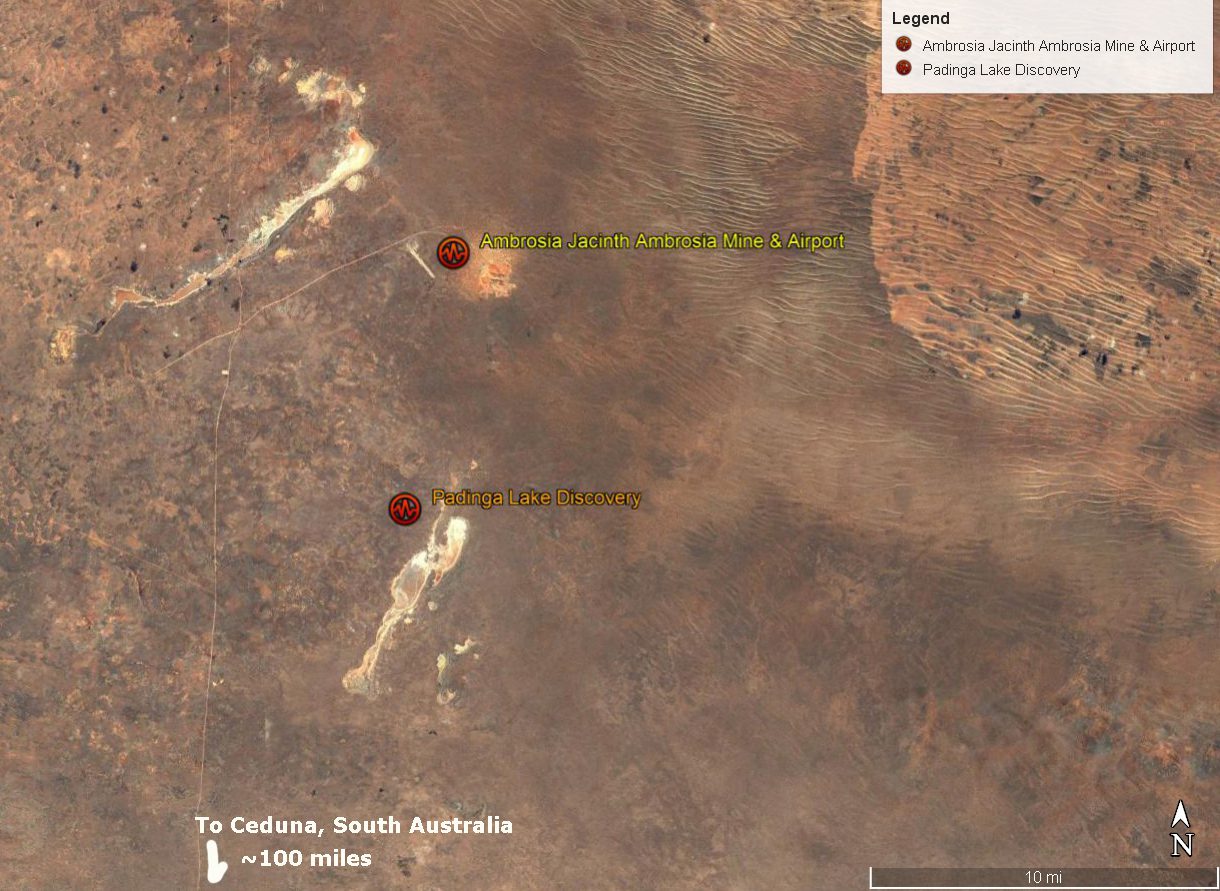
Interesting Note: This deposit was developed within a few miles of where in 1969 Mr. Campbell discovered very high radioactivity and a light-green radium mineral in the nearby Pidinga dry lake beds. See (here). Google Earth locations of mine and discovery (more).
Original working URL: https://www.mining-technology.com/projects/jacinth-ambrosia/
Managed & Built by I2M Consulting, LLC | © 2010-
