


Hodgson reported in early September 2026 that a report forecasts that Russia-controlled mines will supply a greater proportion of an already tight market by 2040. Analysts have forecast a growing supply deficit over the next decade for uranium, which is mined predominantly in Kazakhstan, Australia, Namibia and Canada.

Russia could control more than a third of mined uranium supply by 2040, a dominance that would compromise western energy security as demand from new nuclear power plants soars, researchers have warned. Supply fears are compounded by an existing deficit because of limited investment appetite and permitting delays to new mines.
At the same time, Russian and Russian-owned uranium mining capacity will keep growing, the Centre for Strategic Advantage (CSA) non-profit said in its inaugural report. That sets up greater dependency on a country that has demonstrated its willingness to weaponise its control over energy supplies, and risks Europe and other nations being unable to secure the material they need, it warned.
“By 2040, we could be looking at a dependency on Russian-mined uranium akin to our reliance on Russian oil and gas in 2022,” said Gareth Heywood, special project lead at the centre, ahead of the annual World Nuclear Symposium taking place in London.
Uranium, a silvery-grey radioactive element, is mined predominantly in Kazakhstan, Australia, Namibia and Canada. But mining analysts have forecast a growing supply deficit over the next decade, after years of low uranium prices saw mines shuttered and exploration spending fall to a fraction of the levels seen before the Fukushima meltdown. By the middle of next decade,
... “there is no question that the sector will need new supply”, said Alex Bedwany, analyst at Stifel. Countries including Canada had the potential to bring more mines online, but “these things carry significant development risks, and it appears the market is quite reliant on them”, he said.

Canada-based NexGen Energy is developing a huge project in Saskatchewan, while miner Cameco is licensed to expand its McArthur River mine by more than a third to 25 million pounds a year, or 11,340 tonnes. The question facing the industry is whether there is:
...“enough resilience and flex in the system”, said Sarah Forman, head of strategy at uranium enrichment specialist Urenco. “It takes a long time to build new mines,” she said. “What you’re looking for is for governments to send a clear signal that nuclear is going to be part of our energy mix for a long time, [to say] ‘industry, you can put capital into this’.”
Russia produced about 5 per cent of the world’s mined uranium in 2024. But its domestic production masks the nation’s much greater international operations: when accounting for Russian-controlled mines overseas, its share of global production capacity across the world’s major uranium sources was almost a quarter in 2024, the centre found.
A subsidiary of state-owned nuclear company Rosatom, Uranium One, controls about 10,000 tonnes a year of uranium mining capacity outside Russia’s borders, in Kazakhstan. The CSA said that if all countries went ahead with their existing, committed, planned and prospective production, and mined each asset at full capacity, Moscow’s share would rise from almost a quarter to 36 per cent by 2040.
Russia is developing mines in Tanzania and Namibia via Uranium One. Moscow also signed an agreement with Niger last year to boost co-operation over uranium. French nuclear group Orano was in effect expelled from Niger last year and has launched legal proceedings over the expropriation of its assets. In addition to domestic production, Russian companies control uranium assets in central Asia and Africa
Exxisting and future uranium mines with Russian involvment:
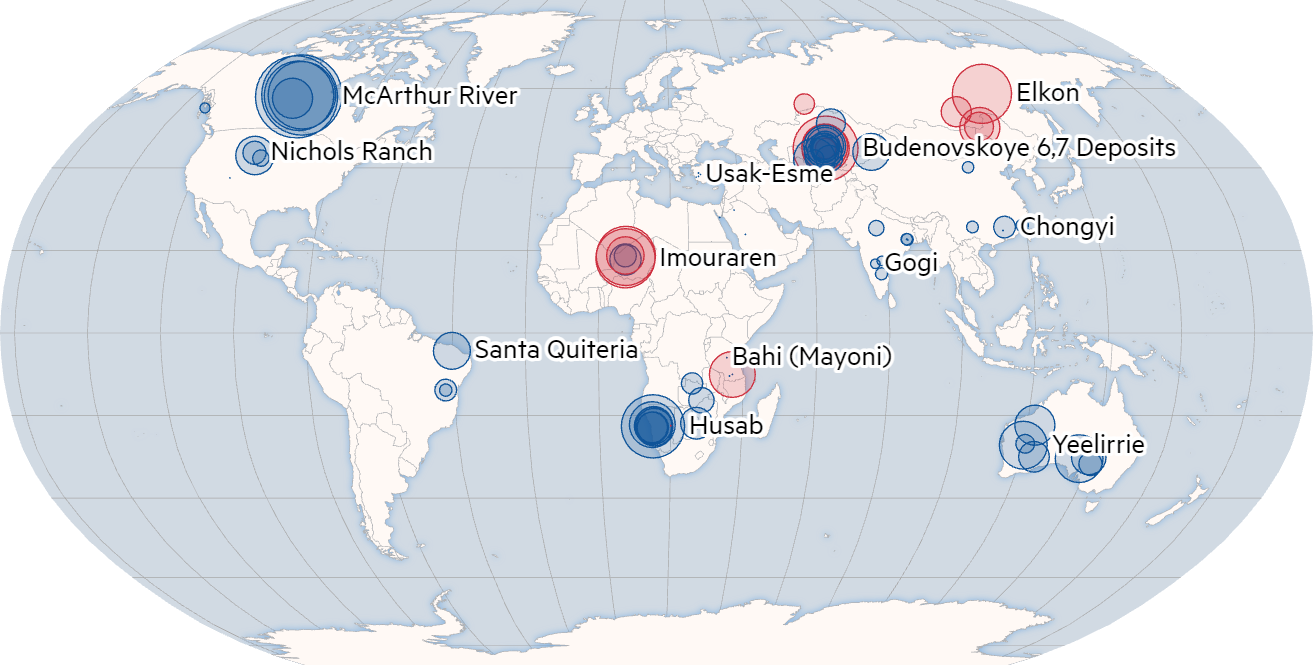 Source: OECD via Centre for Strategic Advantage • *Nigerien mines formally operated by
Orano that were seized. †Mine capacity unavailable if the facility does not yet report it to the OECD.
Western nations have moved to impose sanctions on an array of Russian businesses since the full-scale invasion of Ukraine in 2022. The UK, US, Canada, Japan and France have also stated their intention to counter Russia’s dominance in the nuclear supply chain, and invested in the crucial processing of uranium — though the nation remains a major supplier to Europe of the enriched uranium needed for reactors.
The US has banned Russian uranium imports, though waivers have allowed them to continue until 2028. Higher uranium prices, a recent legal change in Kazakhstan and international action taken to prevent Russia from exploiting assets in Africa could push its share of global production down to about 14 per cent, the CSA said. That could mean, for example, bans on Russian uranium sourced in Niger, Namibia and Tanzania. The planned legal change in Kazakhstan is expected to increase the host country’s share of what is mined domestically. UxC’s long-term price forecast rose from $80 per pound a year ago to $94 per pound in its latest assessment.
“Whether we have reached a true long-term incentive price [for new mines] remains unclear,” said UxC president Jonathan Hinze, adding that he expected prices to keep rising.
The centre recommended that policymakers in OECD nations promote investment in new mines by subsidising long-term contracts between producers and utilities to lock in prices for producers.
[The U prices are beginning to rise .... (more) and (more)].
Managed & Built by I2M Consulting, LLC | © 2010-
