


Luo and 6 co-authors reported in 2007 that A microcosm study was performed to investigate the effect of ethanol and acetate on uranium(VI) biological reduction and microbial community changes under various geochemical conditions.
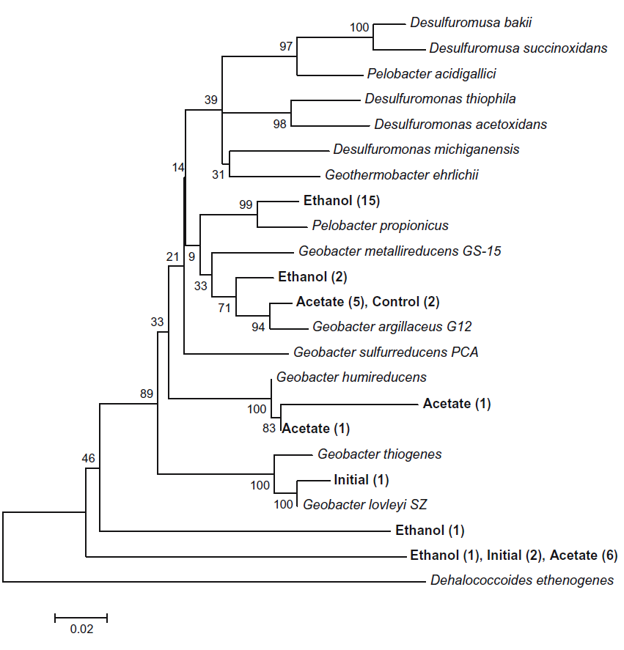 In the graphic above, the phylogenetic affiliation of Geobacteraceae clones taken from samples were removed on day 7 from microcosms with low-sulfate concentrations (S1C1 and S1C2). Reference sequences were downloaded from the Ribosomal Databases Project II. The sequences from this study (in bold font) are indicated by the treatment. Dehalococcoides ethenogenes was used as the outgroup of the tree. The numbers of clones are indicated in the parentheses
Each microcosm contained an uranium-contaminated sediment (up to 2.8 g U/kg) suspended in buffer with bicarbonate at concentrations of either 1 or 40 mM and sulfate at either 1.1 or 3.2 mM.
Ethanol or acetate was used as an electron donor. Results indicate that ethanol yielded in significantly higher U(VI) reduction rates than acetate. A low bicarbonate concentration (1 mM) was favored for U(VI) bioreduction to occur in sediments, but high concentrations of bicarbonate (40 mM) and sulfate (3.2 mM) decreased the reduction rates of U(VI).
Microbial communities were dominated by species from the Geothrix genus and Proteobacteria phylum in all microcosms.
However, species in the Geobacteraceae family capable of reducing U(VI) were significantly enriched by ethanol and acetate in low-bicarbonate buffer. Ethanol increased the population of unclassified Desulfuromonales,
while acetate increased the population of Desulfovibrio.
Additionally, species in the Geobacteraceae family were not enriched in high-bicarbonate buffer, but the Geothrix and the unclassified Betaproteobacteria species were enriched. This study concludes that ethanol could be a better electron donor than acetate for reducing U(VI) under given experimental conditions, and electron donor and groundwater geochemistry alter microbial communities responsible for U(VI) reduction.
Managed & Built by I2M Consulting, LLC | © 2010-
