
Hower and 4 co-authors reported in 2023 that coal is increasingly evaluated as a source of rare earth elements (REEs) in the United States to address the overreliance on imported REEs. The objective of this study was to assess the distribution of REEs in lignites from selected mining areas in the Texas Gulf Coastal Plain region.
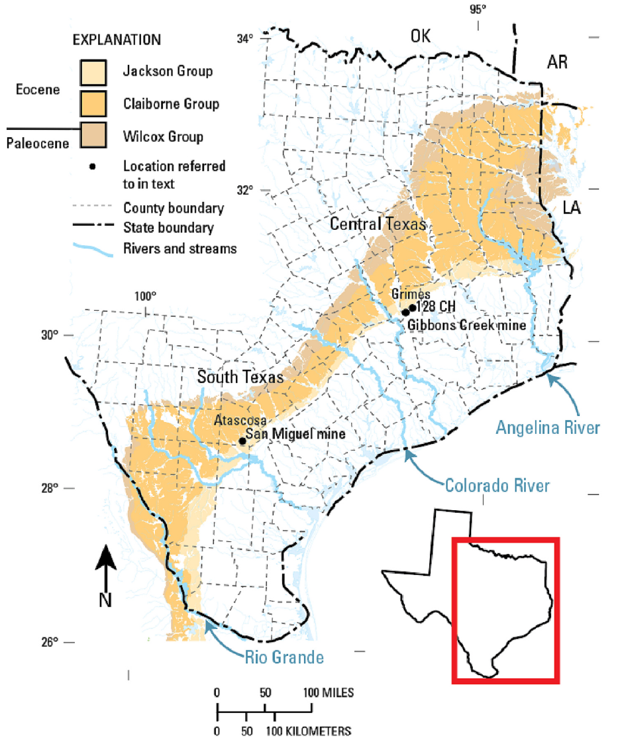
Outcrop distribution of Paleocene to Eocene lignite-bearing rocks in Texas is illustrtared in the above figure. Counties referred to in Table 1 are labelled. Central Texas is the region between the Angelina and Colorado Rivers. South Texas is the region between the Rio Grande and the Colorado River. Index map shows area of Texas considered in figure. Modified from Warwick et al. (1997) and Hook et al. (2011).
Thirty-one archived lignite and rock samples previously collected by the U.S. Geological Survey were analyzed for their rare earth element and critical mineral content. These include samples from one core (5400 and 5500 lignite horizons) and two opencast lignite mines (Gibbons Creek 3500 and 4500 horizons, and San Miguel horizons A to D) in the Eocene Jackson Group of the Texas Gulf of Mexico Coastal Plain. Some lithologies in the Gibbons Creek 3500 and 4500 lignite-bearing sections have high total rare earth, yttrium (Y), and scandium (Sc) (REYSc) values, up to 7,800 ppm (ash basis) REYSc.
The lignite lithologies show an enrichment in rare earths, [samarium (Sm) through gadolinium (Gd)]. The basal Gibbons Creek 3500 lignite bench shows a heavy rare earth element enrichment pattern resembling that often seen in peats through high volatile A bituminous coals. The 5500 lignite sequence, overlying the latter lignite sections, shows a light rare earth enrichment. The San Miguel lignite benches have heavy rare earth enrichments with a negative europium (Eu) anomaly.
Managed & Built by I2M Consulting, LLC | © 2010-