
Wang and two co-authors conducted laboratory experiments in 2015 to investigate isotopic fractionations during oxidation of tetravalent uranium, U(IV), by dissolved oxygen. In hydrochloric acid media with the U(IV) dissolved, the d238U value of the remaining U(IV) increased as the extent of oxidation increased.
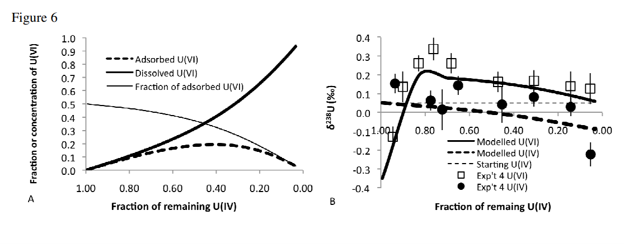 The above figure illustrates the results of the adsorption mass balance modeling by the authors. Oxidation kinetics are modeled to confirm their Experiment 3. For convenience, the starting U(IV) concentration was arbitrarily set to be 1 (dimensionless), so that the fraction of remaining U(IV) and U(VI) concentrations share the same y-axis. See Supplementary Information for modeling details.
The d238U value of the product U(VI) paralleled, but was offset to1.1 ± 0.2‰ lower than the remaining U(IV). In contrast, oxidation of solid U(IV) by dissolved oxygen in 20 mM NaHCO3 solution at pH = 9.4 caused only a weak fractionation (0.1‰ to 0.3‰), with d238U being higher in the dissolved U(VI) relative to the solid U(IV).
The authors suggested that isotope fractionation during oxidation of solid U(IV) is inhibited by a “rind effect”,
where the surface layer of the solid U(IV) must be completely oxidized before the next layer is exposed to oxidant. The necessity of complete conversion of each layer results in minimal isotopic effect. The weak shift in d238U of U(VI) is attributed to adsorption of part of the product U(VI) to the solid U(IV) surfaces.
[Note: In the authors' introduction of this paper, they made a blatantly biased statement claiming falsely that uranium mining, even if surface mining, has cause groundwater contamination by their conflating the use of depleted uranium (DU) and its possible health effects with the general mining of uranium. The statement casts serious doubts on their objectivity. They should be reprimanded!]
Managed & Built by I2M Consulting, LLC | © 2010-