

Szabó reported in mid-2025 that deep-sea mining presents a critical sustainability paradox; it offers access to essential minerals for the technologies of the green transition (e.g., batteries, wind turbines, electric vehicles) yet threatens fragile marine ecosystems.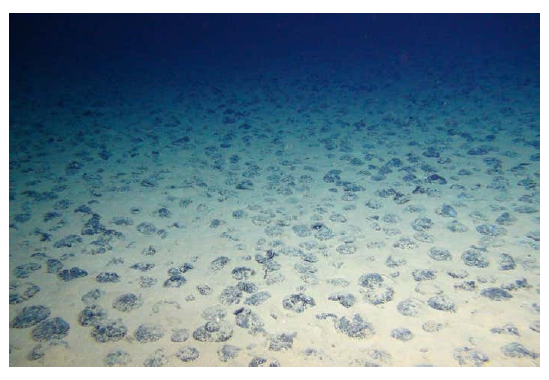
Figure 10 in the paper shows manganese nodules on the seafloor in the CCZ in a 2015 expedition with anROV KIEL 6000 (GEOMAR—Helmholtz Centre for Ocean Research Kiel, Kiel, Germany) remotely operated vehicle [140].
As the terrestrial sources of these materials face mounting geopolitical, environmental, and ethical constraints, undersea depositsare increasingly being viewed as alternatives. However, the extraction technologies remain unproven at large scales, posing risks related to biodiversity loss, sediment disruption, and altered oceanic carbon cycles.
The author explores how deep-sea mining might be reconciled with sustainable development, arguing that its viability hinges on addressing five interdependent challenges—technological readiness, environmental protection, economic feasibility, robust governance, and social acceptability. Progress requires parallel advancements across all domains.
The author also reviews the current knowledge of deep-sea resources and extraction methods, analyzes the ecological and sociopolitical risks, and proposes systemic solutions, including the implementation of stringent regulatory frameworks, technological innovation, responsible terrestrial sourcing, and circular economy strategies. A precautionary and integrated approach is emphasized to ensure that the securing of critical minerals does not compromise marine ecosystem health or long-term sustainability objectives.
[Related articles: (here)].
Managed & Built by I2M Consulting, LLC | © 2010-
