

Mwetulundila and Atangana reported in early 2025 on the implications of in-situ leach (ISL) mining for uranium in the Auob aquifer of the Stampriet Transboundary Aquifer System (STAS). A mathematical model accounting for complex real-world processes, including heterogeneity, borehole interactions, and the dynamics of the leaching process was derived to simulate groundwater abstraction and injection in a confined aquifer.
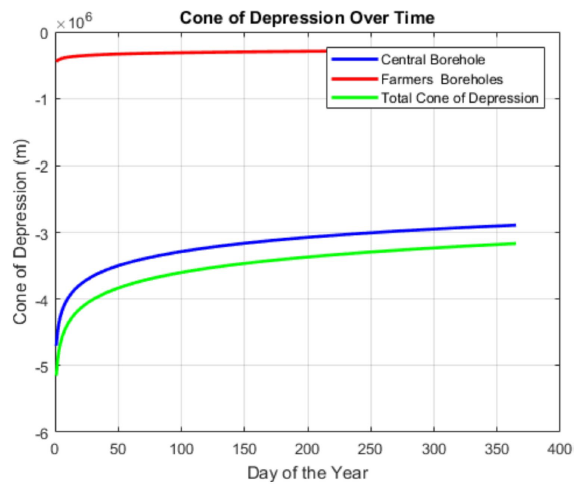 Simulation of the cones of depressions generated during
the ISL mining and agricultural irrigations
Extensive model analyses were performed, including sensitivity analysis of storativity and transmissivity, contributions of individual boreholes, and asymptotic behaviour of the system in early and late time. Simulations were conducted, including the radius of influence, mass balance, and flow dynamics analysis considering the reinjection effect with different transfer efficiencies.
An iterative approach was defined for implementation and examples are provided in terms of figures and maps of the decision-making process of evaluating if the ISL mining places an unacceptable burden on water quality and resource sustainability. The results underscore the risks of ISL activities for the STAS and provide approaches towards reducing possible contamination with a parallel focus on optimizing uranium recovery.
The graphical abstract gives the overview of the article that focuses on in-situ leach (ISL) uranium mining in the Auob
aquifer of the Stampriet Transboundary Aquifer System (STAS). It includes the study area with borehole localization for
groundwater abstraction and reinjection, a sketch of the mathematical model used for leaching, and very detailed results
including sensitivity studies of storativity and transmissivity. Furthermore, it refers to the cone of depression and radius
of influence. Additionally, decision-making variables about potential contamination risks, mitigation measures, and maximization of uranium recovery are described in the abstract.
The sections are visually broken down into clearly designated categories, enabling researchers to interpret complex relationships between the facets of the model and the wider aims of the research with respect to sustainability.
Managed & Built by I2M Consulting, LLC | © 2010-
