

Uranium Unleashed reported in April 2026 that China has quietly accumulated twelve years of forward uranium supply. The United States has fourteen months. That gap is not a forecast — it is already built into the mine equity deals, long-term contracts, and enrichment agreements that Beijing has been assembling since the early 2000s, while Western markets were focused elsewhere.
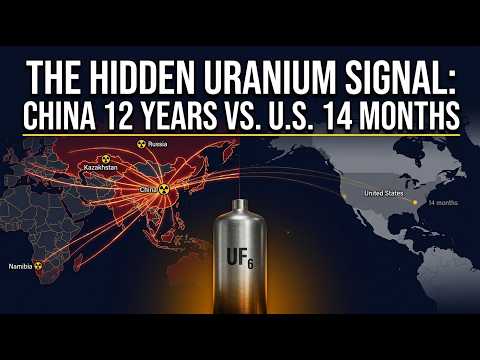
The uranium supply asymmetry between China and the West is one of the most consequential — and most underreported — structural imbalances in global energy markets right now. This video breaks down exactly how it was built, what the data shows, and what it means for uranium prices, nuclear fuel security, and uranium equities going into the next decade.
In January 2026, the U.S. Department of Energy announced a $2.7 billion emergency investment in domestic uranium enrichment capacity — the largest such commitment in decades. It is an acknowledgment that the gap is real. But new enrichment facilities will not produce low-enriched uranium at scale until 2031 to 2034, leaving a five-to-eight year window of structural exposure for American and European utilities.
Meanwhile, China's footprint in Namibia's uranium mines, its dominant position in Kazakhstan's production, and its continued access to Russian enrichment services has created a supply architecture that Western competitors cannot replicate quickly. The signal was always in the data: import volumes, mine equity percentages, enrichment purchase agreements. This video shows you how to read it.
Managed & Built by I2M Consulting, LLC | © 2010-
