

Unleashed Uranium Group reported in mid-April that China spent $5.8 billion on nuclear fuel imports in 2025 — absorbing roughly 40% of all primary uranium produced globally. That is not reactor demand. That is stockpiling. And it is quietly cornering the supply that Western utilities need.
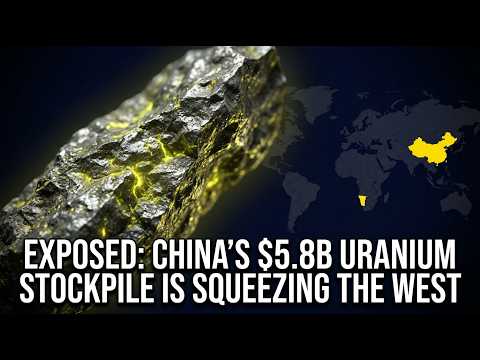
What almost no one is covering: two of Namibia's three largest uranium mines — Husab and Rössing — are majority-owned by Chinese state entities CGN and CNNC. Together they produce nearly 7,800 tonnes of U3O8 per year, roughly 10–12% of global primary supply. When that uranium leaves Walvis Bay, it goes into Chinese supply chains. It is not available to a US or European utility at any market price.
Layers in the enrichment picture — TENEX and CNNC now jointly control more than 62% of global SWU capacity — and the structural compression becomes clear. Western uranium buyers face a shrinking pool of non-Russian, non-Chinese-controlled supply, at precisely the moment nuclear energy demand is accelerating from data centres, fleet life extensions, and new reactor builds. The uranium spot price hit $101.41 per pound in January 2026 before correcting; the structural signal has not corrected with it. Canada's Wheeler River ISR approval and the US government's $2.7 billion enrichment funding package are meaningful, but mine-to-fuel-pin cycles are long. The uranium that will power 2028 reactors is being contracted now.
This video is a forensic look at who controls the supply — and what that means for prices, equities, and energy security over the next 24 to 36 months.
Covered in video: China's record $5.8B nuclear fuel imports, the Namibia ownership revelation, TENEX-CNNC SWU dominance, uranium spot price dynamics, the Western decoupling timeline, and what it means for uranium stocks, U3O8 pricing, and long-term contract rates.
Resource Portal for I2M Clients, Associates, and Geoscientists
Managed & Built by I2M Consulting, LLC | © 2010-

Managed & Built by I2M Consulting, LLC | © 2010-