
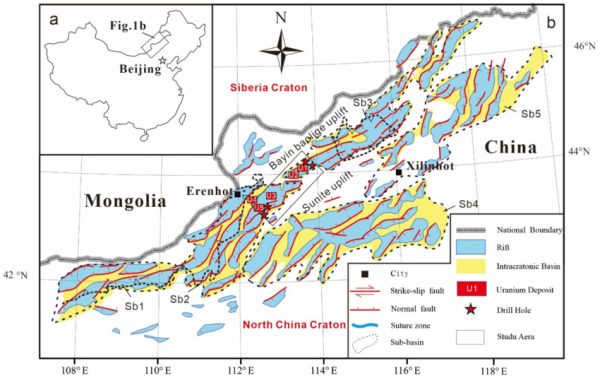

Lin-Fei Qiu and 5 co-authors reported in 2021 that he relationship of sedimentary organic matter, oil-gas and sandstone-type uranium (U) deposits is the key problem of U-mineralization. Whether migrate hydrocarbons participate in U-mineralization is still a controversy.
Typical U deposits of the Erlian Basin in northeast China have been investigated through detailed petrography, mineralogical, micro spectroscopic, organic geochemical and C-isotope studies. Petrographic observations, Microscopic Laser Raman Spectroscopic, Infrared Spectroscopic and Scanning Electron Microscope analyses indicated there are three types of organic matter (including carbonaceous debris and migrated hydrocarbons).
A significant amount of uranium was associated with pyrites, clay minerals and carbonaceous debris organic matter, either coexisted with hydrocarbon fluids. There are at least two stages mineralization events, stage I is related to sedimentary organic matter (syngenetic pre-enrichment stage), and stage II is related to mobile hydrocarbon fluids (main mineralization stage). Therefore, the authors' results support the view that migrated hydrocarbons were involved as a reducing agent for the main uranium mineralization after synsedimentary mineralization.
Managed & Built by I2M Consulting, LLC | © 2010-
