

Michael D. Campbell, P.G., P.H., President and CEO of the I2M Corporation (I2M) in Katy, Texas announced in late February 2026 that their projects are moving forward with veterans of the earlier uranium period and other seasoned personnel in building a new company to help meet the anticipated rise in demand for uranium to support the nuclear renaissance in the U.S.
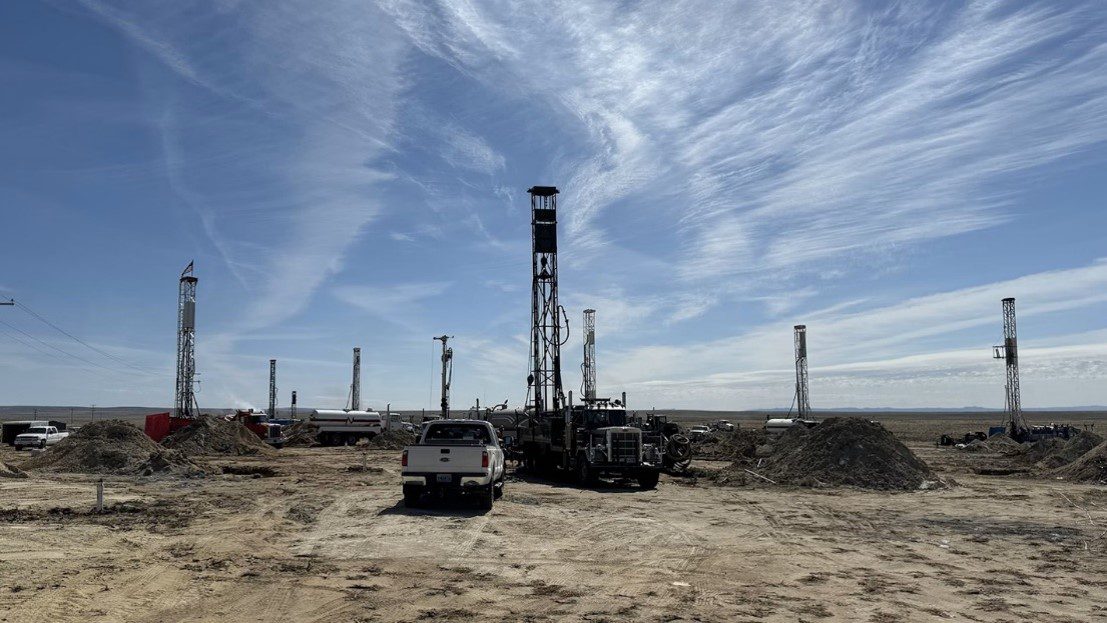 Pattern Drilling in a Typical Project Developing Roll-Front Uranium Deposits
He indicated that:
“We are pursuing multiple funding strategies to advance our most promising projects,” said Campbell. “Our goal is to bring at least one ISR project into production as soon as possible with a realistic timeline given the benefits of ISR compared to conventional surface or underground mining.”
Expanding Uranium Prospects in Texas
The I2M Corporation, based in Katy, Texas, was formed in early 2024 with senior personnel from the I2M Consulting Group for the purpose of focusing on in-situ uranium recovery (ISR) projects in Texas and Alaska. Henry M. Wise, P.G., I2M’s Vice President – Operations said that:
“We have developed twelve pipeline projects in Texas identified as drillable exploration targets, with one project moving quietly forward with investigations indicating identified uranium resources of at least 10 million pounds during recent investigations of the likely trends of mineralized intervals of uranium roll-front deposits in the general area including the resources recognized in the early 1980s.”
I2M Team Rooted in Experience
I2M is a different kind of uranium company with some of the personnel having worked for the Conoco mining group in Sydney, Australia in the 1960s and for the Conoco Uranium Group, and later, three of the I2M personnel worked for Teton Exploration, a division of the United Nuclear Corporation in the early 1970s, while others were employed by the U.S. Steel Uranium Group in south Texas in the late 1970s and by Cambridge Royalty Company in the early 1980s. The I2M Board of Directors also include senior personnel who have worked for ExxonMobil for decades, the DOE’s WIPP project, and for DuPont.
The I2M Technical Advisors have come from decades with the U.S. Geological Survey, a major university, and from senior management in the enCore Energy group in south Texas.
The I2M personnel with earlier experience in the uranium industry had to deal with falling uranium prices in the 1970s and 1980s, and with the media coverage of the Three Mile Island incident that panicked everyone in the U.S. At the same time, demand for electricity had fallen off, combined with the Chernobyl disaster only a few years later, interest in building new nuclear power plants in the U.S. waned for decades. I2M personnel, at the time, then turned their geological skills toward the expanding environmental field where they functioned as senior professional geologists and hydrogeologists for decades conducting environmental investigations and managing associated remediation projects.
But in the early 2000s, I2M personnel began monitoring the activities of the uranium and nuclear power industries, which were beginning to show the early signs that nuclear power may be re-emerging in response to the sharp increase in demand for electricity that was emerging throughout the U.S. and around the world.
In 2020, they began to call for the uranium industry to be ready for the coming renaissance of nuclear power in the foreseeable future (here), but it soon became obvious that only increasing uranium prices would stimulate mothballed projects and new exploration to re-emerge in the U.S.
Safe, Proven In-Situ Recovery
I2M personnel also recognized the need for clarifying what actually occurs during in-situ uranium recovery (ISR) projects rather than traditional "uranium mining." It's not mining as in an open-pit or underground mining, where uranium ore is recovered by blasting, removing overburden/waste rock, and hauling from within 300 feet of the surface or much deeper, but more like environmental remediation of naturally occurring uranium in “contaminated”
groundwater, where recovery operations involve the well-known "pump-and-treat" method of otherwise generally removing man-made contamination from the groundwater, which is what they had been investigating over the previous decades.
The I2M management team consists of senior, professionally licensed geologists and hydrogeologists to provide control of the hydrodynamics of the recovery systems, and chemical engineers to provide input where needed in the processing of the produced uranium fluids (of very low radioactivity) into yellowcake. These backgrounds, both in knowledge of uranium ISR projects, but also of environmental projects involving groundwater, on which most such projects are investigated today, brings the best of both fields in uranium and in environmental awareness and responsibility to their uranium projects today.
Commitment to Public Transparency
The I2M management team has been contributing to the public consciousness to enlist their support on new uranium recovery projects, while also conducting exploration and development of I2M pipeline projects by publishing a number of reports (see Example), articles (see Example), and public presentations (see Example) on the general features of the ISR development methods used in favorable deep sands in Texas and elsewhere, and on the ultimate need for nuclear power (see Examples) via I2M’s ongoing research incorporated within the I2M Web Portal in a searchable data base containing almost 15,000 records focusing on geoscience subjects with an emphasis on nuclear power and uranium (see Examples).
Outlook
Mr. Campbell also said that:
“If all goes as planned, I2M will be conducting drilling soon to confirm historical data from drilling in the early 1980s, followed by I2M producing our findings in a report (assuming the findings will be favorable) to present to their financial team for releasing funds to initiate formal permitting activities on the primary project, but also funded to acquire leases and drilling in the areas of our pipeline projects.
"If all goes well,” Campbell concluded, “our aim is to begin start-up construction as soon as all permits are approved, with initial production begun thereafter. Over time, we expect several additional projects from our pipeline to follow, potentially adding at least 40 to 50 million pounds of uranium to future U.S. supplies”
Contact:
The I2M Corporation
Katy, Texas
mdc@i2mcorporation.com
For a compressed version of this Press Release, see (here).
Managed & Built by I2M Consulting, LLC | © 2010-
