

Tai and Sun reported in September 2025 that the high sorption capacity of nanomaterials is related not only to the tunable porous structures and functional special groups, but also to their stability and reusability.
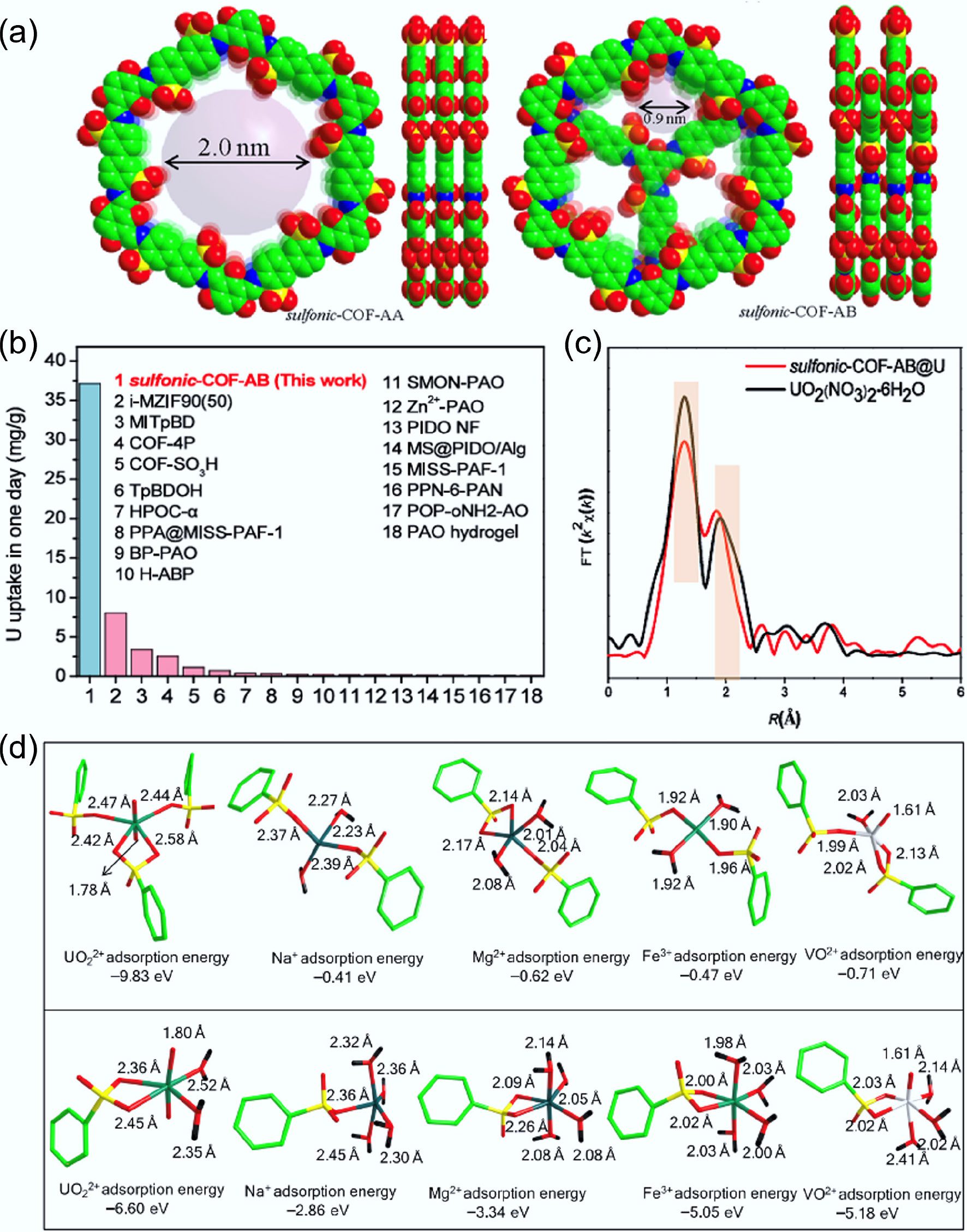
In the figure above: (a) Top and side views of S-COFs with AA and AB stacking modes. (b) Comparison of uranyl extraction by S-COFs-AB from seawater in one day with other material. (c) EXAFS analysis of S-COF-AB@U and UO2(NO3)2·6H2O. (d) Sorption structures of UO22+, Na+, Mg2+, Fe3+, and VO2 + in S-COF-AB (up) and SCOF- AA (down) with corresponding sorption energies, respectively.
In seawater uranium extraction, the fiber materials modified with amidoxime groups (for high selective binding of uranyl ions), active sites (toimprove sorption ability), light absorption property (for antibacterial activity and photocatalytic reduction ability), electroconductivity (for electrochemical extraction), porous structures (for fast transfer of uranyl ions), low cost at industrial level synthesis (for real application on a large scale), high stability (against the possible loss and reduce potential pollution in the ocean), reusability (to reduce the cost) etc., are promising materials in ocean applications.
At the laboratory level, high extraction ability can be easily achieved;however, the way for ocean uranium extraction with low economic level, and high ability is still a huge challenge for nuclear energy utilization.
The authors concluded that uranium extraction from the ocean will open a new way for nuclear fuel preparation with the development of technology and science.
[Because of the importance in expanding the available sources of uranium, see the AI Summary below]:
Research on producing uranium from seawater is rapidly advancing, focused on developing highly efficient, selective, and reusable adsorbent materials to move the technology from laboratory testing to industrial viability. Recent breakthroughs have led to record-high extraction performances, with significant progress made in China on kilogram-scale production in real marine conditions.
Key Areas of Progress and Innovation
Novel Adsorbent Materials: The primary focus is on developing new porous materials like Covalent Organic Frameworks (COFs), Metal-Organic Frameworks (MOFs), and functionalized polymers.
Record Efficiency: A new sulfonic COF material, developed by researchers from Weifang University and North China Electric Power University, achieved the highest performance ever reported for uranium extraction from natural seawater by engineering the material's internal architecture to match the uranium ion's shape and charge.
Bio-inspired Designs: Scientists have created bio-inspired materials, such as hierarchical porous membranes and protein-engineered hydrogel fibers, that mimic natural structures to increase surface area and improve ion transport efficiency.
Enhanced Selectivity: New materials are designed to be highly selective, using specific binding sites (like amidoxime and carboxyl groups) to capture uranium while ignoring competing ions such as vanadium, which has historically been a challenge.
Advanced Extraction Methods: Researchers are exploring integrated systems for faster, more efficient extraction:
Adsorption-Photocatalytic/Electrocatalytic Systems: These innovative systems use light or electricity to convert adsorbed uranium ions into solid, harvestable products (like UO₂) directly, which can improve kinetics and reduce biofouling.
Electrochemical Routes: The electrochemical method is gaining attention for its potential for high efficiency and material regeneration at a low operating voltage, though high energy consumption remains a general challenge for this approach.
Scalability and Real-World Testing:Kilogram-Scale Production: Chinese nuclear institutions have made a significant breakthrough by successfully extracting kilogram-level uranium from seawater using an offshore test platform in the South China Sea, moving beyond lab-scale experiments.
Deployment Strategies: Research includes developing robust fiber adsorbents that can be braided and deployed in ocean currents to utilize natural water movement and resist biofouling.
Challenges and Outlook
Despite these advances, the technology is still in early stages for industrial viability. Key challenges include:
- Improving the cost-effectiveness and scalability of adsorbent production.
- Ensuring the materials are robust and resistant to biofouling in long-term marine deployment.
- The current cost of extraction (estimated at roughly three times more than conventional mining) needs to decrease significantly to be commercially competitive.
Overall, the scientific community is optimistic that continued research and engineering cooperation will lead to a viable and sustainable source of nuclear fuel from the world's oceans in the future.
Additional References (here).
Managed & Built by I2M Consulting, LLC | © 2010-
