

Uranium Unleashed reported in early February 2026 that uranium sits at the center of one of the most asymmetric arbitrage setups in the entire natural resource sector. This video breaks down why the physical uranium market is screaming “structural bull market” while junior exploration stocks remain trapped in a capital‑starved desert.
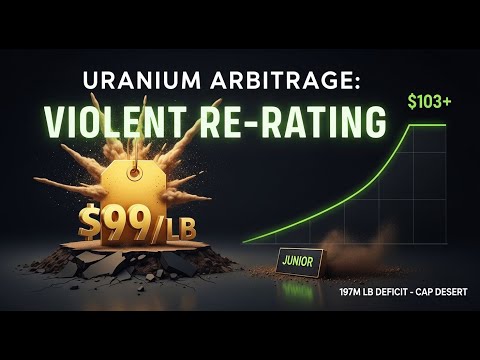
We start by deconstructing the bull case: long‑term reactor life extensions, AI‑driven power demand, U.S. policy support for nuclear, and a mathematically unavoidable uranium supply deficit. Then we walk through the supply crunch—Kazatomprom production cuts, extreme market concentration among a handful of producers, and the forward curve contango that shows utilities quietly pricing in much higher uranium prices.
Next, we map the paradox in capital flows. While billions chase gold and silver momentum, uranium exploration remains largely ignored. Sovereign wealth funds and large institutions have near‑zero exposure to early‑stage uranium discovery, leaving high‑quality juniors dependent on fickle retail capital and dilutive financings.
From there, we outline how to separate “marketing machines” from true acquisition‑grade uranium assets. We focus on explorers with real geology, proximity to mills and infrastructure, credible paths to production, and joint‑venture backing from majors or utilities. These are the names most likely to be aggressively re‑rated when the sector finally attracts institutional capital. We also walk through the catalyst sequence for a violent re‑rating: capital rotation out of overheated precious metals, utility panic‑buying as inventories shrink, and a full narrative flip from “unsexy uranium” to “critical energy security.”
When that rotation hits a tiny pool of credible uranium explorers, the result can be explosive upside. Finally, we stress‑test the thesis with a clear risk section. What if the re‑rating takes years longer than expected? We look at capital‑runway risk, predatory takeovers, investor fatigue—and how focusing on “real players” with JV partners and balance‑sheet strength can help mitigate those risks.
If you’re an investor looking for asymmetric returns in a sector where the deficit isn’t speculation but arithmetic, this deep dive into the uranium arbitrage is for you. Subscribe for more nuclear fuel cycle analysis, junior mining due‑diligence frameworks, and contrarian energy ideas each week.
[Hint: See the I2M Corporation].
The I2M Corporation (I2M), based in Katy, Texas, was formed in early 2024 for the purpose of focusing on in-situ uranium recovery (ISR) projects in Texas and Alaska. With one project moving quietly forward having already indicated uranium resources of at least 10 million pounds in place, and ten other projects in Texas identified as drillable exploration targets, the I2M is considering various sources of funding to move many of these highly prospective projects forward. As a new group on the block, with veterans of the earlier uranium period, they are building a new company to help meet the incredible forecasted rise in demand for yellowcake.
I2M is a different kind of uranium company with some of the personnel having worked for the CONOCO mining group in Sydney, Australia in the 1960s and for CONOCO Uranium Group in the early 1970s, while others were employed by the U.S. Steel uranium group in south Texas in the late 1970s and early 1980s. But as the uranium price fell and with Three Mile Island incidents' media coverage panicking everyone in the U.S., and while demand for electricity had fallen off, combined with Chernobyl disaster, this finally seized up interest in building new nuclear power plants in the U.S. and the uranium prices fell off, until recently. I2M personnel at the time then turned their geological skills toward the expanding environmental field where they functioned as senior professional geologists and hydrogeologists for some 30 years.
In early 2000s, I2M personnel began monitoring the activities of the uranium industry (here) and of the nuclear power industry (here), and there were early signs that nuclear power may be re-emerging in response to the sharp increase in demand of electricity that was occurring throughout the U.S. and around the world. They began to call out the uranium industry in 2020 to be ready for the coming Renaissance of nuclear power in the foreseeable future (here).
The I2M saw the need for not just uranium exploration and mining experience, but the need to re-cast the terms "uranium mining" into what actually goes on in an ISR project. It's not mining as in an open-pit where uranium is within 300 feet of the surface, but more like environmental remediation of naturally occurring uranium where recovery operations involve the well-known "pump-and-treat" method of otherwise generally removing man-made contamination from the groundwater, which is what they had been investigating over the many years.
The I2M management team consists of senior, professionally licensed geologists and hydrogeologists, and chemical engineering contractors to provide input where needed in the processing of the produced uranium fluids (of very low radioactivity) into yellowcake. These backgrounds, both in knowledge of uranium ISR projects, but also of environmental projects involving groundwater, on which most such projects are investigated today, brings the best of both fields in uranium and in environmental awareness and responsibility to their uranium projects today.
The I2M has been contributing to the public consciousness, while also conducting exploration and development of their projects, by publishing a number of reports (Example), articles (Example), and public presentations (Example) on the general features of the ISR development methods used in favorable deep sands in Texas and elsewhere, and on the need for nuclear power (Examples).]
Managed & Built by I2M Consulting, LLC | © 2010-
