

Nguyen and 10 co-authors reported in 2025 The oldest constituents in chondritic samples are presolar grains that condensed in the outflows and explosions of dying stars. These grains divulge the types and concentrations of dust that seeded our Solar System.
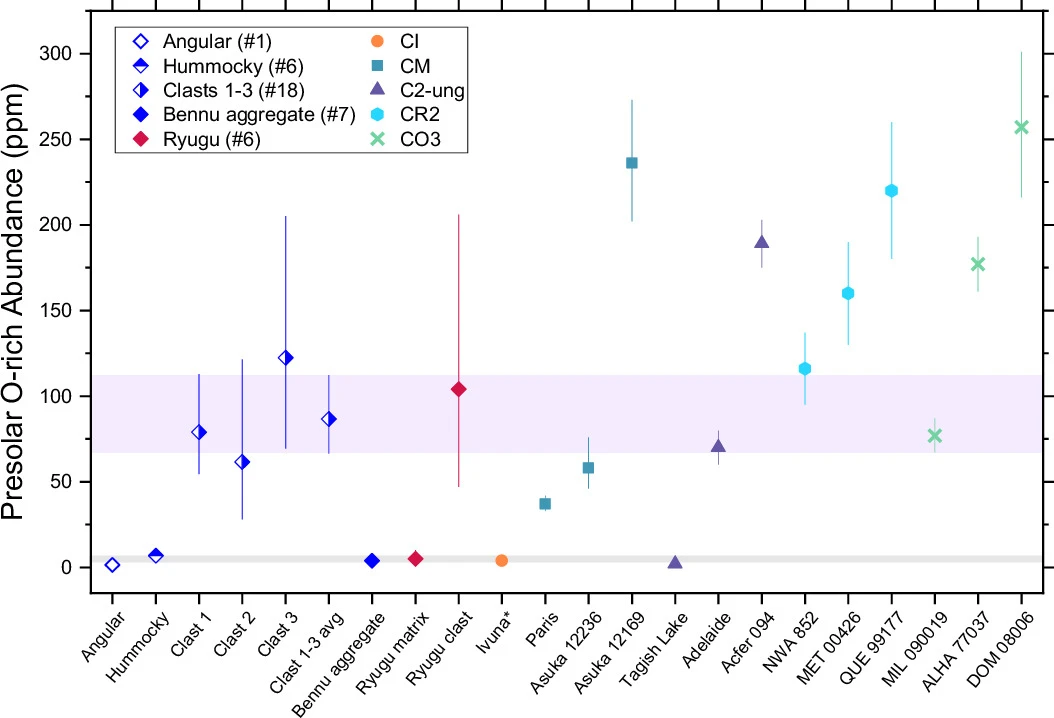 The caption for the above graphic indicates the abundances in the different Bennu samples analyzed here are compared with those in an aggregate Bennu sample, matrix material and an exogenous clast from Ryugu, and various carbonaceous chondrites. The abundance for Ivuna is an upper limit. See Methods for supporting references. The grey shaded region is the mean abundance for Bennu angular, aggregate, and hummocky samples, excluding Clasts 1–3 (see Source Data). The purple shaded region is the mean abundance for Clasts 1–3 from the hummocky Bennu particle, including 1σ errors. Error bars are 1σ.
However, they are subject to destruction during planetesimal formation and alteration. The authors conducted a detailed study of presolar grains in fragments of asteroid Bennu to elucidate the alteration history of distinct lithologies—angular and hummocky—and the sources of stardust that were accreted by the parent asteroid. The presolar grain abundances support a history of substantial aqueous alteration. Nevertheless, we found organic-rich clasts within a hummocky particle having higher presolar silicate abundances, akin to some of the least altered chondritic meteorites, and presolar silicate, oxide and SiC grains that retain their crystallinity.
These clasts illustrate that aqueous alteration was heterogeneous within the parent body and their properties may better represent the starting materials that accreted to form the protolith. In addition, the Bennu samples we analysed have a six-times greater proportion of C-rich supernova dust than other chondritic samples, injected perhaps from a nearby supernova. This observation adds to evidence that Bennu’s parent body sampled a region of the protoplanetary disk having a distinct mixture of starting materials.
Managed & Built by I2M Consulting, LLC | © 2010-
