

Hidayat reported on December 31 2025 that the modern industrial economy depends on materials that exist in limited quantities, often concentrated in geographically specific regions controlled by foreign governments. When supply chains for these materials become vulnerable to disruption, nations must reassess their strategic priorities and classification systems.
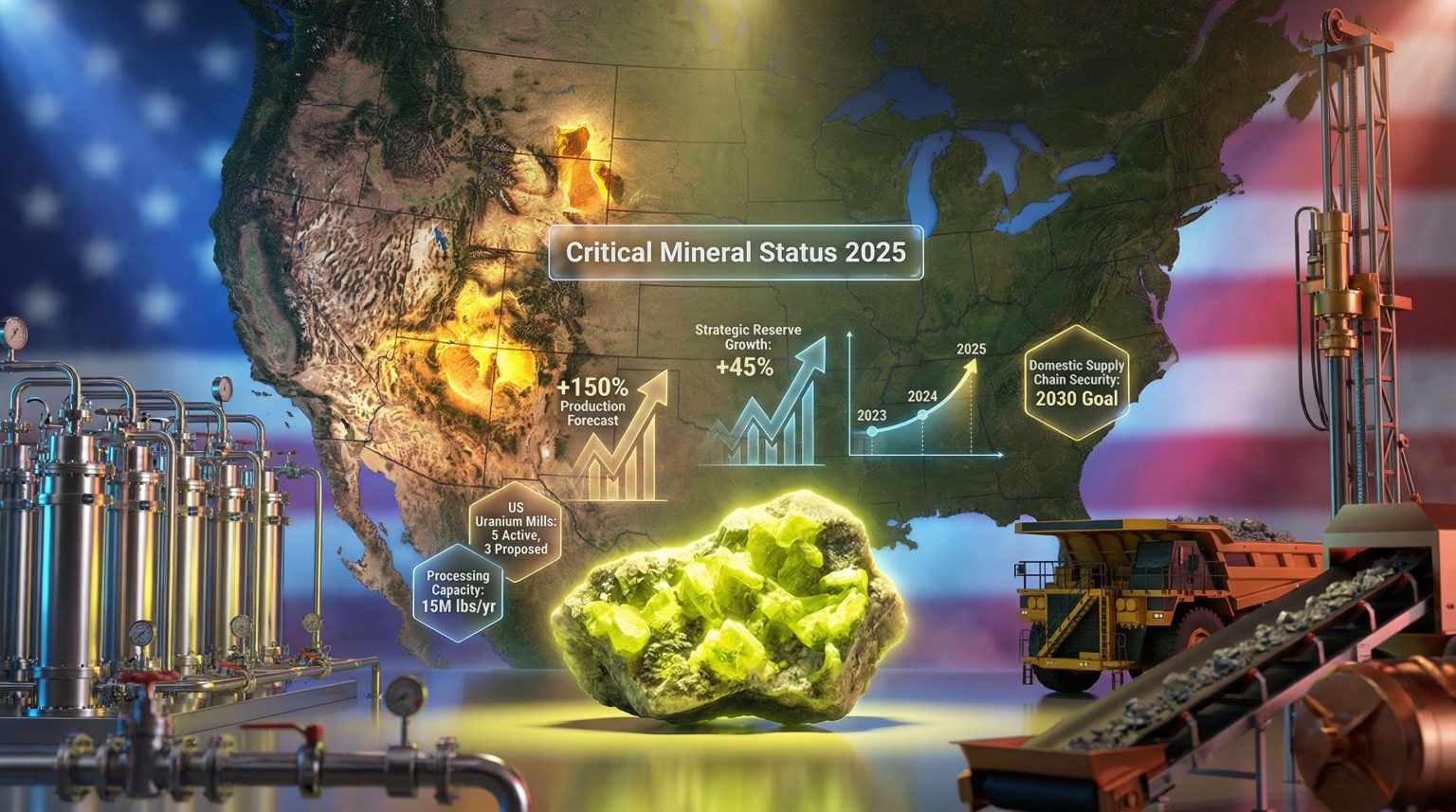
This fundamental challenge has driven the United States to continuously evolve its approach to critical minerals identification, balancing technical definitions against real-world security requirements. The recent decision to place uranium back on US critical minerals list reflects this underlying strategic necessity.
Nuclear fuel represents a particularly complex case within this framework. Unlike conventional commodities that can be substituted or sourced from multiple suppliers with relative ease, uranium requires highly specialized processing infrastructure that cannot be rapidly deployed or easily replaced. The material flows through a rigid sequence of technical stages, each representing a potential chokepoint where disruption cascades throughout the entire supply system.
Understanding the Strategic Shift: Why Uranium Regained Critical Mineral Status in 2025
The Classification Paradox That Ended
The uranium classification saga illustrates how legislative precision can create unintended strategic gaps. When Congress passed the Energy Act of 2020, the legislation redefined critical minerals to explicitly exclude fuel materials, automatically disqualifying uranium despite its obvious importance to energy infrastructure. This exclusion created a policy contradiction where federal agencies continued uranium supply programmes while the material lacked formal critical status.
The 2025 U.S. Geological Survey Critical Minerals List expanded to 60 commodities, up from 50 in 2022. The decision to place uranium back on US critical minerals list represented a deliberate correction of this definitional oversight. The original 2018 list included 35 minerals with uranium amongst them, reflecting straightforward metrics of import dependence, supply concentration, and strategic importance.
During the exclusion period from 2022 to 2025, uranium occupied what industry analysts termed classification limbo. Federal agencies maintained strategic uranium reserve programmes, funded domestic conversion facilities, and supported advanced fuel development whilst the material technically lacked critical minerals designation. This disconnect between policy reality and formal classification became increasingly untenable as geopolitical tensions heightened uranium market volatility concerns.
Energy Security Imperatives Driving Policy Change
America's nuclear infrastructure generates approximately 19-20% of total electricity production through 94 operating reactors across 28 states. This baseload capacity operates on fixed refuelling schedules determined years in advance, creating non-negotiable fuel requirements where alternatives simply do not exist. Unlike fossil fuel power generation that can adjust sourcing and timing based on market conditions, nuclear reactors require predetermined fuel delivery schedules that cannot accommodate supply disruptions.
The strategic vulnerability became acute when U.S. uranium import dependency reached approximately 90% of annual requirements. Historical supply arrangements with Russian-linked providers, originally established through post-Cold War agreements designed to absorb excess Soviet enrichment capacity, suddenly represented critical national security exposures rather than economic conveniences.
Key vulnerability metrics that drove the reclassification include:
- Annual uranium requirements: 40+ million pounds of uranium concentrate for existing reactor operations,
- Domestic production capacity (2024-2025): Less than 10% of annual requirements,
- Processing bottlenecks: Single domestic conversion facility, limited enrichment capacity,
- Refuelling inflexibility: 18-24 month fixed cycles with 24-36 month procurement lead times,
- Inventory limitations: Utilities maintain 18-24 months of emergency stock, insufficient for prolonged disruption
Nuclear Power's Role in America's Energy Independence Strategy
The convergence of artificial intelligence data centre expansion, electric vehicle adoption, and grid modernisation requirements has intensified electricity demand growth projections beyond traditional forecasting models. Furthermore, nuclear power's role as dispatchable baseload generation becomes increasingly critical as renewable intermittency challenges grid stability requirements.
Energy transition and security considerations drove advanced reactor technologies currently in development to require High-Assay Low-Enriched Uranium (HALEU) with 5-20% uranium-235 content, compared to 3-5% in conventional reactor fuel. Prior to 2023, no domestic commercial HALEU production existed, creating complete dependency on foreign enrichment services for next-generation nuclear deployment.
The strategic calculus behind uranium's critical status restoration reflects long-term energy architecture planning rather than immediate supply concerns. Federal planners recognised that nuclear capacity expansion, essential for meeting climate goals and energy security objectives, required fuel cycle independence that could not be achieved through market mechanisms alone.
What Does Critical Mineral Status Mean for Uranium Supply Chains?
Federal Funding Mechanisms Now Available
The May 2024 Russian uranium import ban triggered release of $2.72 billion in previously appropriated federal funding. This funding addresses domestic low-enriched uranium supply contracts, enrichment infrastructure expansion, and fuel fabrication capability advancement. Consequently, this represents the largest federal investment in uranium supply chain development since the early Cold War period.
Critical minerals designation provides uranium projects with access to several federal support mechanisms:
- Defense Production Act authority for supply chain priority allocation,
- Critical Materials Institute coordination for federal agency alignment,
- Strategic reserve development authorisation enabling long-term inventory building,
- Infrastructure investment tax credits for processing facility construction,
- Fast-track environmental review under critical infrastructure provisions.
The funding distribution prioritises different stages of the fuel cycle based on vulnerability assessment. However, conversion and enrichment capacity receive the highest priority due to their roles as primary bottlenecks, whilst mining development receives support focused on geographic diversification and production scaling.
Accelerated Permitting and Regulatory Pathways
Critical minerals designation qualifies uranium projects for expedited environmental review timelines under National Environmental Policy Act (NEPA) provisions designed for critical infrastructure. This acceleration can reduce permitting timelines from 7-10 years to 3-5 years for mining projects, though the reduction varies significantly based on project complexity and environmental sensitivity.
The fast-track process coordinates multiple federal agencies through the Critical Materials Institute. In addition, this eliminates redundant review procedures that previously created delays between Bureau of Land Management, Forest Service, and Nuclear Regulatory Commission oversight. Projects must still meet all environmental and safety standards, but regulatory sequencing becomes streamlined and predictable.
Public lands access represents a critical component of accelerated permitting. Approximately 60% of identified U.S. uranium resources exist on federal lands, primarily in the Colorado Plateau region spanning Utah, Colorado, Arizona, and New Mexico. Critical status provides uranium exploration and development with priority consideration for land access permits, though environmental protections remain intact.
Strategic Reserve Development Authorization
The strategic uranium reserve programme allows federal acquisition of uranium for national security purposes independent of current reactor demand cycles. Reserve management enables inventory buffer creation against supply disruptions, market stabilisation through coordinated acquisition, and reactor fuel security decoupled from foreign supplier reliability.
Reserve targets remain classified, but industry estimates suggest 25-50 million pounds of uranium concentrate would provide adequate buffer capacity for national security requirements. The reserve operates through long-term contracts with domestic producers, providing price stability that enables investment in expanded production capacity.
Uranium Critical Minerals Benefits vs. Other Energy Commodities
see table in article.
How Does America's Nuclear Fuel Dependency Create Strategic Vulnerability?
Multi-Stage Processing Requirements and Bottlenecks
The uranium fuel cycle requires sequential processing through five distinct technical stages, each representing a potential chokepoint where disruption affects the entire supply system. Unlike other energy commodities where processing stages can be bypassed or substituted, nuclear fuel fabrication demands precise specifications that cannot accommodate alternative pathways.
Stage 1: Mining and Milling
- Uranium ore extraction through conventional underground, open-pit, or in-situ recovery methods,
- Concentration to uranium oxide (yellowcake, U₃O₈) containing 85% uranium by weight,
- U.S. capacity: Energy Fuels' White Mesa Mill (Utah) represents the only operating conventional uranium mill,
- 2025 domestic production: 1+ million pounds uranium oxide from White Mesa operations.
Stage 2: Conversion
- Transformation of yellowcake to uranium hexafluoride (UF₆) gas required for enrichment,
- ConverDyn Metropolis Works (Illinois): Only domestic conversion facility, idle 2017-2023,
- Global conversion capacity: ~70,000 metric tons UF₆ annually, U.S. share <5%,
- Conversion bottleneck: Facility construction requires 5-7 years minimum lead time.
Stage 3: Enrichment
- Increasing uranium-235 concentration from natural 0.7% to reactor requirements,
- Commercial reactors: 3-5% enrichment (Low-Enriched Uranium, LEU),
- Advanced reactors: 5-20% enrichment (High-Assay Low-Enriched Uranium, HALEU),
- Current U.S. commercial enrichment capacity: Effectively zero for large-scale production.
Foreign Control Over Enrichment Capacity
Global uranium enrichment capacity concentration creates strategic vulnerabilities that extend beyond simple import dependency. Russia controls approximately 35% of global enrichment capacity, China controls 25%, and European consortium Urenco controls 20%, leaving U.S. domestic capacity below 1% of global total.
Centrus Energy operates the only licensed domestic enrichment facility at Piketon, Ohio, but current capacity remains limited to demonstration-scale HALEU production through a 16-machine cascade. Commercial-scale enrichment for standard reactor fuel requires significantly expanded infrastructure not currently available domestically.
The enrichment vulnerability differs fundamentally from raw material import dependency because enrichment services cannot be stockpiled. Unlike uranium concentrate that can be stored as yellowcake for extended periods, enrichment represents a service that must be performed on specific material at specific times to meet reactor fuel delivery schedules.
Historical enrichment arrangements with Russia originated from 1993 Megatons to Megawatts program, which converted weapons-grade uranium to reactor fuel. These arrangements continued post-programme completion in 2013 due to economic advantages and limited domestic alternatives. However, the May 2024 import ban eliminated these arrangements, creating immediate pressure for alternative enrichment capacity development.
How Do Fixed Refuelling Schedules Limit Supply Chain Flexibility?
Nuclear reactor operations require fixed refuelling schedules that cannot accommodate supply chain flexibility. For instance, a typical 1,000 MW pressurised water reactor operates on an 18-24 month cycle with approximately one-third of fuel assemblies replaced during each refuelling outage. This schedule is determined by nuclear physics and safety requirements, not market convenience.
The refuelling rigidity creates several vulnerability points:
- Procurement timeline inflexibility: Fuel assembly orders placed 24-36 months before installation,
- Specification lock-in: Reactor physics calculations require exact fuel composition, geometry, and enrichment levels,
- No substitution capability: Alternative fuel designs cannot be accommodated once refuelling schedules are established,
- Inventory limitations: Utilities maintain limited excess inventory due to storage costs and licensing requirements.
Emergency fuel procurement options remain extremely limited. If primary suppliers cannot deliver on schedule, reactor operators face difficult choices between delayed refuelling (creating capacity shortages) or premium-priced emergency supply contracts that may not meet exact specifications.
Current reactor fleet vulnerability metrics include:
- 94 operating reactors requiring coordinated fuel supply across 28 states,
- 18-24 month inventory buffers representing maximum disruption tolerance,
- $40+ billion annual fuel requirements with limited supplier diversification options,
- Fixed refuelling schedules extending 3-5 years into the future with limited flexibility,
Which Domestic Uranium Projects Benefit Most from Critical Status?
Energy Fuels' Arizona and Utah Operations Expansion
Energy Fuels Inc. represents the primary beneficiary of placing uranium back on US critical minerals list through its integrated mining and milling operations in the Colorado Plateau region. The company's Pinyon Plain mine in Arizona and La Sal Complex in Utah returned to production in 2024, delivering over 1.6 million pounds of recoverable uranium in ore through 2025.
The White Mesa Mill in Utah processed this material into more than 1 million pounds of finished uranium oxide during 2025. As the only operating conventional uranium mill in the United States, White Mesa holds strategic importance beyond its current production capacity. Critical status benefits for Energy Fuels operations include:
- Federal contract priority for strategic reserve purchases providing long-term price stability,
- Accelerated permitting for expansion projects on adjacent federal lands,
- Infrastructure investment incentives for mill capacity upgrades and efficiency improvements,
- Coordinated regulatory oversight reducing bureaucratic delays between multiple agencies,
The company's Arizona operations benefit particularly from proximity to high-grade uranium deposits in the Grand Canyon region, though environmental restrictions limit access to certain areas. Critical status provides enhanced consideration for land access permits whilst maintaining environmental protection requirements.
Wyoming Powder River Basin In-Situ Recovery Projects
Wyoming's Powder River Basin contains the largest identified uranium resources in the United States, primarily accessible through in-situ recovery (ISR) techniques that inject oxidising solutions into underground ore deposits and pump uranium-bearing solutions to the surface. Furthermore, ISR operations offer significant advantages over conventional mining, including reduced environmental impact and faster development timelines.
Ur-Energy Lost Creek Project:
- Licensed capacity: 2 million pounds U₃O₈ annually,
- Current status: Limited production with expansion potential,
- Critical status benefits: Priority consideration for federal contracts, accelerated expansion permitting,
- Peninsula Energy Lance Project: Licensed capacity: 2.2 million pounds U₃O₈ annually,
- Development status: Construction ready with federal support potential,
- Location advantages: Proximity to existing infrastructure and experienced workforce,
Uranium Energy Corp. Projects:
- Multiple ISR projects in development across Wyoming and South Texas,
- Rapid development capability: ISR projects can achieve production within 2-3 years,
- Federal contract potential: Critical status provides enhanced contracting opportunities,
- ISR technology advantages align well with critical minerals strategy priorities:
Rapid deployment: 2-3 year development timeline vs. 7-10 years for conventional mines,
Lower capital requirements: $50-100 million vs. $500+ million for conventional projects
Environmental advantages: Minimal surface disturbance and waste generation
Operational flexibility: Production can be scaled based on market demand and federal contracts
Texas Gulf Coast Uranium Development Pipeline
South Texas hosts significant ISR-recoverable uranium resources in sandstone formations extending from the Gulf Coast inland. These deposits offer several strategic advantages, including proximity to existing energy infrastructure, favourable geology for ISR operations, and reduced regulatory complexity on private land holdings.
enCore Energy Rosita/Kingsville Dome Projects:
- Combined resources: 10+ million pounds U₃O₈ in measured and indicated categories,
- Development timeline: 18-24 months to production with adequate funding,
- Infrastructure advantages: Existing roads, power, and processing facilities.
Uranium Energy Corp. South Texas Operations:
- Multiple projects including Palangana, Burke Hollow, and Goliad,
- Rapid restart capability: Previously operating projects with maintained infrastructure,
- Federal contracting potential: ISR operations ideal for strategic reserve supply
Major U.S. Uranium Production Facilities (2025)
See table in article
What Are the Geopolitical Implications of Russian Uranium Sanctions?
$2.72 Billion Federal Response Package Analysis
The May 2024 Russian uranium import ban activated $2.72 billion in previously appropriated federal funding, representing the largest uranium supply chain investment since the Manhattan Project era. This funding addresses multiple vulnerabilities across the nuclear fuel cycle whilst establishing domestic capacity sufficient to achieve strategic independence within 10-15 years.
Funding allocation priorities target specific bottlenecks:
Enrichment Infrastructure (40% of funding):
- Centrus Energy HALEU expansion at Piketon, Ohio,
- Commercial-scale enrichment facility development,
- Advanced centrifuge technology deployment,
- Workforce training and technical capability development.
Conversion Capacity (25% of funding):
- ConverDyn Metropolis Works expansion and modernisation,
- Alternative conversion facility development consideration,
- Technical process improvements and efficiency upgrades,
- Supply chain resilience through redundant capacity.
Domestic Mining and Milling (20% of funding):
- Strategic reserve purchase contracts with domestic producers,
- Mining infrastructure development and expansion,
- Environmental compliance and community engagement,
- Workforce development in uranium-producing regions.
Advanced Fuel Development (15% of funding):
- HALEU production scaling for advanced reactor deployment,
- Research and development for next-generation fuel cycles,
- Fuel fabrication capability for specialised reactor designs,
- Technical standards development and licensing support.
The funding structure emphasises long-term strategic capability rather than immediate supply replacement. Federal planners recognised that Russian uranium import substitution required systematic capacity building across all fuel cycle stages, not simply alternative sourcing arrangements.
Alternative Supply Source Development Strategies
Eliminating Russian uranium imports necessitates diversified sourcing strategies that balance immediate supply requirements with long-term strategic independence. The federal response package supports both domestic capacity development and alliance-based supply arrangements with trusted international partners.
Primary Alternative Supply Sources:
Canada (Cameco Corporation):
- World's second-largest uranium producer with high-grade deposits in Saskatchewan,
- Established supply relationships with U.S. utilities according to National Defense Magazine,
- Political stability and regulatory alignment with U.S. standards,
- Cigar Lake and McArthur River mines represent world-class operations
Australia (BHP, Paladin Resources):
- Olympic Dam and Ranger mines provide established production,
- Four Corners Energy Agreement facilitates nuclear cooperation,
- Paladin Resources' Langer Heinrich mine in Namibia offers additional supply diversity,
- Long-term production potential through undeveloped resource base.
Kazakhstan (Kazatomprom):
- World's largest uranium producer through ISR operations,
- Geopolitical considerations require careful evaluation of supply security,
- Technical cooperation through international nuclear agreements,
- Production capacity exceeds current global demand requirements
Timeline for Achieving Import Independence
Complete uranium supply independence requires coordinated development across all fuel cycle stages with different timeline requirements for each component. Federal planners have established phased milestones that prioritise critical bottlenecks whilst building comprehensive domestic capacity.
Phase 1 (2025-2027): Critical Capacity Restoration
- ConverDyn Metropolis Works full operational capacity,
- Energy Fuels production scaling to 2-3 million pounds annually,
- Centrus Energy HALEU commercial demonstration,
- Emergency supply contract diversification away from Russian sources.
Phase 2 (2027-2030): Infrastructure Expansion
- Wyoming ISR project development and production initiation,
- Commercial-scale HALEU production facility construction,
- Additional conversion facility development consideration,
- Strategic reserve accumulation to 20-30 million pound inventory
Phase 3 (2030-2035): Supply Independence Achievement
- Domestic production capacity: 50+ million pounds annually,
- Commercial enrichment capacity: 100% of domestic requirements,
- Advanced fuel cycle capability: HALEU and specialised fuel production,
- Strategic reserve: Full coverage for 5-year supply disruption scenario.
The timeline assumes sustained federal support, favourable permitting outcomes, and successful private sector execution. However, delays in any major component could extend independence achievement by 3-5 years, emphasising the importance of coordinated progress across all fuel cycle stages.
How Will Critical Status Transform Nuclear Fuel Processing Infrastructure?
ConverDyn Metropolis Works Expansion Potential
The ConverDyn Metropolis Works facility in Illinois represents America's most critical uranium processing bottleneck, as the only domestic facility capable of converting uranium oxide to uranium hexafluoride (UF₆) required for enrichment. After an eight-year operational gap from 2017-2023, the facility's restart with federal support marks the beginning of conversion capacity restoration essential for fuel cycle independence.
Current Facility Specifications:
- Annual capacity: 15,000 metric tons uranium as UF₆,
- Technology: Dry fluoride process using hydrogen fluoride,
- Strategic importance: Gateway between mining/milling and enrichment stages,
- Employment: 150+ specialised technical positions
Critical status enables several expansion opportunities:
Capacity Scaling Projects:
- Production line modernisation and efficiency improvements,
- Additional conversion train construction for redundancy,
- Waste management system upgrades for environmental compliance,
- Process automation and digital control system implementation
Technical Capability Enhancement:
- High-purity UF₆ production for advanced reactor applications,
- Quality assurance and testing laboratory expansion,
- Research and development facility integration,
- International standard certification for export markets.
Federal investment priorities emphasise reliability and surge capacity rather than maximum throughput. Planners recognise that conversion represents the primary fuel cycle chokepoint where disruption affects all downstream operations.
High-Assay Low-Enriched Uranium (HALEU) Production Scaling
HALEU production represents the most technically challenging aspect of nuclear fuel independence due to specialised enrichment requirements and limited global supply sources. Advanced reactor designs require HALEU with 5-20% uranium-235 content, compared to conventional reactor fuel containing 3-5% enrichment.
Advanced Reactor HALEU Requirements:
TerraPower Natrium Reactor:
HALEU specifications: 19.75% uranium-235 enrichment
Annual fuel requirements: 40-60 metric tons HALEU per reactor
Fuel form: Ceramic pellets in specialised cladding
Quality standards: Nuclear reactor grade with stringent impurity limits
X-energy Xe-100 Reactor:
HALEU specifications: 15.5% uranium-235 enrichment
Fuel form: TRISO (tristructural isotropic) particles
Manufacturing complexity: Specialized coating technology required
Supply requirements: Multiple reactor deployment scenarios
Centrus Energy HALEU Scaling Strategy:
Phase 1: Demonstration Cascade (Completed 2023)
16-machine demonstration cascade at Piketon, Ohio
Production capacity: Limited demonstration quantities
Technical achievement: First domestic HALEU production since 1992
Regulatory milestone: Nuclear Regulatory Commission licensing precedent
Phase 2: Commercial Production (2025-2027)
120-machine commercial cascade construction
Annual capacity: 6-10 metric tons HALEU
Federal funding: $150+ million Department of Energy contract
Commercial viability: Long-term supply contracts with reactor developers
What About Advanced Reactor Fuel Requirements and Supply Gaps?
Advanced reactor deployment creates fundamentally different fuel cycle requirements that extend beyond HALEU enrichment to encompass specialised materials, manufacturing techniques, and quality standards not required for conventional nuclear power. In fact, this transformation has been amplified by the executive mineral order supporting enhanced critical materials development.
TRISO Fuel Manufacturing:
TRISO (tristructural isotropic) particles represent the most advanced nuclear fuel technology, offering enhanced safety characteristics through multiple containment barriers. Each TRISO particle contains a uranium kernel surrounded by four layers of engineered materials providing containment under extreme conditions.
Manufacturing Process Complexity:
Kernel production: High-quality uranium carbide or uranium oxide microspheres
Coating application: Chemical vapour deposition requiring precise temperature and timing control
Quality control: Individual particle inspection using advanced analytical techniques
Assembly: Integration into graphite blocks or metallic matrix fuel elements
Current U.S. TRISO Capability:
BWX Technologies: Limited research and demonstration quantities
Oak Ridge National Laboratory: Research facility with pilot-scale capability
Commercial gap: No large-scale TRISO manufacturing facility exists domestically
The U.S. Geological Survey's decision to restore uranium to the critical minerals list, as reported by Military.com, recognises the strategic importance of advanced fuel capabilities for national security applications.
Critical Status Impact on TRISO Development:
- Federal funding for commercial TRISO facility construction,
- Public-private partnerships for technology transfer from national laboratories,
- Regulatory framework development for TRISO fuel licensing,
- International cooperation on TRISO standards and testing protocols
Metallic Fuel Development:
Sodium-cooled fast reactors require metallic fuel containing uranium-zirconium alloys with specialised cladding materials. This fuel type offers enhanced breeding capabilities and improved waste utilisation but requires completely different manufacturing infrastructure.
What Market Dynamics Drive Uranium Price Volatility Under Critical Status?
Supply Contract Mechanisms and Federal Procurement
Uranium market dynamics differ fundamentally from other commodities due to the strategic nature of nuclear fuel, limited supplier base, and long-term contract requirements that dominate price discovery. Critical minerals designation introduces federal procurement as a significant market participant with different objectives from commercial utilities.
Traditional Uranium Market Structure:
Long-Term Contracts (70-80% of market):
Contract duration: 3-10 years with fixed delivery schedules
Price mechanisms: Base price with escalation clauses tied to inflation or production costs
Volume commitments: Minimum annual delivery quantities with flexibility provisions
Quality specifications: Precise uranium content and impurity limits
Spot Market (20-30% of market):
Price volatility: High sensitivity to supply/demand imbalances
Transaction volume: Limited quantities available for immediate delivery
Market participants: Utilities meeting short-term requirements, financial speculators
Price discovery: Weekly spot price assessments by industry publications
Federal Procurement Impact:
The strategic uranium reserve programme creates a new category of demand that operates independently of electricity generation requirements. Federal procurement strategies prioritise supply security and domestic capacity support over cost minimisation, introducing different price dynamics.
Strategic Reserve Purchasing:
Procurement timeline: Multi-year contracts supporting domestic production
Price approach: Premium pricing to incentivise capacity development
Volume targets: 25-50 million pounds over 5-10 year period
Market impact: Price floor effect supporting sustained production
Inventory Management Strategies for Utilities
Nuclear utilities maintain uranium inventories based on operational requirements rather than market speculation, but critical status creates new considerations for inventory strategy and supply contract management.
Traditional Inventory Approach:
- Working inventory: 18-24 months of fuel requirements,
- Emergency reserves: 6-12 months additional buffer,
- Cost optimisation: Balance carrying costs against price volatility exposure,
- Regulatory requirements: Nuclear Regulatory Commission fuel assurance standards.
Critical Status Inventory Implications:
Supply Security Emphasis:
- Inventory targets: Increased buffer stocks for supply disruption scenarios,
- Supplier diversification: Multiple contract partners reducing concentration risk,
- Domestic preference: Premium acceptable for domestic supply security,
- Strategic coordination: Voluntary cooperation with federal inventory objectives
Long-Term Price Stabilisation Through Strategic Reserves
Strategic reserve management aims to create uranium price stability that enables sustained domestic production investment whilst avoiding the boom-bust cycles that historically disrupted U.S. uranium industry development.
Historical Price Volatility:
- 2003-2007 uranium boom: Prices increased from $10/lb to $140/lb,
- 2008-2016 decline: Prices fell to $18/lb following Fukushima accident,
- Market characteristics: Long development timelines create supply lag responses,
- Investment cycles: Extreme volatility discourages long-term investment
The decision to restore uranium back on US critical minerals list represents a fundamental shift in American energy security strategy. By addressing supply chain vulnerabilities across the entire nuclear fuel cycle, this designation provides the framework for achieving strategic independence whilst supporting next-generation nuclear technologies essential for climate goals and national security objectives. However, success requires sustained federal commitment, coordinated industry investment, and careful management of international relationships during the transition to domestic supply independence.
Ready to Capitalize on America's Nuclear Energy Renaissance?
Discovery Alert's proprietary Discovery IQ model identifies significant uranium and critical minerals discoveries as they're announced on the ASX, providing immediate access to opportunities in a market where supply security is driving unprecedented investment. With Australia hosting major uranium reserves and American nuclear independence creating sustained demand, subscribers gain crucial insights into actionable uranium exploration developments that could benefit from this strategic shift. Begin your 30-day free trial today to position yourself ahead of the nuclear fuel supply transformation.
Managed & Built by I2M Consulting, LLC | © 2010-
