

Reedy and 6 co-authors reported in early 2025 that United States' heavy reliance on imports of critical minerals (CMs), including rare earth elements (REEs), underscores the importance of development of domestic sources. The study objective was to quantify CM and REE concentrations in coals in the US Gulf Coast region.
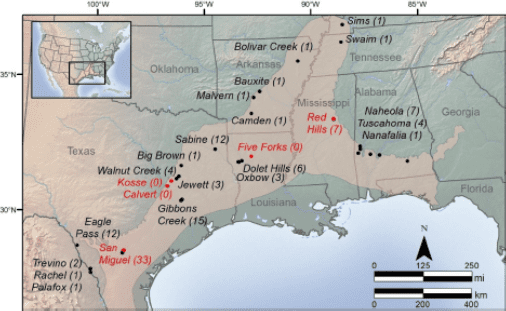
In the graphic above, the location of samples analyzed is shown for critical minerals (including rare earth elements, REEs) collected from coal mines and outcrops in the Gulf Coastal Plain region (red font and dots show active mines). Numbers in parentheses indicate the number of samples analyzed at each site. Some of the active mines were not sampled. Trevino, Rachel, and Palafox mines are located near Laredo, Texas. The locations of the sampled sites are provided in Table S2. Base map from Esri37.
CM and REE concentrations were measured for 118 samples from outcrops and 14 mines in the Gulf Coast. Results show that total REE+Yttrium (REY) concentrations (dry coal basis) are comparable to those of the upper continental crust (UCC) with localized hot spots, such as the Texas Gibbons Creek mine (REY≤~2,860 ppm). When normalized to UCC REY concentration (169 ppm, dry coal basis), REY to UCC ratios for Gulf Coast coal samples range from 2.2 to 307 (median ratio 11).
REE extractability from lignites is high (median: 63– 93%) using environmentally benign weak acid. In addition to raw coal, coal ash from power plants could also serve as a REE source with median REY concentration ~3 times higher than that from coal; however, extractability from coal ash is generally much lower (~20–30%). The median price for extracted REY + scandium (Sc) is ~ $10/tonne of coal assuming ~ 50% extraction.
Although estimated Gulf Coast coal resources are high (10s of billions of tonnes), there are only five active coal mines that produced ~ 15 million tonnes in 2023. Estimated power plant coal ash volume in landfills/ponds and potentially accessible is ~260 million tonnes. REE production from coal would likely require co-products, such as activated carbon or humic acids, to attain economic viability.
Production of REEs from coal ash could offset remediation costs related to potential water contamination. This reconnaissance study shows the potential for REE production from coal and coal ash in the Gulf Coast; however, carbon coproducts and/or societal benefits would likely be required for socioeconomic viability.
Managed & Built by I2M Consulting, LLC | © 2010-
