

Hobday and Dallowway reported in 1998 that hydrologic processes are fundamental in the emplacement of all three major categories of sedimentary uranium deposits: syngenetic, syndiagenetic, and epigenetic.
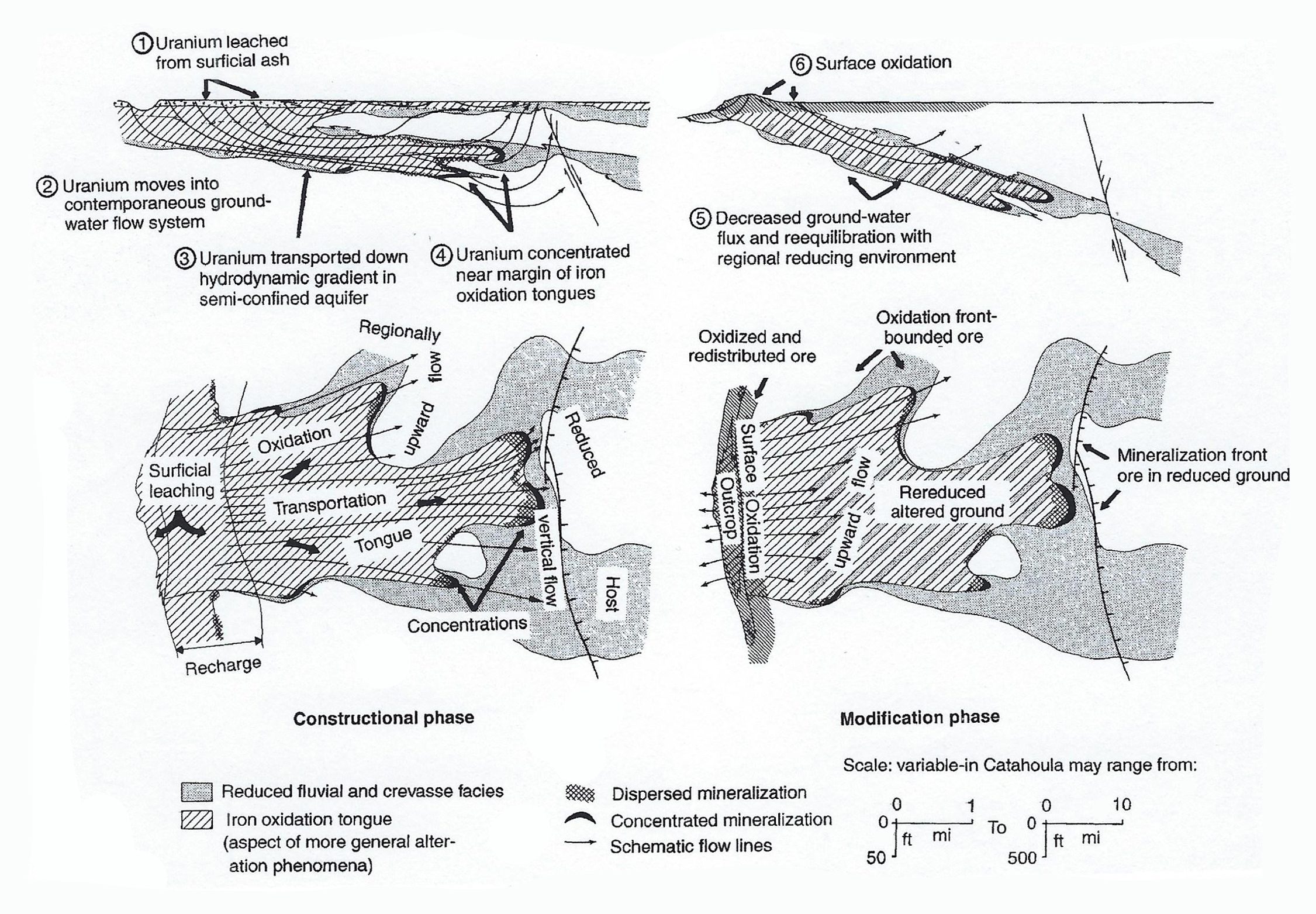
In the above graphic, Two principal phases of the uranium mineralization cycle typical of many epigenetic roll-type uranium deposits. Constructional events include primary mobilization, migration, and concentration of uranium within a semiconfined aquifer system during or soon after deposition of volcanic ash (or alternative uranium source) in the regional recharge area.
Possible modifications of the primary mineralization trends include rereduction of parts of the alteration tongue and local remobilization or destruction of shallow deposits by surface oxidation at or above the ambient water table. Scale of the cycle is a function of the size of the aquifer system. (After Galloway 1977)
In each case, the basic sedimentary uranium-enrichment cycle involves:
(1) leaching or erosion of uranium from a low-grade provenance;
(2) transport of uranium by surface or groundwater flow; and
(3) concentration of uranium by mechanical, geochemical, or physiochemical processes.
Although surface flow was responsible for lower Precambrian uranium deposits, groundwater was the primary agent in upper Precambrian and Phanerozoic sedimentary uranium emplacement.
Meteoric or more deeply derived groundwater flow transported uranium in solution through transmissive facies, generally sands and gravels, until it was precipitated under reducing conditions. Syndiagenetic uranium deposits are typically concentrated in reducing lacustrine and swamp environments, whereas epigenetic deposits accumulated along mineralization fronts or tabular boundaries.
The role of groundwater is particularly well illustrated in the bedload fluvial systems of the South Texas uranium province. Upward migration of deep, reducing brines conditioned the host rock before oxidizing meteoric flow concentrated uranium and other secondary minerals. Interactions between uraniumtransporting groundwater and the transmissive aquifer facies are also reflected in the uranium mineralization fronts in the lower Tertiary basins of Wyoming. Similar relationships are observed in the tabular uranium deposits of the Colorado Plateau.
The authors concluded that groundwater processes are responsible for the emplacement of both syndiagenetic and epigenetic uranium ores. Syndiagenesis involves solution transport of uranium and its precipitation by organic-rich reducing facies such as peat. The Miocene Date Creek ores of Arizona are an example. Here, uranium mineralization is hosted by fluvial arkoses, overlain by volcaniclastics of a shallow, restricted lake environment.
Epigenetic uranium mineralization ideally involves air-fall volcanic ash in the recharge area, which liberates uranium in soluble form. This uranium is transported down semiconfined aquifers until it encounters reducing conditions, where it is precipitated or adsorbed, for example in the South Texas uranium province, Tertiary strata of Wyoming, and the Colorado plateau. Any change in the hydrologic system results in modification of the ore bodies. Application of this model in exploration needs to take into account the volume and duration of groundwater circulation, concentration of dissolved uranium, and efficiency of fixation processes.
The largest uranium-producing districts of this type are represented by a relatively limited suite of depositional systems, including alluvial-fan and bedload
fluvial systems, and less commonly, shore-zone and mixed-load fluvial systems. Alluvial-fan and bedload fluvial systems are highly transmissive to groundwater flow because of their coarse grain size, dip orientation, and topographic gradients parallel to depositional trends.
Understanding and predicting the distribution of epigenetic uranium deposits therefore requires reconstruction of depositional environment as well as groundwater flow history.
Managed & Built by I2M Consulting, LLC | © 2010-
