

Stylo and six co-authors reported in 2015 that a knowledge of paleo-redox conditions in the Earth’s history provides a window into events that shaped the evolution of life on our planet. The role of microbial activity in paleo-redox processes remains unexplored due to the inability to discriminate biotic from abiotic redox transformations in the rock record.
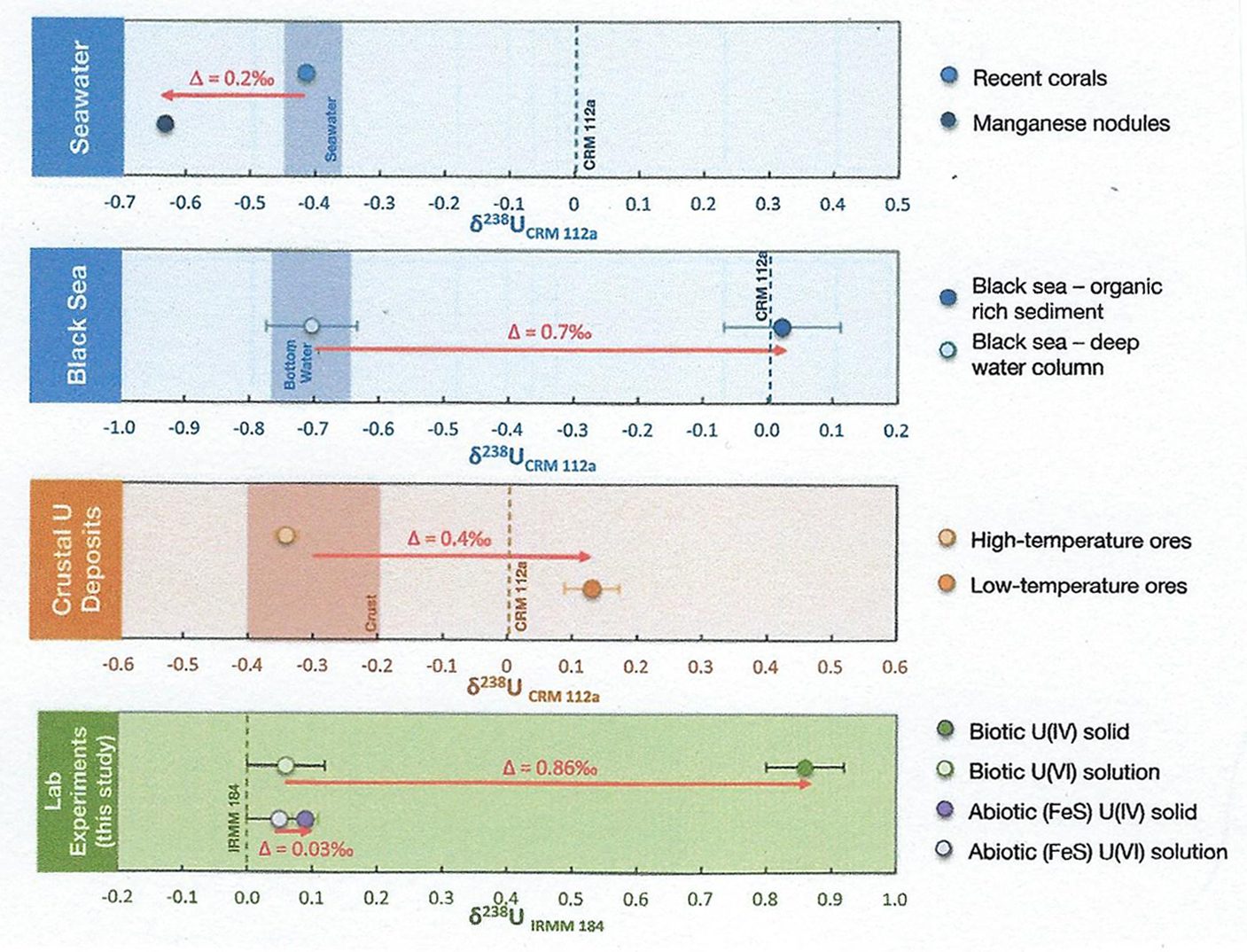 The graphic above illustrates the compilation of δ238U values for various U(IV) deposits including seawater and authigenic U (blue) (Refs: 9, 10, 14, 37) and crustal U deposits (orange) (Refs: 8–10, 36) compared with biotic and abiotic reduction products (green and purple, this study). Red arrows indicate isotopic fractionation (Δ238U) between two products of U reduction. Symbols represent the mean of multiple samples, and the error bars represent the isotopic variation observed in each reservoir.
The ability to deconvolute these two processes would provide a means to identify environmental niches in which microbial activity was prevalent at a specific time in paleo-history and to correlate specific biogeochemical events with the corresponding microbial metabolism.
The authors demonstrated that the isotopic signature associated with microbial reduction of hexavalent uranium (U), i.e., the accumulation of the heavy isotope in the U(IV) phase, is readily distinguishable from that generated by abiotic uranium reduction in laboratory experiments. Thus, isotope signatures preserved in the geologic record through the reductive precipitation of uranium may provide the sought-after tool to probe for biotic processes.
Because uranium is a common element in the Earth’s crust and a wide variety of metabolic groups of microorganisms catalyze the biological reduction of U(VI), this tool is applicable to a multiplicity of geological epochs and terrestrial environments.
The findings of this study indicate that biological activity contributed to the formation of many authigenic U deposits, including sandstone U deposits of various ages, as well as modern, Cretaceous, and Archean black shales. Additionally, engineered bioremediation activities also exhibit a biotic signature, suggesting that, although multiple pathways may be involved in the reduction, direct enzymatic reduction contributes substantially to the immobilization of uranium.
[An update on U isotopes (here).]
Managed & Built by I2M Consulting, LLC | © 2010-
