
Khollam reported in mid-November 2025 that the material holds up in real seawater and rejects competing ions, marking a major step for ocean-based uranium extraction.
 Zhangzhou Nuclear Power Project. Credit: China National Nuclear Corporation
Countries planning long-term clean energy strategies increasingly see nuclear power as a stable anchor for low-carbon electricity. But the industry faces a fundamental resource problem. Easy-to-mine uranium reserves are shrinking, and the cost of new exploration keeps rising. This pressure has revived scientific interest in pulling uranium directly from seawater.
The world’s oceans hold vast quantities of the element, albeit in only low ppb concentrations, but extracting it efficiently has remained one of the sector’s most stubborn technical challenges. A new study now attempts to break that barrier. Uranium-235 powers most nuclear reactors and sits at the core of energy transition plans. Yet current land reserves may support only a few more decades of consumption.
Oceans, however, contain nearly 4.5 billion tons of uranium. The problem is that uranium exists in seawater at extremely low concentrations and competes with ions, microbes, and organic matter that cling to almost everything placed in the water.
Researchers Dr. Xishi Tai of Weifang University and Dr. Zhenli Sun of North China Electric Power University set out to tackle this bottleneck. They developed a new family of sulfonic covalent organic frameworks, or S-COFs. Their focus was not only on the chemistry but on how the internal layers of the material sit relative to each other.
Dr. Tai explained the design philosophy.
“Our study introduces a new design concept called stacking mode engineering,” he said. He added that the team created “a confined space that perfectly matches the shape and coordination preferences of uranium ions.”
The main point is the precision with which they arranged the internal layers. The team concentrated on an AB stacking mode. In this layout, sulfonic groups form a pocket that holds uranium ions through four-point coordination. This structure contrasts with the traditional AA stacking mode, which offers weaker attraction and less selective binding.
Record-setting extraction results
The results show a major performance jump. The AB-stacked S-COFs exhibited a binding affinity roughly 1,000 times higher than the AA version.
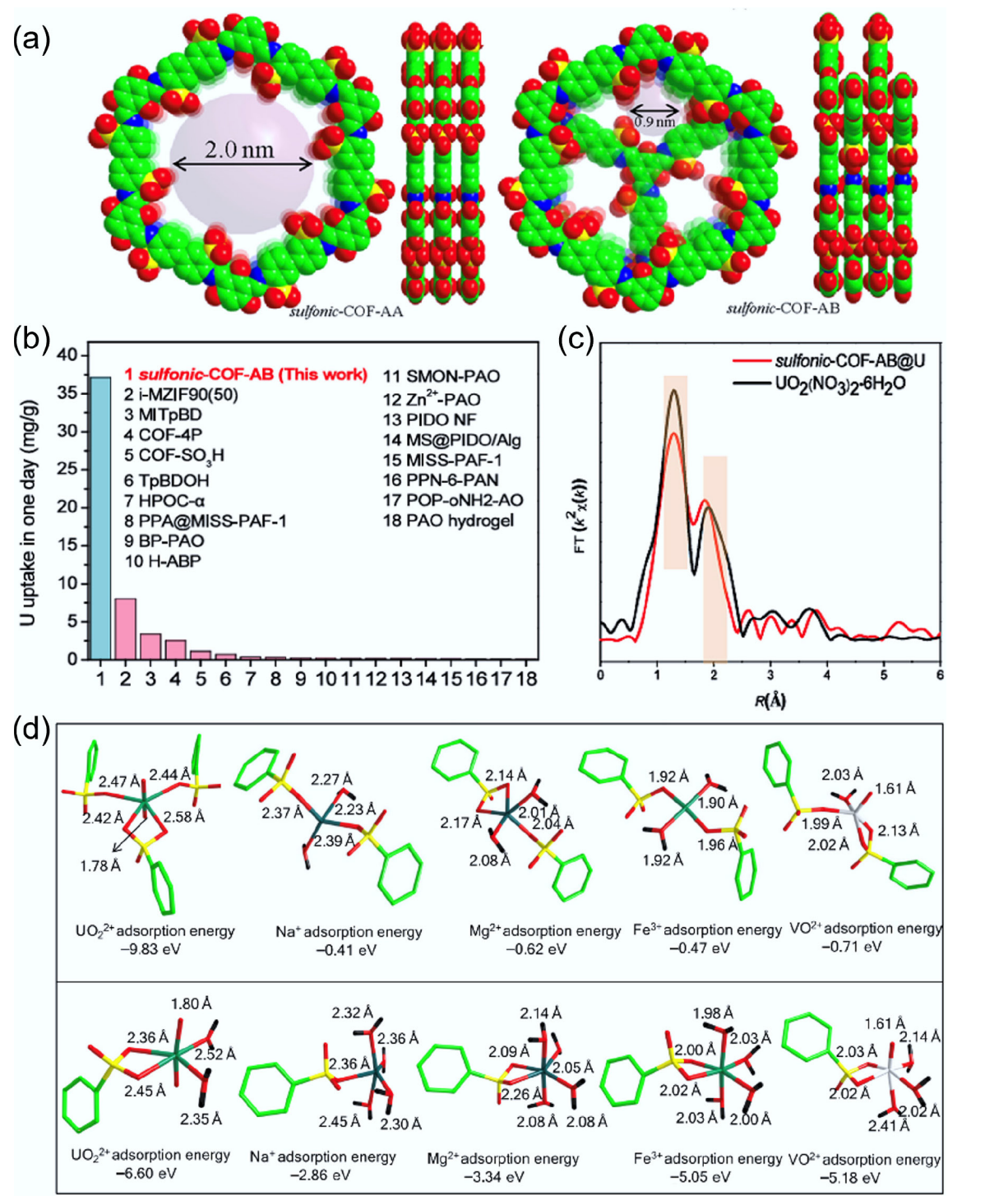 Enhanced uranium extraction from seawater using COFs engineered through
structural geometry and active-site tuning. Credit – Xishi Tai, Zhenli Sun
The researchers then tested the material in natural seawater. In just one day, it extracted 31.5 milligrams of uranium per gram of sorbent. No previous system has reached that level. Dr. Sun highlighted the achievement.
“This is the highest performance ever reported for uranium extraction from natural seawater,” he said.
He also pointed to the material’s ability to ignore ions like vanadium, which normally interfere with uranium capture. The team believes this level of selectivity could guide new approaches to isolating other ions in complex environments.
Path to real-world use
The researchers stress that the technology remains in early stages. Any material used in real marine conditions must endure constant movement, salt exposure, and biological growth. It must regenerate many times without losing its structure. It must also scale at a cost competitive with mining. These hurdles remain substantial, but the team views its progress as a meaningful step.
Dr. Tai said continued improvements are likely.
“As technology advances, we expect to see broader use of smart materials like these in sustainable energy systems,” he added.
The study is published in the journal Sustainable Carbon Materials.
Managed & Built by I2M Consulting, LLC | © 2010-