

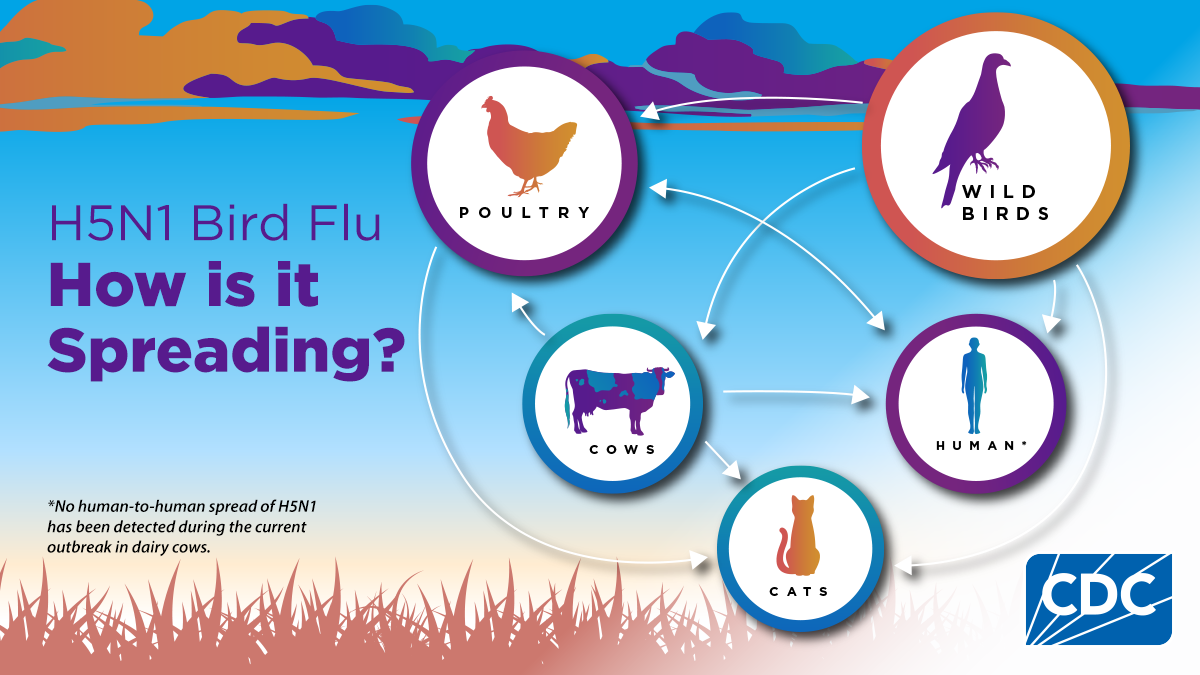
For over a year, pandemic experts have been closely tracking bird flu, a contagious form of H5N1 that has spread through chicken and cow farms and infected around 40 people. With 17 states now reporting infected animals, researchers need to determine how the disease is spreading to protect farms and the people who work there.
 Also see: https://www.cdc.gov/bird-flu/situation-summary/index.html
Researchers traveled to 14 H5N1-positive dairy farms to sample the milk and breath of cows, as well as the air, milking machines, and wastewater. After conducting extra testing at farms that came back positive, the researchers concluded that H5N1 was indeed spreading through the air. As the team’s small number of samples of exhaled breath from sick cows did not contain any live virus, the team concluded that positive air samples were likely because of spewing milk during milking.
“There’s tons of aerosols being generated during the process of milking,” senior author Seema Lakdawala told The New York Times.
The disease was also found to be transmitted through milking equipment and wastewater, where contaminated milk often gets funneled. Though milking equipment was already known to be a culprit, this study provides some of the first proof that the disease could also be spreading through inhalation.
The result emphasizes the importance of farm workers wearing protective equipment when milking cows or cleaning the milking parlors, a process often done with contaminated water. With only one human death yet reported,
“We’ve dodged a little bit of a bullet so far,” virologist Richard Webby told Scientific American.
Another concerning finding is that a mammary gland inflammation called mastitis, typically thought to be a harbinger for H5N1, was not always present in infected cows, meaning that there may be infected animals presenting without symptoms. The more the virus spreads without containment, the more opportunities it has to evolve into deadlier strains. As a result, Lakdawala told Scientific American,
“We need to be expanding biosafety measures, biosecurity measures and trying to control where the virus is.”
For the complete paper, see: https://www.i2mconsultants.com/downloads/corp/2025.07.31.666798.full.pdf
Managed & Built by I2M Consulting, LLC | © 2010-
