
Where Were We and Where Are We Now? Revisting Chapter 9 - Nuclear Power and Associated Environmental Issues in the Transition of Exploration and Mining on Earth to the Development of Off-World Natural Resources in the 21st Century - 2012
Astrogeology, Asteroids, Robots, Space Flight & Extraterrestrial Matters / Lunar Activities
Date posted: 10/29/25
Campbell and 5 co-authors concluded in 2012 in Chapter 9 of the AAPG-EMD's Memoir 101 that once humans landed on the Moon on July 20, 1969, the goal of space exploration envisioned by United States President John F. Kennedy in 1961 was already being realized. Achievement of this goal depended on the development of technologies to turn his vision into reality.
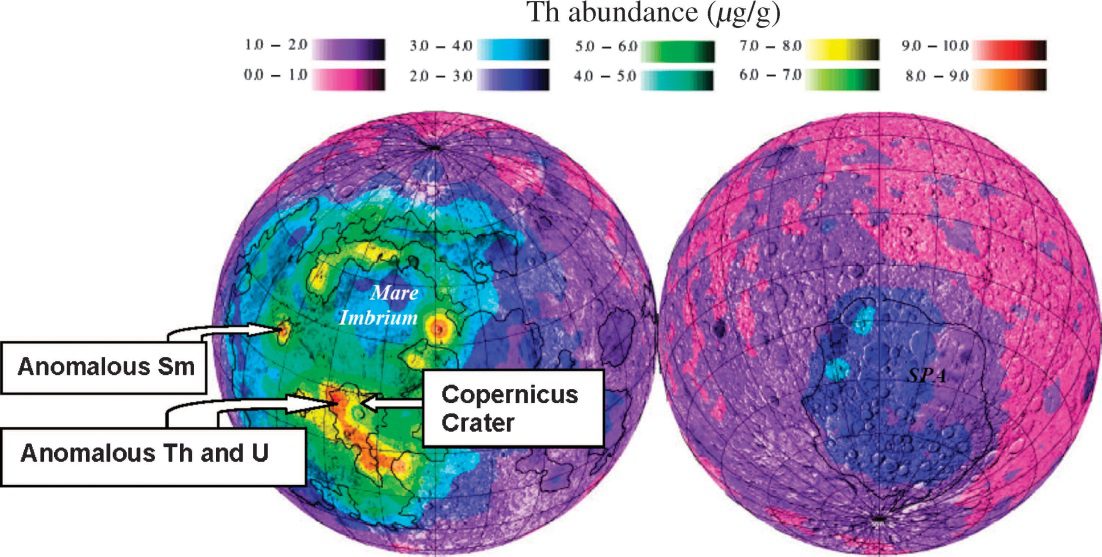 Inferred thorium (Th) abundance on a twohemisphere map projection. Data for
Th and samarium (Sm) are from Elphic et al. (2000), and data for uranium
(U) and Th are from Yamashita et al. (2009).
One technology that was critical to the success of this goal was the harnessing of nuclear power to run these new systems. Nuclear systems provide power for satellite and deep space exploratory missions. In the future, they will provide propulsion for spacecraft and drive planet-based power systems. The maturation of technol- ogies that underlie these systems ran parallel to an evolving rationale regarding the need to explore our own solar system and beyond.
Since the the first Space Race (involving The Soviets), forward-looking analysis of our situation on Earth reveals that space exploration will one day provide natural resources that will enable further exploration and will provide new sources for our dwindling resources and offset their increasing prices or scarcity on Earth. Mining is anticipated on the Moon for increasingly valuable commodities, such as thorium (Th) and samarium (Sm), and on selected asteroids or other moons as a demonstration of technology at scales never before imagined.
In addition, the discovery of helium-3 on the Moon may provide an abundant power source on the Moon and on Earth through nuclear fusion technologies. However, until the physics of fusion is solved, that resource will remain on the shelf and may even be stockpiled on the Moon until needed. It is clear that nuclear power will provide the means necessary to realize these goals while advances in other areas will provide enhanced environmental safeguards in using nuclear power in innovative ways, such as a space elevator or by a ramjet space plane to deliver materials to and from the Earth’s surface and personnel and equipment into space and a space gravity tractor to nudge errant asteroids and other bodies out of collision orbits.
Nuclear systems will enable humankind to expand beyond the boundaries of Earth, provide new frontiers for exploration, ensure our protection, and renew critical natural resources while advancing spin-off technology on Earth. During the past ten years, China, Japan, India, and other countries have mounted serious missions to explore the Moon and elsewhere. Recent exploration discoveries by Japan on the Moon may mark the beginning of a new race to the Moon and into space to explore for and develop natural resources, including water (from dark craters to make hydrogen for fuel and oxygen, etc.), nuclear minerals (uranium, thorium, and helium-3), rare-earth minerals, and other industrial commodities needed for use in space and on Earth in the decades ahead.
[As we seriously contemplate occupying the Moon in late 2025, the 2nd Space Race has continued with China leading to date. The U.S. will return to the Moon soon as long as Musk's SpaceEx activities continue to excel. For recent reporting on lunar activities see (here)].
Managed & Built by I2M Consulting, LLC | © 2010-
