

Delogkos and 11 co-authors reported in 2018 that the active, opencast, lignite mines in the Ptolemais Basin, NW Greece, provide world-class outcrops for characterising and understanding normal fault systems from km- down to mm-scale. The authors have visited and mapped these mines 26 times at ca. 3 month intervals since October 2009.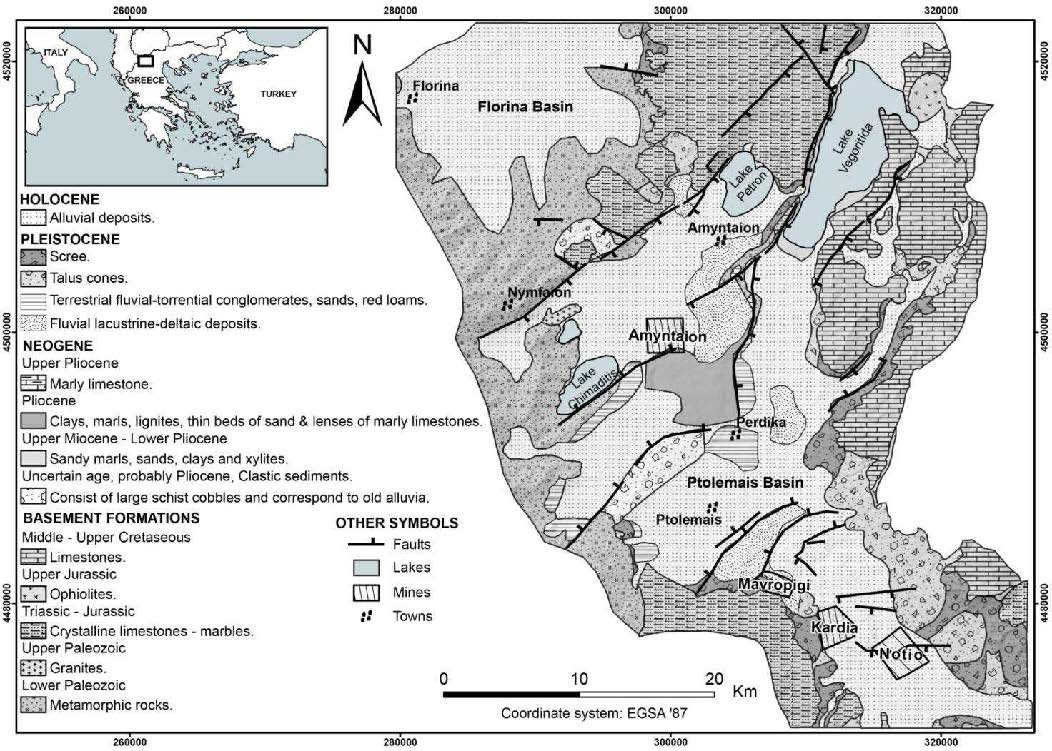 Geological map of the Ptolemais Basin showing the major fault structures
and the locations of the four active, open-pit lignite mines.
The data collected during each fieldwork campaign were structural measurements, interpretations, various resolutions of photographs and GPS locations for all exposed faults and related structures observed in each mine. Part of this unique dataset has been imported within a fully georeferenced 3D structural interpretation package and has been used for fault and horizon interpretations.
The authors' motivation for this work is to advance our generic understanding of the structure and development of normal faults, but in this contribution, we focus on some of our findings that might be of more general interest to mine planners and designers.
The authors concluded that the exposed lignite-marl sequence of the Ptolemais Basin is displaced by numerous normal faults with maximum displacement up to 55 m. The displacement along each fault surface decreases from a maximum value at the centre of the fault surface towards zero-displacement fault tips. A notable characteristic of these faults is that they have higher displacement gradients (i.e. the ratiobetween maximum displacement and length) than normal faults in other areas, and are also more segmented at a range of scales.
A characteristic of the mines is the presence of gentle folds which often become more pronounced close to the normal faults. These folds are not formed by tectonic compression, but are the result of normal and reverse drag geometries developed during the growth of the extensional normal fault system. Furthermore, in Kardia Mine, normal faulting was associated with contemporaneous bed-parallel slip resulting in further segmentation of the normal faults and in the development of structures that can contain either a repeated or a missing section of stratigraphy.
Finally, Notio Mine contains thrusts within a well-defined stratigraphic interval towards the lower part of the Ptolemais Formation. These thrusts have a syn-sedimentary rather than tectonic origin, and are contained within a mass transport complex extending over the width of the mine, and containing an irregular stratigraphy. The thrusts are sometimes reactivated in extension during the later faulting event.
Managed & Built by I2M Consulting, LLC | © 2010-
