

Qin and Shearer reorted in late August 2025 that for years, Chinese policymakers and official media have consistently described coal power as the ʻballast' of the power system—an essential foundation for ensuring energy security. Since late 2023, as clean energy has gained growing economic significance, the tone has begun to shift: more attention is being placed on the role of renewables in energy security, and on coal powerʼs future as a flexible, supporting resource rather than a primary generator.
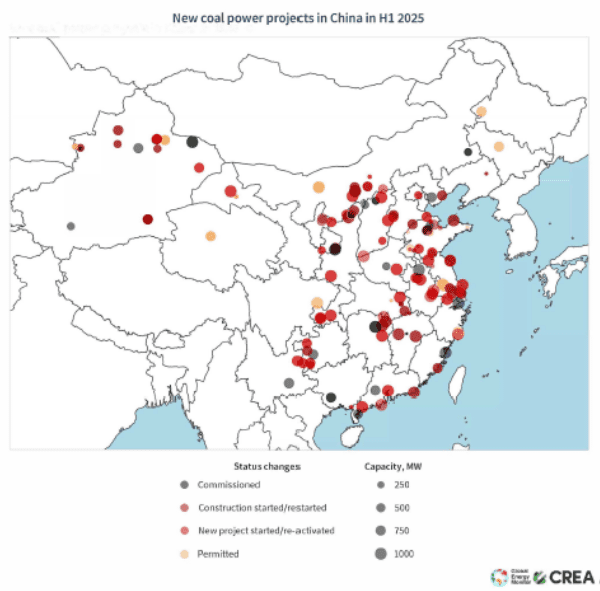 Yet despite this discursive shift and the rapid expansion of clean energy, coal remains deeply embedded in the power system, with little public discussion of its phase-down or eventual exit. The core tension of 2025 is increasingly evident: coalʼs share in power generation has fallen to record lows, yet new coal power capacity additions are on track to reach decade highs. Clean energy is growing at an unprecedented speed and is now capable of meeting nearly all incremental demand, but coal power continues to expand in absolute capacity terms and remains structurally protected. But while the generation mix is shifting, the underlying rules of the system remain largely unchanged.
Instead of adapting to a cleaner, more flexible power structure, current institutions continue to lock in coalʼs position. Broad capacity payments, inflexible
dispatch practices, long-term contracting, and the absence of a national retirement pathway all serve to keep coal power in place, regardless of whether itʼs still needed.
This report examines how institutional inertia is slowing the transition away from coal. Without stronger corrective policies, there is a real risk that rapid clean energy growth will continue to be offset by slow structural reform, leaving emissions on a high plateau and coal locked into the system for years to come.
Key findings:
● Coal power construction and commissioned projects remain high, with no clear signs of slowing. 21 gigawatts (GW) was commissioned in H1 2025, the
highest first-half total since 2016. And full-year additions are expected to exceed 80 GW, according to association projections. Construction starts and restarts reached 46 GW, equivalent to the entire coal power capacity of South Korea and sustaining
the high pace set in 2022.
● New project approvals remain strong, with signs of pre-carbon peak acceleration. 25 GW was permitted in H1 2025, slightly down from previous years.
However, new and revived proposals totalled 75 GW, the highest H1 figure in a decade, reflecting a continued push to advance coal projects before the 2030
carbon peaking deadline.
● The commissioning boom of 2025 reflects a delayed response to the permitting surge of 2022–2023, when more than 100 GW of coal power was approved each year. Unless policy action is taken, these previously approved projects will continue to drive high levels of commissioning in 2026–2027.
● Clean energy is expanding at unprecedented speed, reshaping Chinaʼs power mix, while coalʼs role in generation continues to decline. Wind and solar
additions are expected to exceed 500 GW in 2025, which is more than enough to meet total electricity demand growth. Coalʼs share in power generation dropped to a historic low of 51% in June 2025. At the same time, renewables account for 60% of total installed capacity, compared to about 34% for coal. Yet coal capacity continues to rise, highlighting a widening disconnect between capacity growth and actual power generation.
● Coal power is not fulfilling its intended role as a flexible backup for renewables. Current dispatch practices predominantly rely on coal power plants for ramping up power generation when needed, with minimal incentives or explicit requirements to flexibly scale down power generation.
● China still lacks a coherent coal exit strategy, and power plant retirements are far behind official targets. Only 1 GW of coal power was retired in H1 2025, with just 16 GW retired since 2021. To meet the 14th Five-Year Plan goal of 30 GW by the end of 2025, 13 GW would need to be retired in H2, which appears to be an increasingly unlikely prospect.
● The upcoming Nationally Determined Contributions (NDCs) and 15th Five-Year Plan offer a crucial opportunity to establish a clear, coordinated roadmap for managing coal powerʼs decline. While Chinaʼs energy policy direction is aligned with long-term climate goals, the absence of binding targets and institutional reform has allowed legacy incentives for coal power to persist. Without stronger national guidance, clean energy progress may be offset by continued coal expansion, delaying energy transition and stalling emission reductions.
Managed & Built by I2M Consulting, LLC | © 2010-
