

Zega and 45 co-authors reported in late August 2025 that samples of asteroid (101955) Bennu delivered by the OSIRIS-REx mission offer the opportunity to study pristine planetary materials unchanged by exposure to the terrestrial environment.
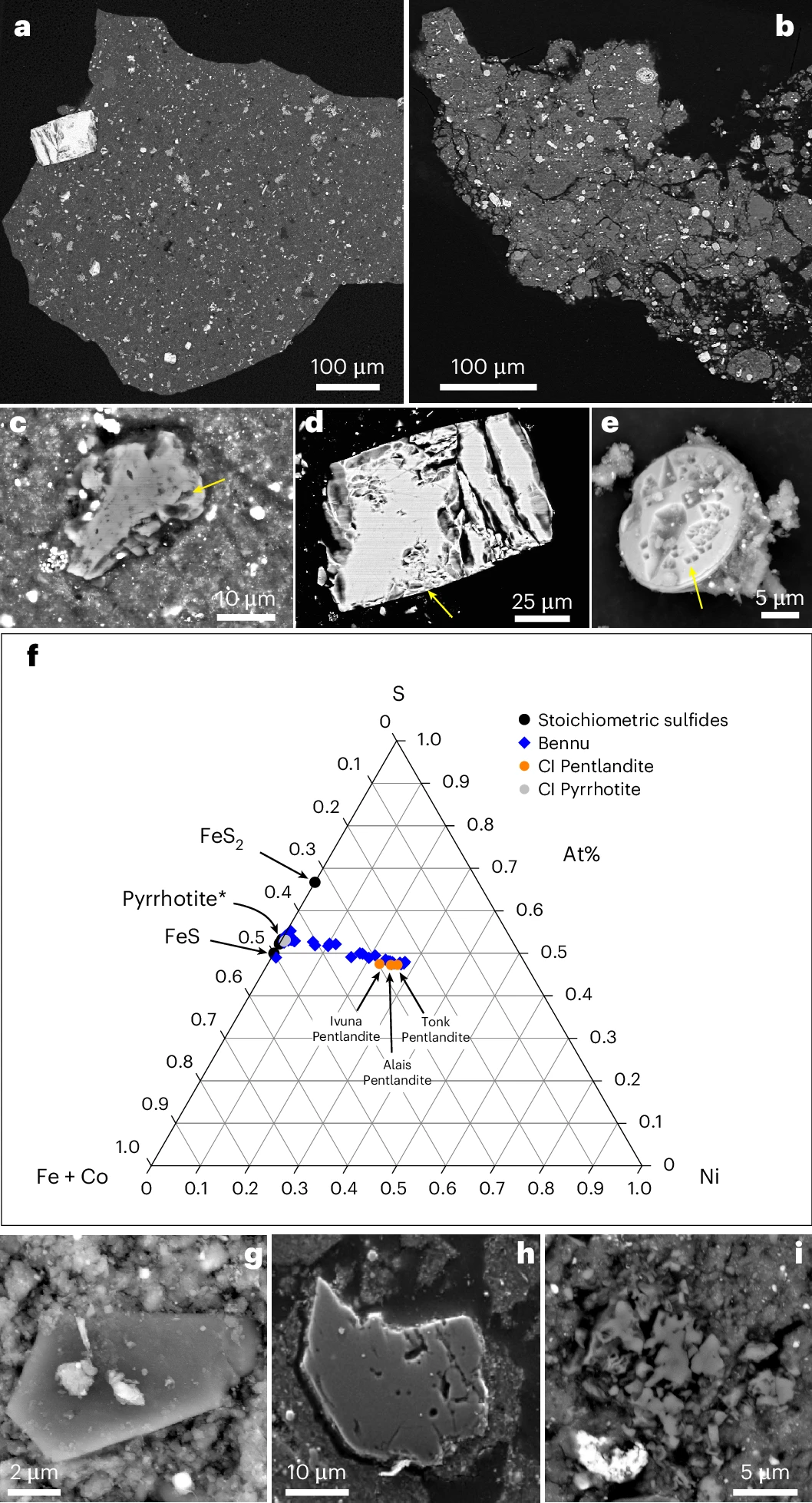 a, BSE image of an angular particle from sample OREX-803095-0. b, BSE image
of a hummocky particle from OREX-803096-0. c–e, BSE images of carbonate
(OREX-803095-0), sulfide (OREX-803095-0) and magnetite (OREX-501030-0) grains.
Yellow arrows point to pitting on grain surfaces. f, Fe+Co-Ni-S ternary diagram
showing the composition of sulfides in samples OREX-803095-0, OREX-803096-0,
OREX-803066-0, OREX-803067-0 and OREX-803070-0, together with reference
sulfides. CI chondrite data from Bullock et al.12.
*Stoichiometric sulfides include pyrrhotite Fe7S8 (4C), Fe9S10 (5C), Fe11S12 (6C)
and Fe10S11 (11C); troilite (FeS) and pyrite (FeS2) for reference. g, BSE image of
olivine from OREX-501019-0. h, Secondary-electron image of pyroxene from
OREX-501059-0. i, BSE image of spinel from OREX-501019-101.
In this paper, the authors use a combination of X-ray diffraction and various electron microscopy techniques to explore the detailed mineralogy of Bennu samples and determine the alteration history of the planetesimal protolith from which they originated. The samples consist largely of hydrated sheet-silicate minerals, namely nanoscale serpentine and saponite of varied grain size, which are decorated with micro- to nanoscale Fe-sulfides, magnetite and carbonates.
The authors observed sheet silicates parallel and normal to sulfide surfaces and as inclusions in sulfides; sulfur-rich veins transecting the sheet-silicate matrix; zoned carbonates and phosphates and sulfide and magnetite grains exhibiting embayment. The mineralogical evidence indicates alteration of accreted minerals by a fluid that evolved with time, leading to etching, dissolution and reprecipitation.
Sulfide compositions indicate alteration at ~25 °C, similar to conditions inferred for asteroid (162173) Ryugu and Ivuna-type (CI) chondrite meteorites. The fluid probably evolved from neutral to alkaline, culminating with the precipitation of highly soluble salts.
The authors concluded that Bennu’s protolith comprised mainly nanometre to micrometre silicates, with fewer chondrules and calcium–aluminium-rich inclusions than those of most chondrite groups.
Managed & Built by I2M Consulting, LLC | © 2010-
