

Keller and 20 co-authors reported in late August 2025 that the OSIRIS-REx mission deployed contact pad samplers to collect regolith from the uppermost surface of the asteroid Bennu that was exposed to the space environment. 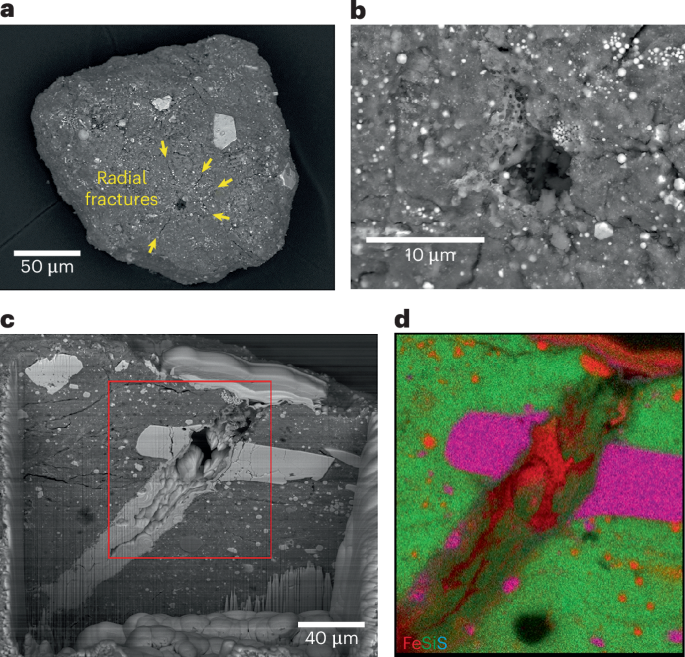 a, A SEM image of the particle showing the crater (dark area) and the radial
fractures surrounding it (yellow arrows). b, The crater entrance is lined with
vesiculated melt. c, The crater as exposed in the FIB trench before extracting
a section for TEM analysis. The red box indicates the area shown in d. d, The
Fe–Si–S (RGB) composite chemical map of the crater path through matrix material,
including a platy pyrrhotite grain (magenta).
Space weathering processes, dominated by micrometeoroid impacts and solar irradiation, modify the mineralogy and chemistry of exposed surfaces to produce solar wind-amorphized layers on clays, metallic whiskers associated with high temperature melts and Fe nitride created by the reaction of indigenous N-bearing gases with space-weathered surfaces.
In this paper, the authors use cosmogenic noble gases and radionuclides to suggest that the upper metre of Bennu’s regolith has been exposed to cosmic rays for 2–7 million years, consistent with remote sensing observations indicating that the asteroid’s surface is dynamic and regularly modified by mass movement. Solar energetic particle track and microcrater densities constrain the space weathering spectral changes observed in Hokioi crater to <50,000 years. These spectral changes are driven largely by the accumulation of impact melt deposits on particle surfaces, although compositional or grain size effects may also occur.
Comparison of Bennu samples with those collected from the asteroids Ryugu and Itokawa suggest that micrometeoroid impacts might play a more active and rapid role in the space weathering of asteroidal surfaces than was initially suggested, particularly for carbonaceous bodies.
Managed & Built by I2M Consulting, LLC | © 2010-
