
South Australian Magnetite Global Comparison Study - 2025
Mining & Minerals - Evaluations / Other Metals
Date posted: 08/25/25
This 2025 report, commissioned by the Geological Survey of South Australia and authored by AMIRA Global, presents an independent analysis of South Australia’s magnetite resources in comparison to domestic and international magnetite projects.
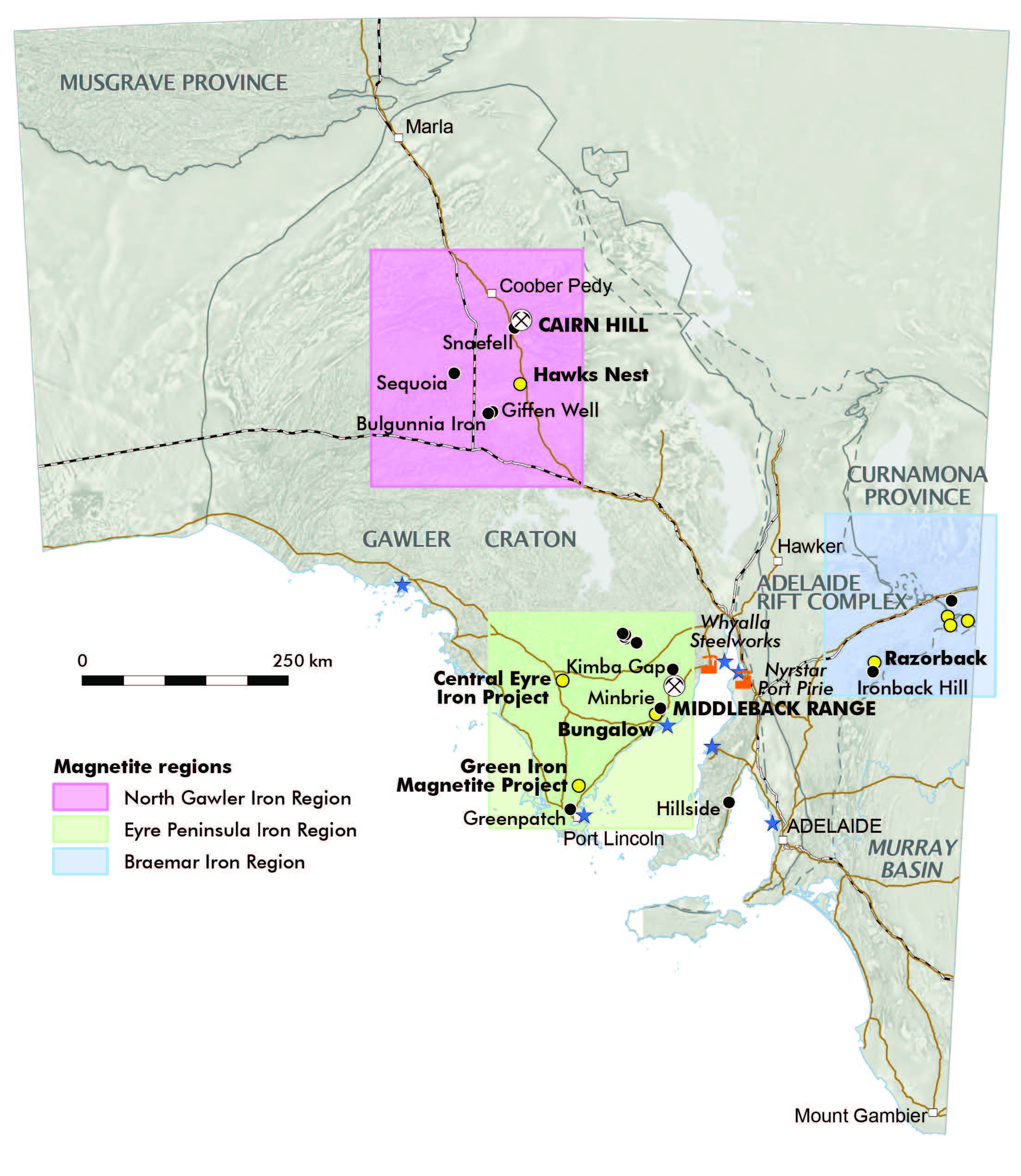 The steel industry, which accounts for 7–9% of global greenhouse gas emissions, is shifting towards high-grade magnetite (≥67% Fe) to reduce its carbon footprint. This transition is expected to drive up prices and create challenges for lower-grade hematite producers, particularly in Western Australia’s
Pilbara region.
Magnetite ores present a significant opportunity for green steel production through the Direct Reduced Iron (DRI) process, where hydrogen replaces carbon as the reducing agent, offering a more sustainable alternative to conventional steelmaking. Notably, recent studies (Geymond et al., 2023) have also identified magnetite as a potential natural hydrogen source. Consequently, magnetite deposits —especially those hosted in Banded Iron Formations (BIF) and metasedimentary ironstones in Western and Southern Australia—are attracting increasing interest for exploration and mining.
In line with this shift, this Amira Global-CSIRO research project (Project No. P1356) commissioned by the Department for Energy and Mining (DEM) through the Geological Survey of South Australia (GSSA), aims to develop a comprehensive global database of magnetite deposits. The project enables systematic comparisons between South Australian deposits and global counterparts by integrating geological, mineralogical, and processing data. The project aims to provide a measure of the competitiveness of South Australian magnetite resources by benchmarking deposits against global resources, and through comparison, identifying data gaps and processing challenges in SouthAustralia, leading to optimised beneficiation strategies.
Globally, magnetite deposits are located in North America, Europe, Australia, South America, Africa, and other regions. Magnetite ores can come from a range of deposit styles including Banded Iron Formations, Mafic-Ultramafic layered intrusions, Iron Oxide Apatite, Skarns, and Iron Oxide-CopperGold. Variations related to each of these mineralisation styles and within individual deposits significantly impact the economic potential of the resource. This extensive compilation of global public and private data sources indicates there is no global standard for data reporting and sharing.
The South Australian dataset on magnetite resources is globally one of the most comprehensive precompetitive datasets across multiple testing parameters.
In order to better understand the opportunities within South Australia, a comparison of geological settings of magnetite mineralisation types in significant magnetite producing jurisdictions has been completed, with reference to; mineralisation style, important processing indicators and data
availability. Key findings include:
• The presence of BIF-hosted magnetite deposits in South Australia similar in style to some currently exploited deposits (e.g. Iron Bridge in Western Australia; Scully, Carol Lake and Bloom Lake in Canada; Northshore, United Taconite, Minntac and Keetac in the USA).
• South Australia, by magnetite tonnage, ranks third globally following Canada and Western Australia.
• Based on head and concentrate grades, magnetite recovery rates in South Australian deposits are comparable to those seen in economically viable mines currently operating in Western Australia and Canada.
• Grinding size is variable across the deposits with some allowing for coarse grinding (>100 µm),
representing a significant advantage compared to many competitors globally.
• Bond work demonstrates that some South Australian deposits host less abrasive magnetite ores compared to other regions.
• Asbestos is uncommon within the South Australian magnetite deposits.
• South Australia’s magnetite competitiveness lies in striking the right balance between deposit scale, grind size, concentrate quality and comminution efficiency.
South Australian magnetite concentrates demonstrate promising suitability for Direct Reduced Iron (DRI) production, particularly in terms of Fe grade, impurity control, and grind size. Most projects produce concentrates that meet or closely approach the practical thresholds for Fe grade and
deleterious elements. However, achieving the preferred specification of <2 wt% acid gangue (SiO₂ + Al₂O₃) remains a key challenge, typically requiring flotation—as currently demonstrated at the Middleback Range project. Alumina and manganese levels, while elevated in some deposits, are generally well controlled in concentrate products and align with international benchmarks, including those from Canadian DRI-oriented projects.
Continued optimisation of flowsheets to enhance silica rejection—particularly without reliance on excessive grinding—will be essential to fully position South Australian magnetite as a competitive feedstock for low-emission steelmaking.
Managed & Built by I2M Consulting, LLC | © 2010-
