

Madden and six co-authors reported in 2009 that bioremediation of uranium was investigated in microcosm experiments containing contaminated sediments from Oak Ridge, Tennessee to explore the importance of electron donor selection for uranium reduction rate and extent.
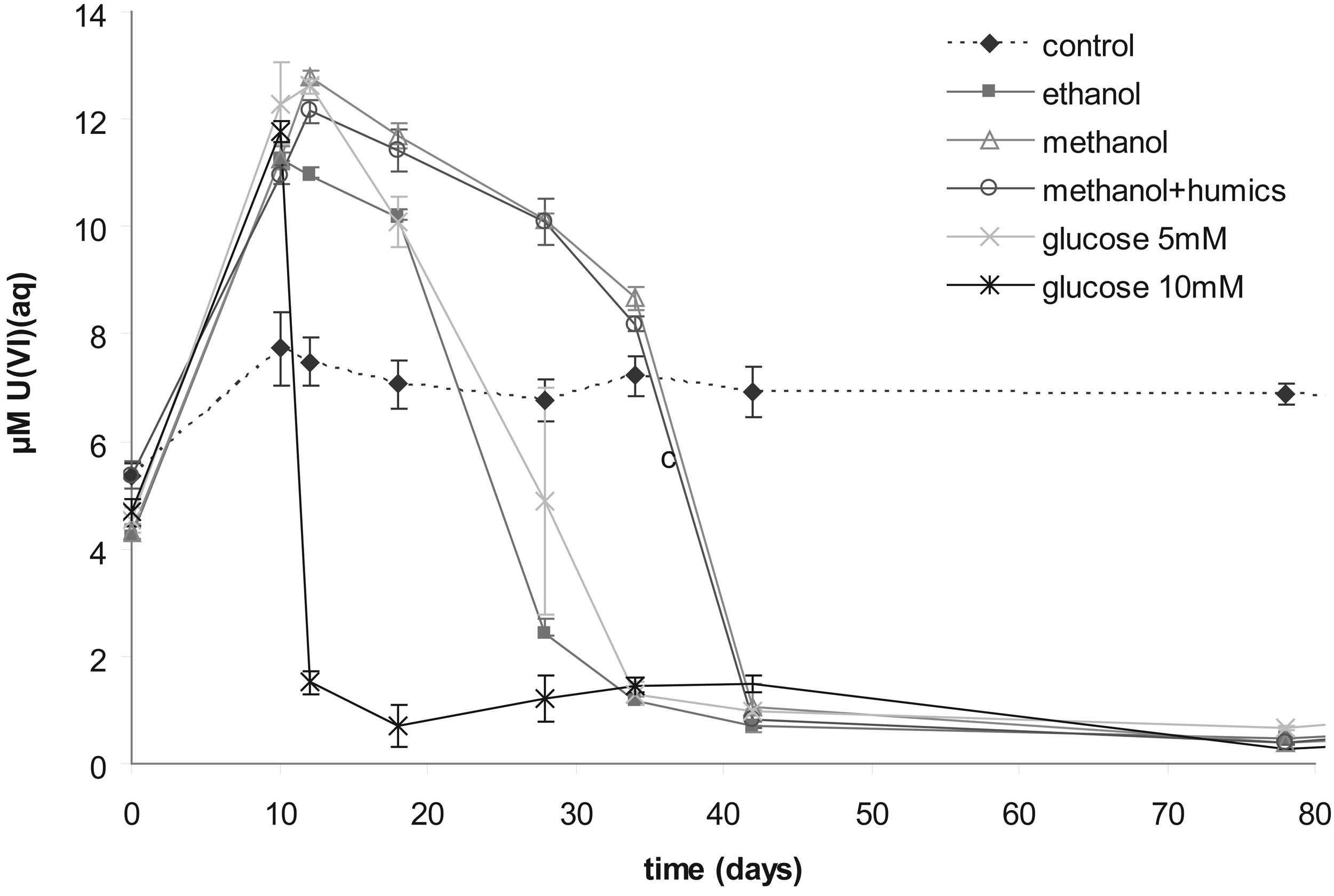 Aqueous uranium concentrations from microcosm experiments. Standard
errors from replicates are shown as error bars.
In these experiments, all of the electron donors, including ethanol, glucose, methanol, and methanol with added humic acids, stimulated the reduction and immobilization of aqueous uranium by the indigenous microbial community. Uranium loss from solution began after the completion of nitrate reduction but essentially concurrent with sulfate reduction. When electron donor concentrations were normalized for their equivalent electron donor potential yield, the rates of uranium reduction were nearly equivalent for all treatments (0.55–0.95 μmol L−1 d−1).
Uranium reduction with methanol proceeded after a 15-days longer lag time relative to that of ethanol or glucose. Signifi cant differences were not found with the inclusion of humic acids.The extent of U reduction in sediment slurries measured by XANES at various time periods after the start of the experiment increased in the order of ethanol (5–7% reduced at 77 days and 153 days), glucose (49% reduced at 53 days), and methanol (93% reduced at 90 days).
The microbial diversity of ethanol- and methanol-amended microcosms in their late stage of U reduction was analyzed with 16S rRNA gene amplification.
Members of the Geobacteraceae were found in all microcosms as well as other potential uranium-reducing organisms, such as Clostridium and Desulfosporosinus.
The effectiveness of methanol relative to ethanol at reducing aqueous and sediment-hosted uranium suggests that bioremediation strategies that encourage fermentative poising of the subsurface to a lower redox potential may be more effective for long-term uranium immobilization as compared with selecting an electron donor that is efficiently metabolized by known uranium-reducing microorganisms.
Managed & Built by I2M Consulting, LLC | © 2010-
