

Williams reported in mid-July 2025 that China has supposedly achieved a monumental milestone by producing its first barrel of natural uranium from the 'National No 1 Uranium' demonstration project in Inner Mongolia, marking a significant advancement in the country's energy security and technological prowess.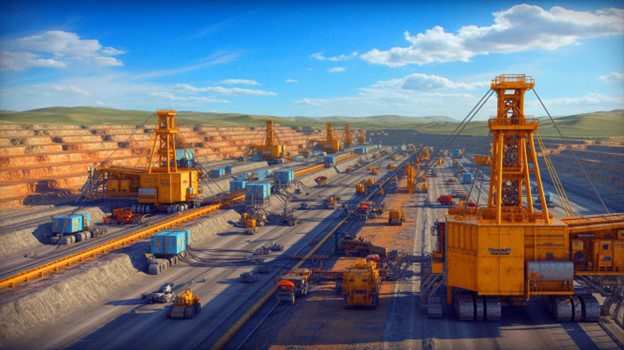
 China 'National No 1 Uranium' project in Inner Mongolia, illustration generated by
artificial intelligence.
[Note: No ripples ! Just Ho-Hum. This article may be AI-Generated as a humanless puff piece on Chinese technology when in reality the in-situ uranium recovery method was first developed in Wyoming and Texas in the late 1950s and 1960s using CO2 and O2. The method is still widely used in the U.S. and in Australia, and Kazakhstan, etc. However the claims asserted about the effectiveness of the in-situ method are all correct, but it is doubtful as to whether a Chinese in-situ recovery project with uranium mineralization at more than 5,000 feet deep could be economic at current uranium prices.]
Advanced in situ leaching technology unlocks previously uneconomical sandstone uranium deposits, transforming them into viable resources. This environmentally friendly method uses an aqueous carbon dioxide-oxygen solution, minimizing ecological impact and eliminating radioactive waste.
The project supports China’s energy security and green transition goals, enhancing its nuclear power capabilities and reducing reliance on imports. In a groundbreaking development, China has achieved a significant milestone by producing its first barrel of natural uranium from its largest domestic project, the ‘National No 1 Uranium’ demonstration project. Located in the Ordos basin of northern Inner Mongolia, this project marks a pivotal shift in China’s uranium production capabilities.
Historically reliant on volcanic and granite deposits, China is now unlocking the potential of sandstone uranium deposits through cutting-edge in situ leaching technology. This advancement not only enhances China’s competitiveness in uranium production but also supports its broader green transition goals within the nuclear power sector.
Revolutionizing Uranium Mining in Inner Mongolia
Previously dismissed as economically unviable, Inner Mongolia’s sandstone uranium resources are now at the forefront of China’s energy strategy. With the advent of advanced in situ leaching technology, these once overlooked deposits are being transformed into valuable assets. This marks a significant departure from China’s traditional uranium mining practices, which were concentrated in the central Jiangxi province, focusing on richer granite-embedded reserves.
The innovation in technology has allowed these dull mines to become economically viable, fueling China’s nuclear energy ambitions. As reported by the South China Morning Post, the project not only boosts energy security but also incorporates modern practices like remote-controlled machinery and intelligent data analysis to enhance operational efficiency and safety. The rapid construction and completion of the project within a year underscore China’s commitment to advancing its uranium mining capabilities.
Advanced Technology Unlocks Sandstone Deposits
Unlike the richer granite-based deposits in Jiangxi, sandstone uranium reserves in Inner Mongolia required innovative extraction techniques to become profitable. The newly implemented in situ leaching method compares to an intravenous drip, injecting a solution into the underground ore to dissolve uranium, which is then pumped to the surface. This technique is not only more efficient but also environmentally friendly.
Traditional methods of acid or alkali leaching caused significant environmental harm. However, the new approach utilizes an aqueous carbon dioxide-oxygen solution, significantly mitigating ecological impact. Notably, this process involves no tunneling, produces no radioactive waste, and results in minimal surface disruption, making it a green, safe, and efficient mining method.
China’s Strategic Shift Towards Energy Independence
This breakthrough in uranium mining is a strategic move for China, which ranks first globally in nuclear power plant generation capacity. The ability to harness domestic uranium resources is crucial for reducing reliance on imports and securing energy independence. The China Energy Research Society emphasizes that this development aligns with China’s long-term energy security and sustainability objectives.
Furthermore, this shift supports China’s broader goals of transitioning to cleaner energy sources. By leveraging domestic uranium reserves, China aims to expand its nuclear energy capacity, contributing to reduced carbon emissions and supporting global climate change mitigation efforts.
The Future of Uranium Mining and Environmental Sustainability
The successful extraction of uranium from Inner Mongolia is not just a testament to technological advancement but also a model for sustainable resource utilization. As China continues to innovate in the energy sector, the lessons learned from this project could be applied to other resource-rich regions worldwide. The focus on environmentally responsible mining practices sets a precedent for future projects.
As China moves forward with its nuclear energy ambitions, the question arises: How will these advancements in uranium mining technology influence global energy policies and environmental standards? The successful integration of green mining techniques could reshape the landscape of energy production and environmental conservation.
[No new information]
Managed & Built by I2M Consulting, LLC | © 2010-
