

Suzuki and three co-authors reported in 2002 that uranium-contaminated sediment and water collected from an inactive uranium mine were incubated anaerobically with organic substrates. Stimulated microbial populations removed U almost entirely from solution within 1 month. X-ray absorption near-edge structure analysis showed that U(VI) was reduced to U(IV) during the incubation.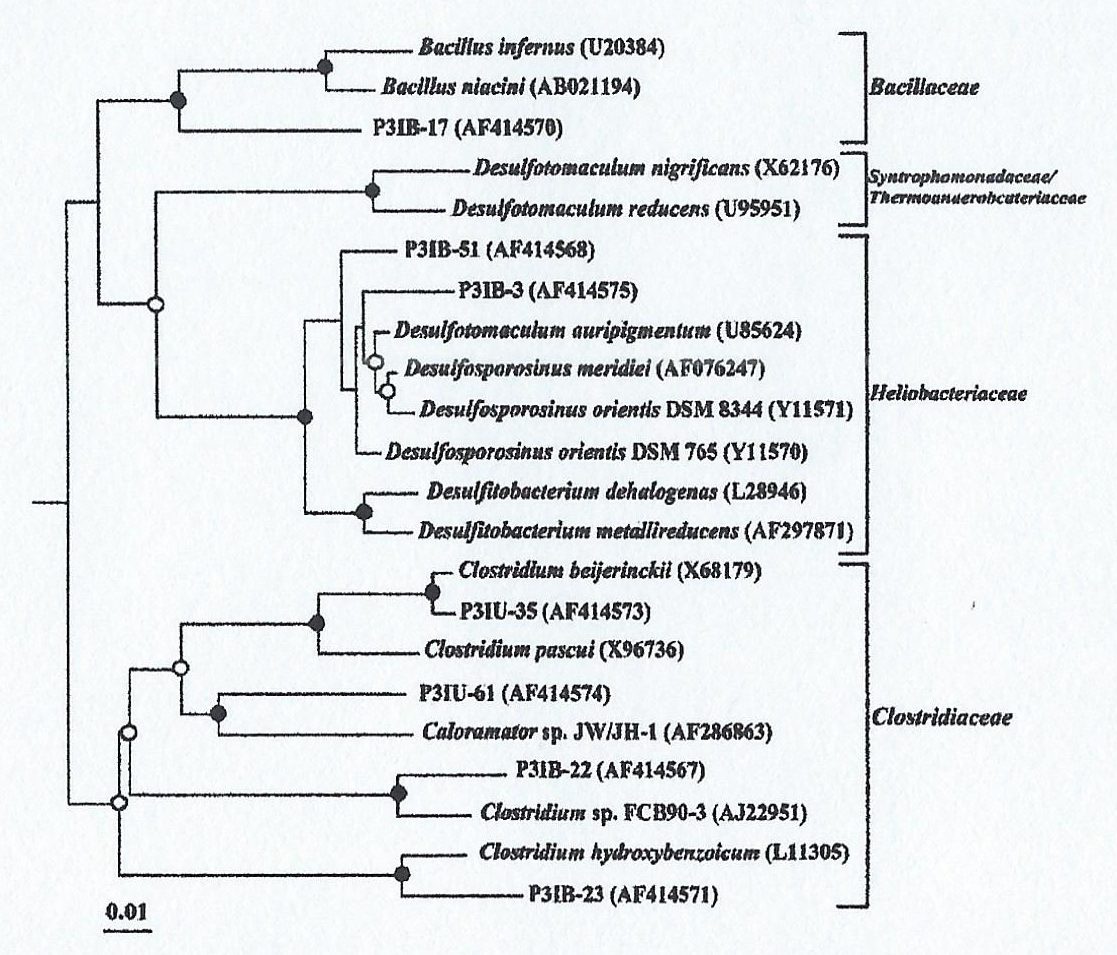
In the chart above, an evolutionary distance dendrogram of pit 3 clones with sequences is shown within the Proteobacteria division based on 1,220 nucleotides of 16S rDNA. Classes are bracketed at the right of the figure. Bacillus subtilis was used as the outgroup (not shown). Branch points supported by distance, maximum-likelihood, and parsimony estimations (bootstrap values ∼75%) are indicated by solid circles. Marginally supported branch points
(supported by most phylogenetic analyses with bootstrap values of 50 to 74%) are indicated by open circles. Branch points without circles are not
supported by the majority of analyses. Evolutionary distances are indicated by the sum of horizontal branch lengths. The scale bar represents
changes per nucleotide.
In this study, the authors attempted to better understand the bioremediation process through integration of results obtained from molecular biological, geochemical, and mineralogical studies. Field-collected uranium-contaminated sediment and water samples were incubated anaerobically with organic substrates, which resulted in removal of uranium from solution. Here there authors studied the mechanisms of uranium removal in detail by analyzing solution chemistry and characterizing solid phases, including minerals and microbial cells. Microbial communities before and after the incubation were also studied by cultureindependent molecular biological techniques.
Observations by transmission electron microscopy, selected area diffraction pattern analysis, and energy-dispersive X-ray spectroscopic analysis showed two distinct types of prokaryotic cells that precipitated only a U(IV) mineral uraninite (UO2) or both uraninite and metal sulfides. Prokaryotic cells associated with uraninite and metal sulfides were inferred to be sulfate-reducing bacteria. Phylogenetic analysis of 16S ribosomal DNA obtained from the original and incubated sediments revealed that microbial populations were changed from microaerophilic Proteobacteria to anaerobic low-G⇒C gram-positive spore-forming bacteria by the incubation.
Forty-two out of 94 clones from the incubated sediment were related to sulfate-reducing Desulfosporosinus spp., and 23 were related to fermentative Clostridium spp. The results suggest that, if in situ bioremediation were attempted in the uranium-mine ponds, Desulfosporosinus spp. would be a major contributor to U(VI) and sulfate reduction and Clostridium spp. to U(VI) reduction.
Managed & Built by I2M Consulting, LLC | © 2010-
