

Hare and 4 co-authors reported in 2021 that groundwater discharge generates streamflow and influences stream thermal regimes. However, the water quality and thermal buffering capacity of groundwater depends on the aquifer source-depth.
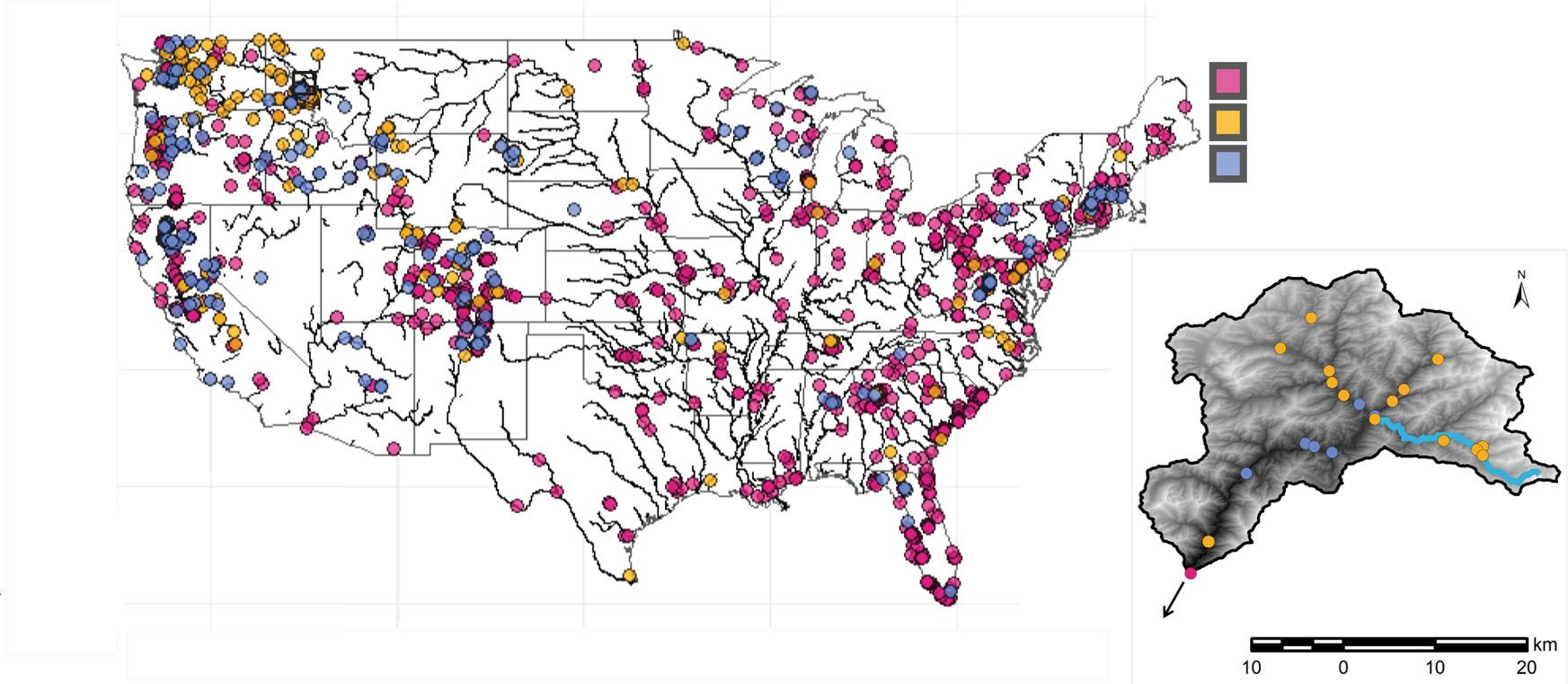 In the figure above, the authors mapped the spatial distribution of stream sites by categorical groundwater signature. Categorical groundwater (GW) signatures derived from annual paired air–stream water temperature signals:
a) across the continental United States and
b) within a single watershed, the North Fork of the Clearwater River-Lake Creek watershed, Idaho—Montana, USA (Hydrologic Unit Code HUC10 – 1706030701). Lake Creek stream is highlighted in the paper.
Across the United States, counts of each category are atmospheric signature (pink) n = 868; shallow groundwater GW signature (yellow) n = 292; deep groundwater GW signature (blue) n = 264. Legend descriptions are maintained between a and b. Base map:
a) was generated from R package ‘maps’ version 3.3.0 and the Nation Hydrography Dataset70 and,
b) was created from 7.5-minute ground surface elevation data courtesy of the U.S. Geological Survey.
Here, the authors paired multi-year air and stream temperature signals to categorize 1729 sites across the continental United States as having major dam influence, shallow or deep groundwater signatures, or lack of pronounced groundwater (atmospheric) signatures. Approximately 40% of non-dam stream sites have substantial groundwater contributions as indicated by characteristic paired air and stream temperature signal metrics.
Streams with shallow groundwater signatures account for half of all groundwater signature sites and show reduced baseflow and a higher proportion of warming trends compared to sites with deep groundwater signatures. These findings align with theory that shallow groundwater is more vulnerable to temperature increase and depletion. Streams with atmospheric signatures tend to drain watersheds with low slope and greater human disturbance, indicating reduced stream-groundwater connectivity in populated valley settings.
The authors concluded that their characterization of groundwater contribution to streamflow has important implications for understanding and predicting how streamflow and water quality respond to climate change, groundwater extraction, and watershed development. By definition, shallow aquifer flow paths with pronounced annual temperature signals are tightly coupled to seasonal temperature (and precipitation) dynamics, and our analysis shows that streams influenced by shallow groundwater are more likely to be warming over time than sites with deep groundwater signatures.
Shallow groundwater discharge will then have reduced stream cooling potential in summer, particularly during anomalous seasons, when thermal refuges in marginal cold-water habitat are most needed. The authors' analysis also showed that streams influenced by shallow groundwater tend to have a reduced fraction of total streamflow composed of baseflow compared to deep groundwater. Thus, streams with substantial shallow groundwater contribution are more vulnerable to extreme low flows or drying from climate change-related increases in drought or evapotranspiration, or from increased groundwater extraction.
The high responsiveness of shallow groundwater to land surface disturbances also suggests streams with substantial shallow stream water contributions are likely more susceptible to diffuse nutrient and other pollution additions, while deeper groundwater can perpetuate legacy watershed land uses3 and emerging contaminants such as per- and polyfluoroalkyl substances from outside the river corridor.4 Still, shallow groundwater dominated streams may be more responsive to short-term management actions that reduce groundwater extraction and limit land application of fertilizers and other chemicals. Thus, the authors' analysis provides foundational knowledge to the importance of source groundwater discharge flow path depth on stream temperature, flow, and water quality.
The authors considered this additional dimension of groundwater discharge essential to informing current stream process models and necessary to building robust predictions in a time of change.
Managed & Built by I2M Consulting, LLC | © 2010-
