

Ullaha and 3 co-authors reported in 2021 that the Taunsa uranium mineralisation is hosted by the upper Miocene–Pliocene Litra Formation, part of the molasse sediments (Siwalik Group) deposited in the Himalayan foreland basin of the eastern Sulaiman Range, Dera Ghazi Khan, Pakistan. The Litra Formation is the only rock unit hosting economic-grade uranium occurrences in the stratigraphic record of Pakistan.
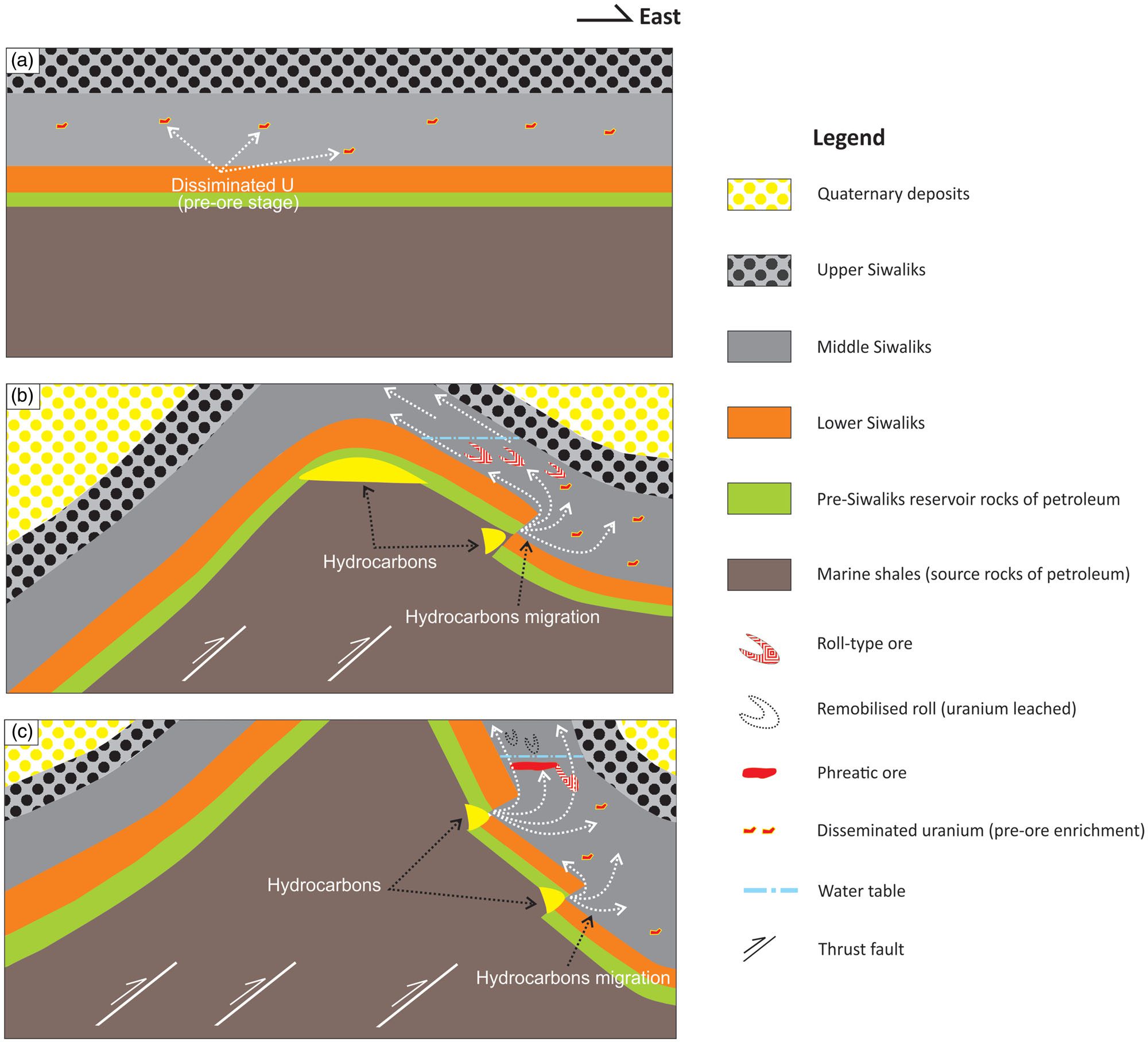
A simplified genetic model is shown above and identifies the Taunsa uranium mineralisation in the eastern limb of Zindapir anticline, eastern Sulaiman Range:
(a) Stage 1. Occurrence of syngenetic (syndepositional) disseminated uranium in the host sandstone.
(b) Stage 2. Formation of tabular (roll-type) ore from the remobilisation of disseminated uranium and its enrichment at redox boundary subsequent to early tectonic uplifting.
(c) Stage-3. Formation of phreatic ore parallel to water-table resulting from the remobilisation of roll-type ore.
Note the ongoing eastward-directed thrust faulting causes secondary and tertiary migration of hydrocarbons through ore-bearing sandstone units into outcrops of the Litra Formation from the underlying black shales and their respective reservoir rocks.
Surface radioactivity is mainly associated with cemented layers of the host sandstone, known as hard-bands, whereas weakly cemented sandstone is non-radioactive. The outcropping sandstone is dominantly whitish grey owing to bleaching, which is probably related to hydrocarbon migration from the underlying marine black shales.
The main sandstone-type uranium mineralisation is phreatic owing to its parallelism with the water-table, whereas the concordantly oriented tabular (roll-type) ore is subordinate. The host sandstone layers have high dips ranging from 70 to 85°E indicating a deformed geological setting that makes the Taunsa uranium ore unique. Uranium is trapped mostly by scant organic matter, probably related to hydrocarbons, and also by Fe–Ti-oxide phases, phyllosilicates (chlorite and biotite), graphitic schist and black shale clasts in the host sandstone.
Uranium ore minerals are mainly coffinite, pitchblende and minor brannerite. Uranium in the ore phases is accompanied by the high contents of Ca, Fe, Ti, Si and Al. Radiometric disequilibrium in the phreatic ore is strongly positive, whereas that in the tabular (roll-front) is moderately positive, which in turn suggests the former is younger than the latter.
The coexistence of the two ore-types, characterised by different intensities of radiometric disequilibrium within the same uranium deposit, suggests that the phreatic uranium ore has possibly resulted from remobilisation of the tectonically uplifted tabular (roll-type) ore and its reprecipitation at the horizontally oriented redox interface following the water-table in the host sandstone aquifers.
Key Points Made:
- The Taunsa uranium resource is dominantly phreatic that has resulted from oxidation and remobilisation of the earlier tabular (roll-type) mineralisation.
- The phreatic uranium mineralisation is very young, which is indicated by low radioactivity and high positive disequilibrium in comparison with that within the tabular (roll-type) ore.
- Uranium phases are mainly pitchblende, coffinite and brannerite, associated with organic matter of hydrocarbon origin, with phyllosilicates and Fe–Ti-oxide phases.
- Outcrop of the host sandstone in the Taunsa area is pervasively bleached and is marked by flat topography.
Managed & Built by I2M Consulting, LLC | © 2010-
