

Crawford and 2 co-authors reported in 2016 that uranium (U) can enter aquatic environments from natural and anthropogenic processes, accumulating in sediments to concentrations that could, if bioavailable, adversely affect benthic organisms.
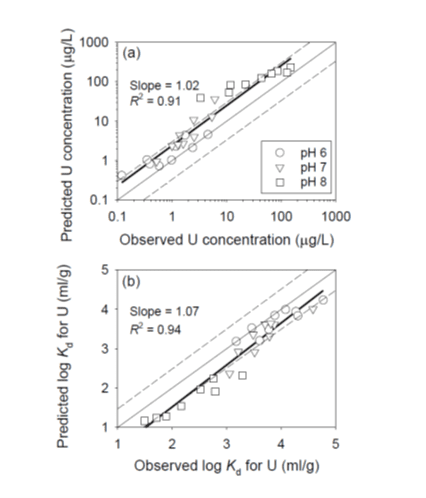 In the WHAM-predicted versus observed values shown in the figure above, see (a) U concentration (µg/L) in the overlying water at 745 equilibrium, and (b) log Kd for U (ml/g) for all nine sediments at pH 6, 7, and 8. Thick solid line 746 represents the linear regression for all data points (p < 0.05); the 1:1 line is bracketed by dashed 747 lines representing a factor of three.
To better predict the sorption and mobility of U in aquatic ecosystems, we investigated the sediment-solution partition coefficients (Kd) of U for nine uncontaminated freshwater sediments with a wide range of physicochemical characteristics over an environmentally relevant pH range.
Test solutions were reconstituted to mimic water quality conditions and U(VI) concentrations (0.023 to 2.3 mg U/L) found downstream of Canadian U mines. Adsorption of U(VI) to each sediment was greatest at pH 6 and 7, and significantly reduced at pH 8. There were significant differences in pH-dependent sorption among sediments with different physicochemical properties, with sorption increasing up until thresholds of 12% total organic carbon, 37% fine
fraction (≤ 50 µm), and 29 g/kg of iron content.
The Kd values for U(VI) were predicted using the Windermere Humic Aqueous Model (WHAM) using total U(VI) concentrations, and water and sediment physicochemical parameters. Predicted Kd-U values were generally within a factor of three of the observed values. These results improve the understanding and assessment of U sorption to field sediment, and quantify the relationship with sediment properties that may influence the bioavailability and ecological risk of U-contaminated sediments, [and a better understanding of the behavoir of naturally contaminated uranium mineralization in fluvial sands.]
Managed & Built by I2M Consulting, LLC | © 2010-
